Pick the unit your lengths are in. Areas are then labelled in square units and volumes in cubic units; nothing is converted.
What the theorem says
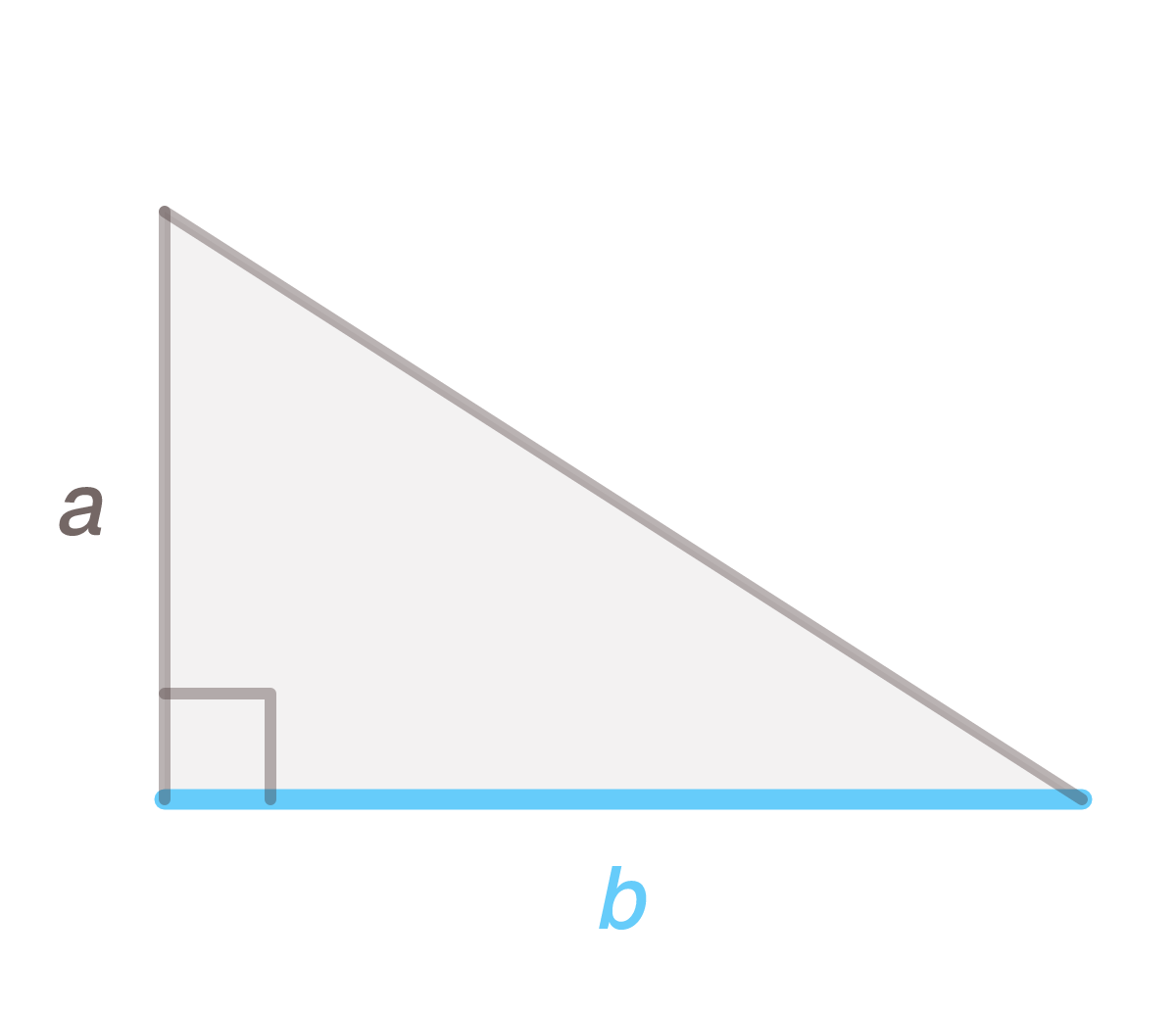
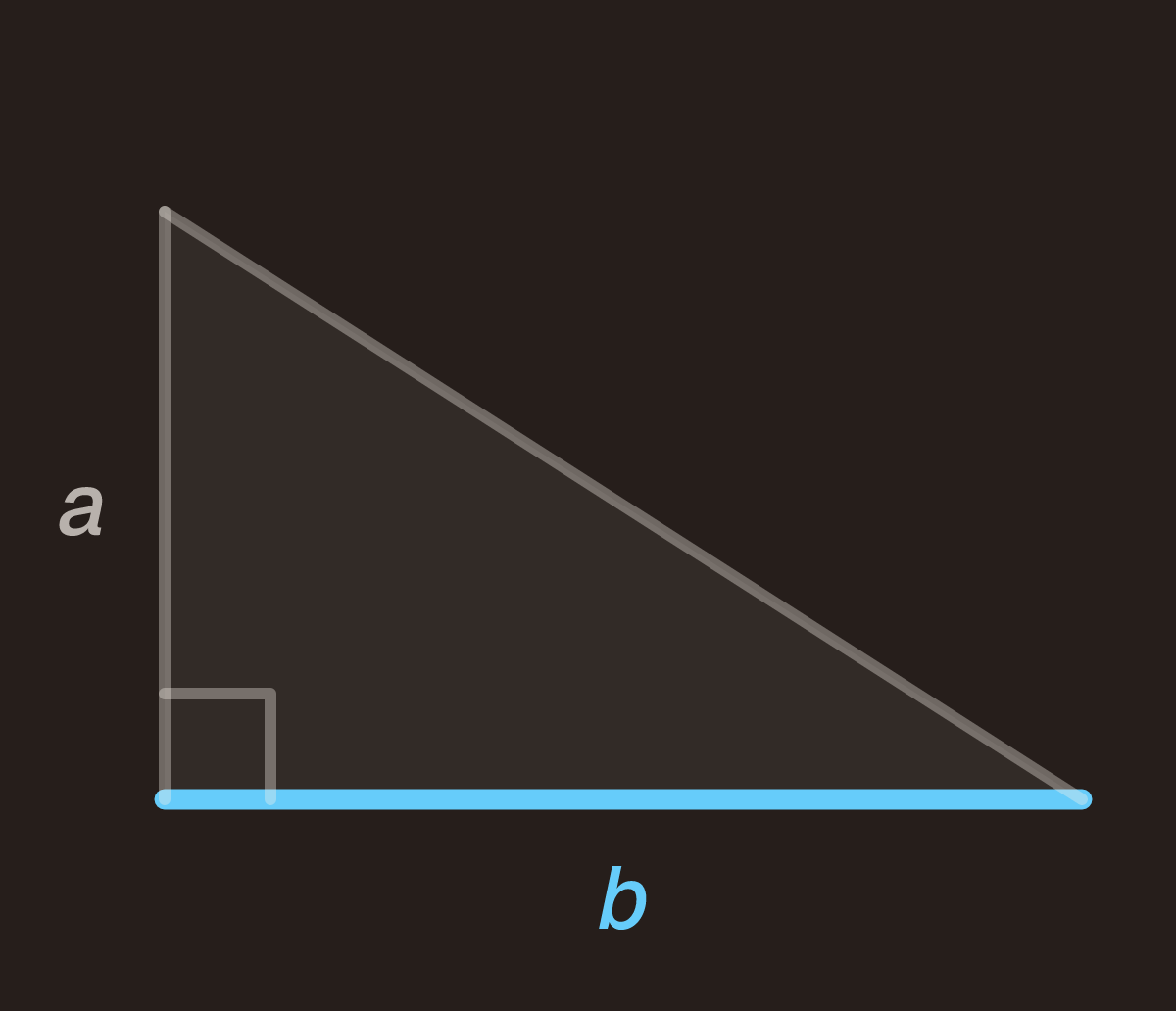
Split an equilateral triangle along its height and you get two right triangles with angles of 30°, 60°
and 90°. The short leg a lies opposite the 30° angle and is half the hypotenuse. The long leg b lies
opposite the 60° angle and is a · √3.
With a short leg of 4 cm the long leg is 4 · 1.732 ≈ 6.93 cm and the hypotenuse is 8 cm. One
measurement fixes the whole triangle.
The ratio 1 : √3 : 2
That is the shape worth remembering:
| Opposite |
Side |
Length |
| 30° |
short leg |
a |
| 60° |
long leg |
a · √3 ≈ 1.732a |
| 90° |
hypotenuse |
2a |
The derivation is the Pythagorean theorem on
the half: with hypotenuse 2a and short leg a, b² = (2a)² − a² = 3a², so b = a√3. That the short leg is
half the hypotenuse follows straight from cutting the equilateral triangle down the middle.
Why the hypotenuse is not in the card
The card works between the two legs, because that is the hard step. The hypotenuse needs no card: it is
twice the short leg, and that you can do in your head. If you have the hypotenuse instead and want
the long leg, halve it first and then multiply by √3.
The same numbers return in
trigonometry: sin 30° = 0.5 and
sin 60° = √3/2 ≈ 0.866.
Worked examples
Short leg 2 m. b = 2√3 ≈ 3.46 m, hypotenuse 4 m.
Short leg 9 cm. b = 9√3 ≈ 15.59 cm, hypotenuse 18 cm.
From the hypotenuse. The hypotenuse is 14 dm. The short leg is 7 dm and the long one 7√3 ≈
12.12 dm.
From the long leg. b = 10 gives a = 10 / √3 ≈ 5.77 and a hypotenuse of ≈ 11.55.
Common mistakes
- Putting √3 on the wrong leg. The long leg is the longer one: a √3 on the short leg makes the
triangle impossible.
- Thinking the hypotenuse is a√3. It is 2a. The root belongs to the long leg.
- Confusing 30° and 60°. The short leg lies opposite the small angle.
- Reaching for √2. That belongs to the
45-45-90 triangle.
Common questions
How do I get the area?
The legs are the base and the height, so A = a · a√3 / 2 = a²√3/2. The equilateral triangle it came
from has area s²√3/4 instead.
Why is the short leg exactly half the hypotenuse?
Because the height of an equilateral triangle bisects the base. Half the base is the short leg, and
the whole side is the hypotenuse.
Does the ratio hold for every 30-60-90 triangle?
Yes. All triangles with those angles are similar, so the sides stand in the ratio 1 : √3 : 2 however
large they are.