Volume of a cuboid
The relation
V
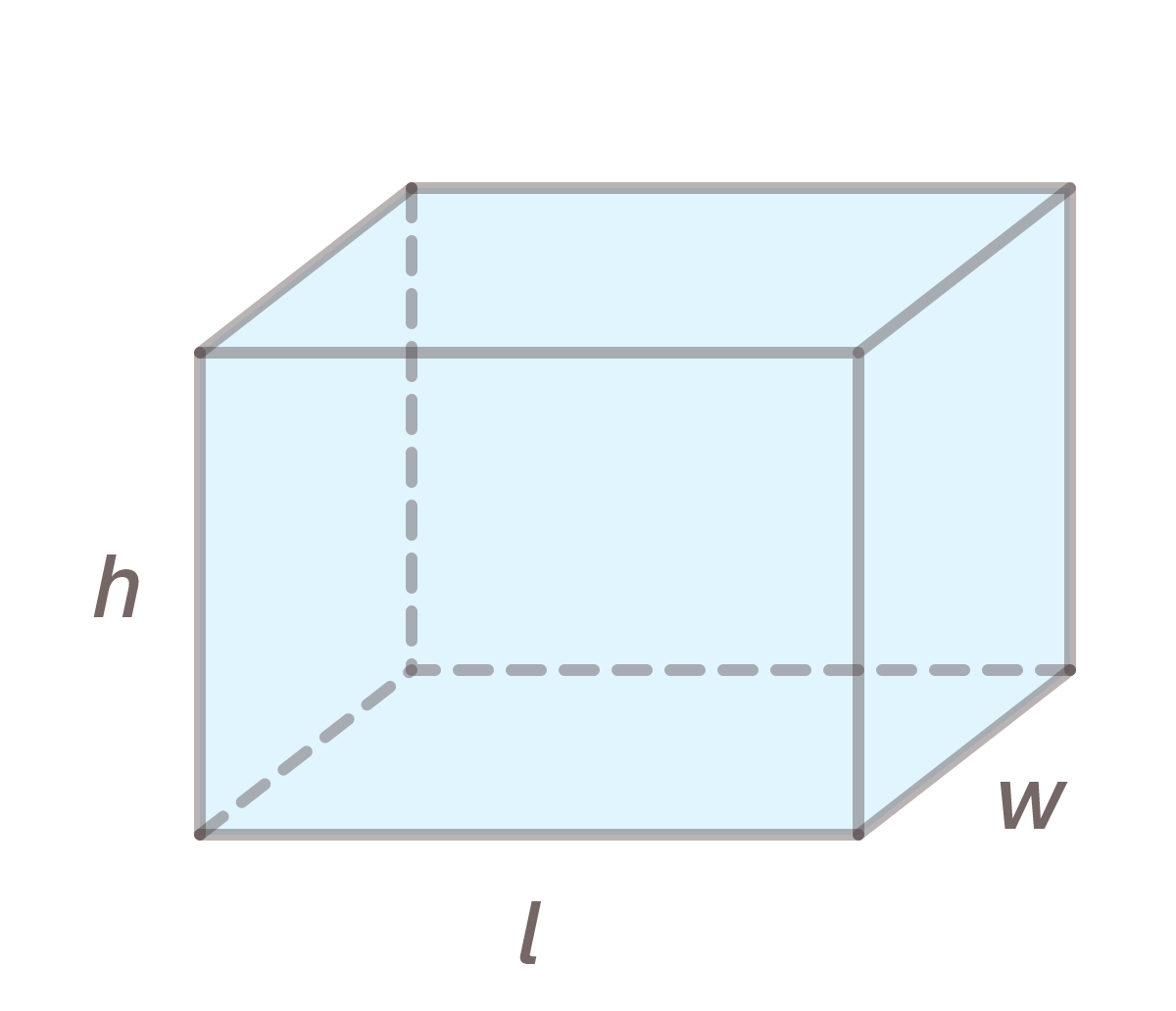
Length times width times height.
Solve for
V=60cm³
V equals (5 times 4) times 3, equals 20 times 3, equals 60 cm³
Den här sidan finns på svenska. Byt till svenska
Definition — what does that mean?
Length times width times height — and one cubic decimetre is exactly one litre.
In Swedish: Rätblockets volym
V
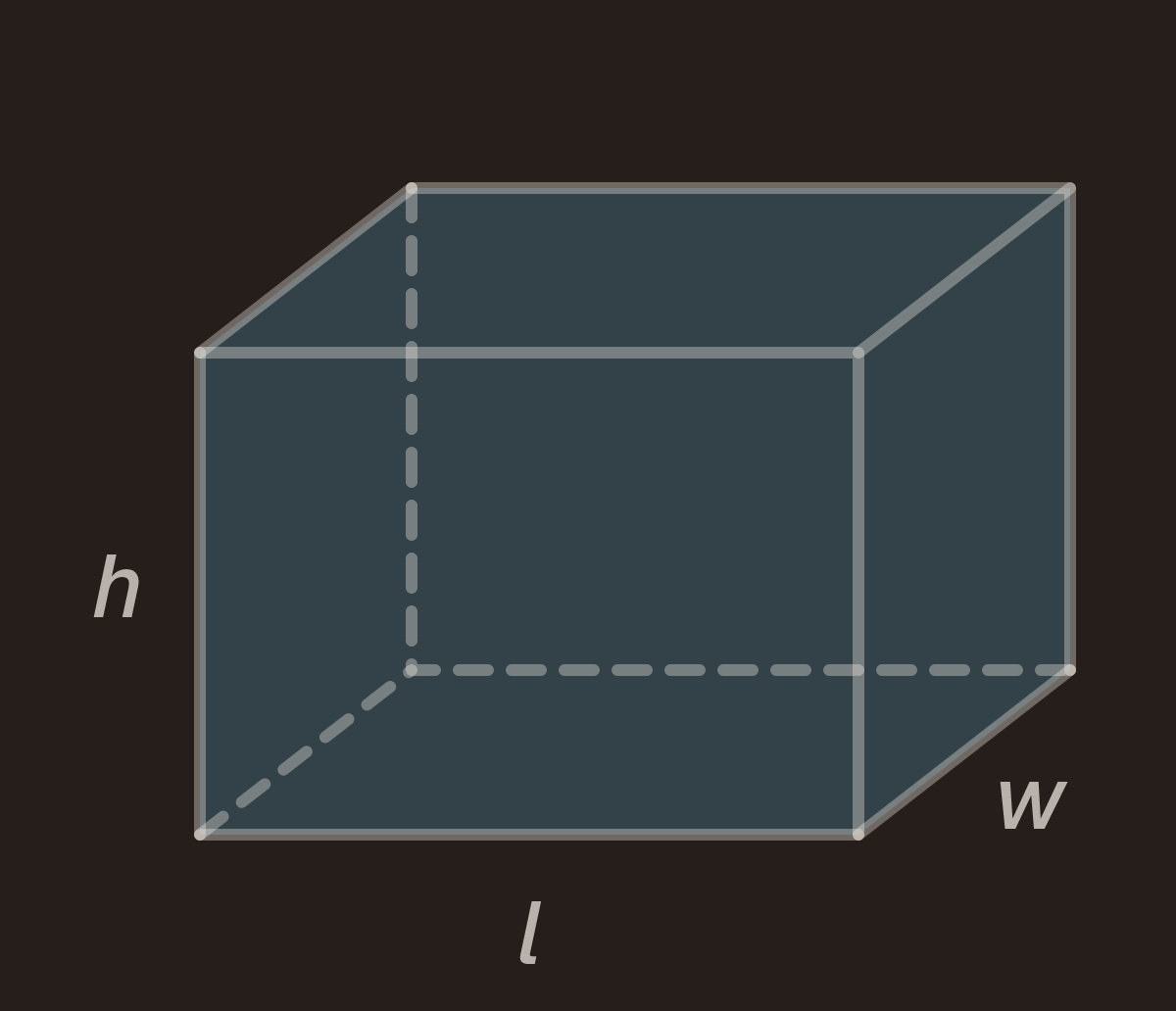
Length times width times height.
V=60cm³
V equals (5 times 4) times 3, equals 20 times 3, equals 60 cm³
You are given
V = ?
Pick the unit your lengths are in. Areas are then labelled in square units and volumes in cubic units; nothing is converted.
Volume is measured in unit cubes: cubes one centimetre, one decimetre or one metre on a side. A cuboid measuring 5 · 4 · 3 holds 5 cubes along its length, 4 across its width and 3 layers high — 60 cubes.
Another way to see it: the base is a rectangle of area l · w, and the volume is that area stacked h times. It is the same idea behind the volume of a cylinder, with a circle on the bottom instead.
As with area, this is a definition rather than a theorem. It is what volume means, and there is nothing under the formula to prove.
The metric system is built so that 1 dm³ = 1 litre, which makes the step from measurements to capacity a short one:
| Volume | In litres |
|---|---|
| 1 cm³ | 0.001 l |
| 1 dm³ | 1 l |
| 1 m³ | 1,000 l |
An aquarium 6 dm long, 3 dm deep and 4 dm high holds 6 · 3 · 4 = 72 dm³, or 72 litres — and about 72 kilos of water.
A moving box of 50 × 40 × 30 cm has a volume of 50 · 40 · 30 = 60,000 cm³ = 60 litres.
Backwards. A load space holds 60 dm³ and its base is 5 dm by 4 dm. The height is 60 / (5 · 4) = 3 dm.
What is the difference between a cuboid and a cube?
A cube is a cuboid whose three measurements are equal, so its volume is the side cubed.
Does it matter which measurement is called the length?
No. The order of the factors changes nothing — 5 · 4 · 3 and 3 · 5 · 4 are the same volume.
| Solve for | Rearranged | With the numbers | Comes to |
|---|---|---|---|
| l | Vwh | 604·3 | 5 cm |
| w | Vlh | 605·3 | 4 cm |
| h | Vlw | 605·4 | 3 cm |
| V | lwh | 5·4·3 | 60 cm³ |
Table
| Unit | In cubic metres |
|---|---|
| mm³ | 1 × 10⁻⁹ |
| ml | 0.000001 |
| cm³ | 0.000001 |
| cl | 0.00001 |
| in³ | 0.000016387064 |
| dl | 0.0001 |
| l | 0.001 |
| dm³ | 0.001 |
| gal | 0.003785411784 |
| ft³ | 0.028316846592 |
| m³ | 1 |
Last reviewed October 6, 2026 ·How pages are reviewed
Sheets that ask this formula, with their answer keys. Open one to see the questions or print it.
Twenty questions on four solids. The volume is asked for in most; in some the volume is given and an edge or the height is asked for instead.
The same drawing, measured in the other ways it can be measured.
Copy the code into your page where the formula card should appear. It loads from lovetocalc.com, so it stays current on its own — all we ask is that the credit line comes with it.