Pick the unit your lengths are in. Areas are then labelled in square units and volumes in cubic units; nothing is converted.
What the theorem says
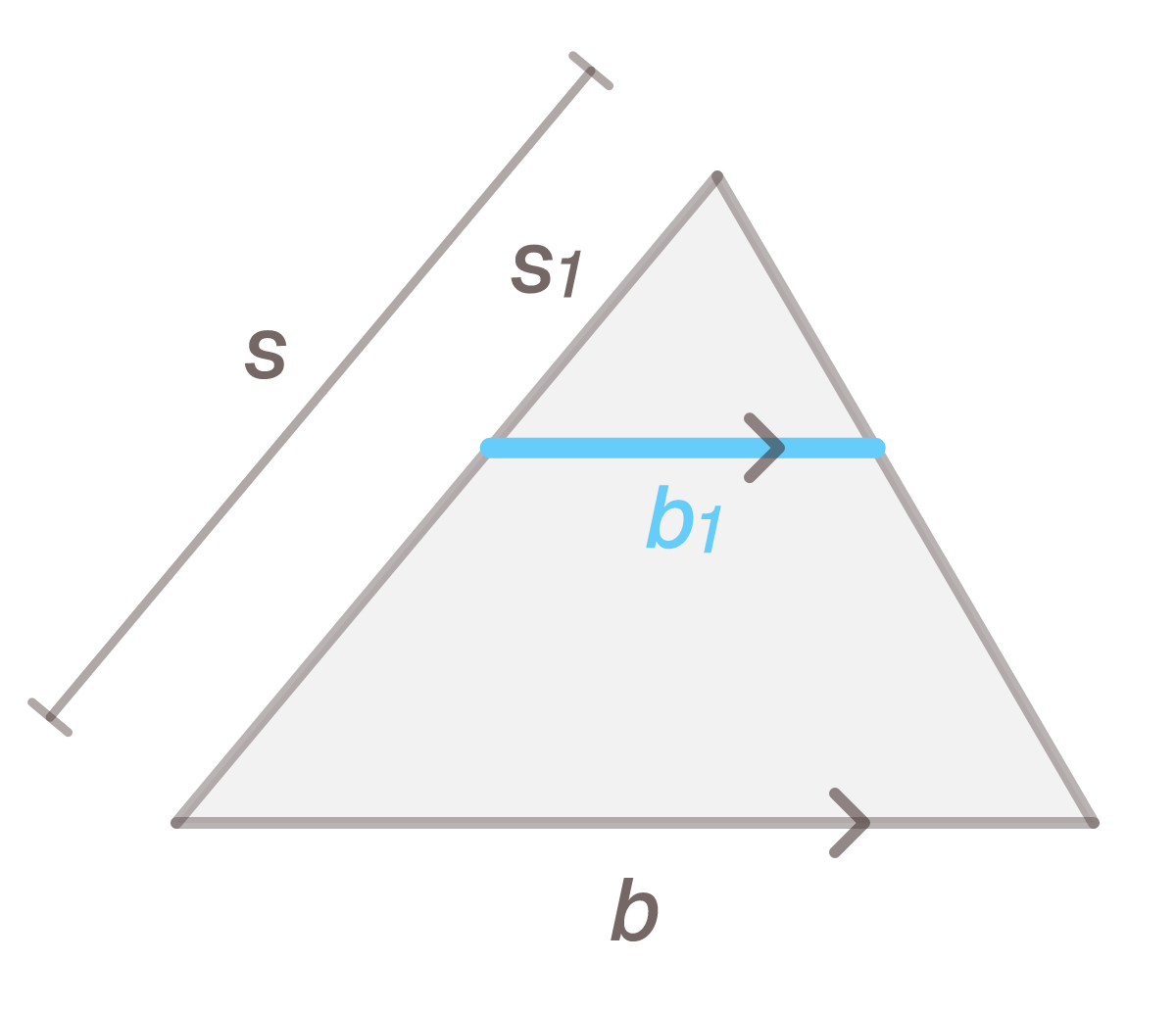
A line drawn parallel to the base cuts a smaller triangle off the top. It has the same angles as the
whole triangle, so the same shape, and every measurement shrinks by the same factor.
The result is also called the basic proportionality theorem, the intercept theorem or the side splitter theorem.
If the cut sits 3 cm down a side that is 6 cm long, and the base is 10 cm, then the cut is
3 · 10 / 6 = 5 cm. Halfway down gives half the base.
Why it holds
The small triangle and the whole one share the apex angle. Because the cut is parallel to the base, the
two other angles match as well — corresponding angles at parallel lines. Two equal angles are enough for
similarity, and similarity gives proportional
sides.
The proof also explains the condition: the line has to be parallel to the base. If it is not, the
triangles are not similar, and the proportion does not hold.
What is compared with what
The theorem compares the small triangle’s measurements with the whole triangle’s — not with what is
left below the cut. That is a common source of error, and it is where this differs from the
transversal theorem: that one
compares the two parts of the sides with each other, this one compares the part with the whole.
So if you were given “the distance from the cut down to the base” rather than the whole side, add them
together first.
Worked examples
Halfway. s₁ = 4, s = 8, b = 16 gives b₁ = 4 · 16 / 8 = 8.
A third of the way down. s₁ = 5, s = 15, b = 21 gives b₁ = 5 · 21 / 15 = 7.
Backwards, the base. The small triangle’s base is 6, its side 4 and the whole side 10. The whole base
is 6 · 10 / 4 = 15.
Backwards, the side. b₁ = 12, b = 18, s = 12 gives s₁ = 12 · 12 / 18 = 8.
Common mistakes
- Comparing the part with the remainder. The denominator is the whole side, not the piece below the
cut.
- Using the theorem on a line that is not parallel. Then the triangles are not similar.
- Expecting the area to shrink by the same factor. Halve the sides and the area becomes a quarter —
see area scale factor.
- Pairing the wrong sides. The small triangle’s side goes over the whole side on the same side of
the figure.
Common questions
How does this differ from the transversal theorem?
This one sets the part against the whole; the transversal theorem sets the two parts against each
other. Both follow from similarity and give the same answer when used correctly.
Does it hold if the line cuts outside the triangle?
Extend the sides and the same proportion holds, but the figure is then no longer a cut-off top. If the
line lies below the base, the original triangle becomes the small one; if it lies above the apex, you get
two similar triangles that meet at the apex and point opposite ways.
What is the area of the small triangle?
The ratio squared, times the whole area. Cut at half the height and the top triangle has a quarter of
the area.