The rule
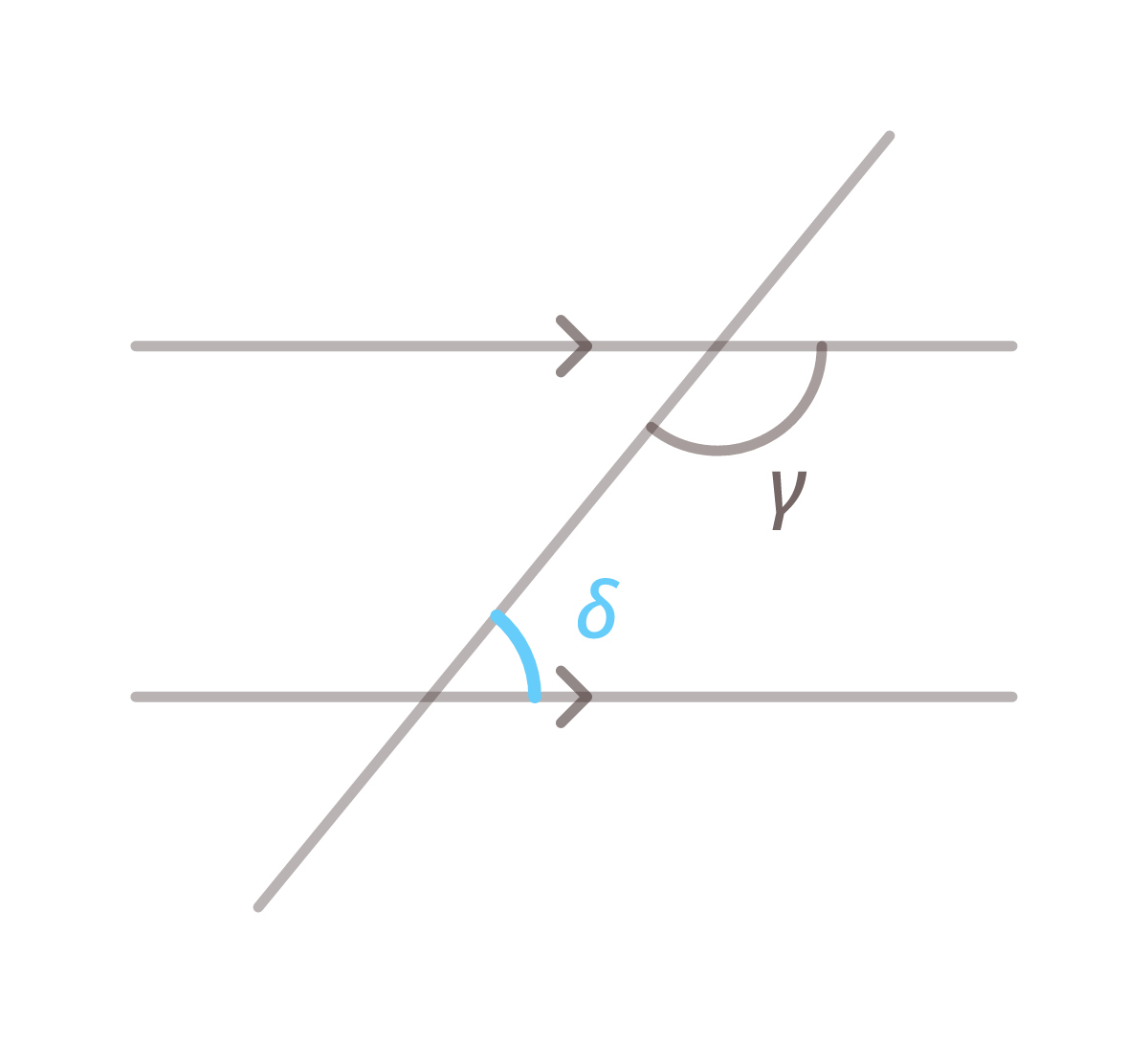
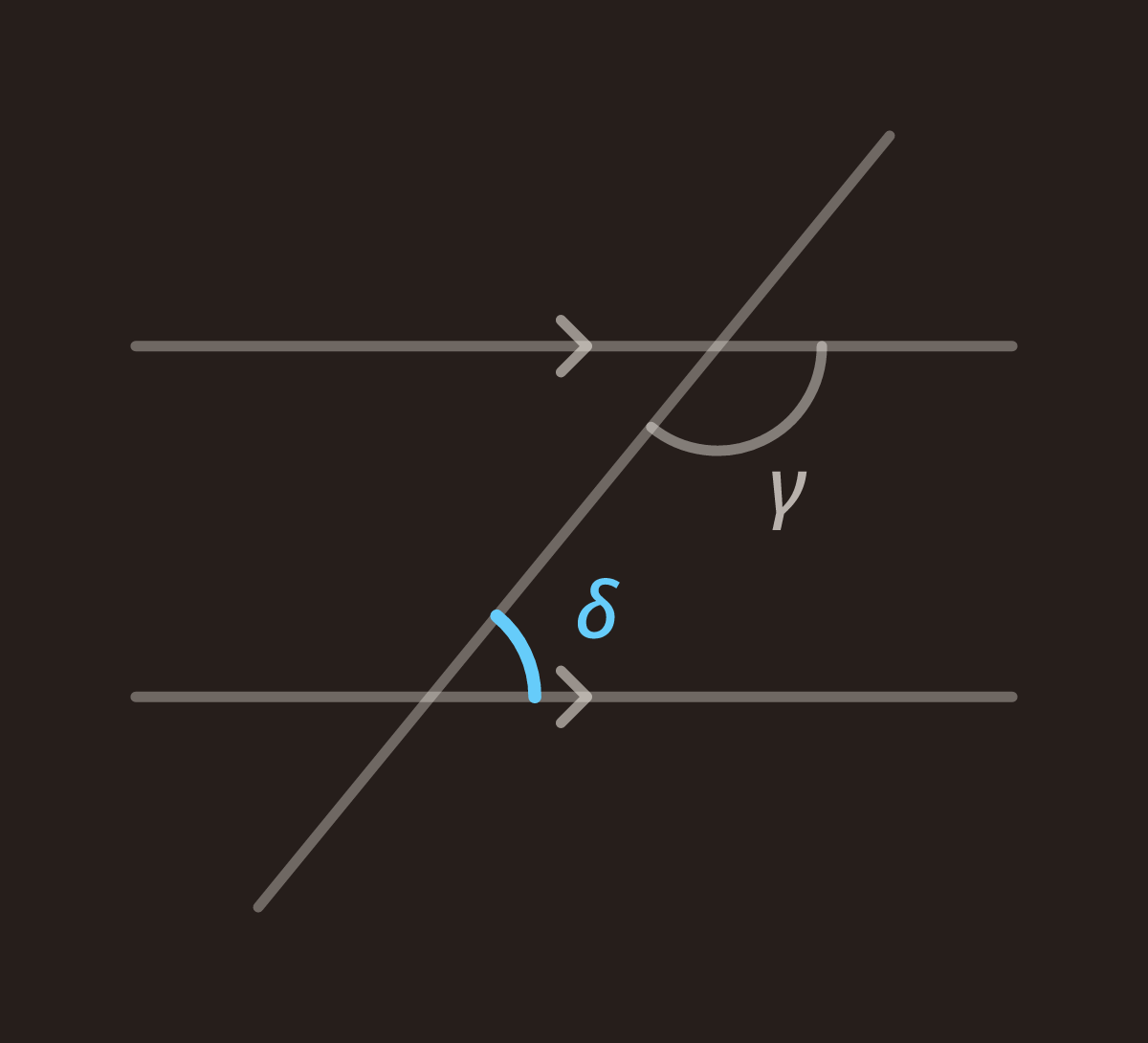
Two parallel lines are crossed by a third line, the transversal. Look at the region between the parallel lines. On one side of the transversal there are two angles, one at each crossing. These are co-interior angles (also called same-side interior angles), and together they make 180°.
Holds when the two lines are parallel. If they are not, the two angles add up to something other than 180°, and it is exactly that difference that shows the lines are not parallel.
Why it holds
Let γ be the angle at the upper crossing. At the lower crossing, the angle on the other side of the transversal from δ is an alternate angle to γ, so it equals γ. It and δ sit side by side on the lower line, so γ + δ = 180°.
An example
The transversal makes an angle of 65° between the lines at the upper crossing. The co-interior angle at the lower crossing is 180° − 65° = 115°.
Backwards: the co-interior angles are 2x and x + 60 (in degrees). Then 2x + x + 60 = 180, so 3x = 120, x = 40, and the angles are 80° and 100°.
Common mistakes
- Taking them to be equal. Co-interior angles are equal only when both are 90°. Alternate and corresponding angles are the equal ones.
- Using the rule on lines that are not parallel. Lines that merely look parallel in a drawing do not count.
- Picking angles on opposite sides. Two interior angles on opposite sides of the transversal are alternate angles, and they are equal.
The full set of pairs is on angles and parallel lines; the pair across a crossing is vertical angles.