Area of a circle
The relation
A
Pi times the radius squared. With the diameter instead, halve it first.
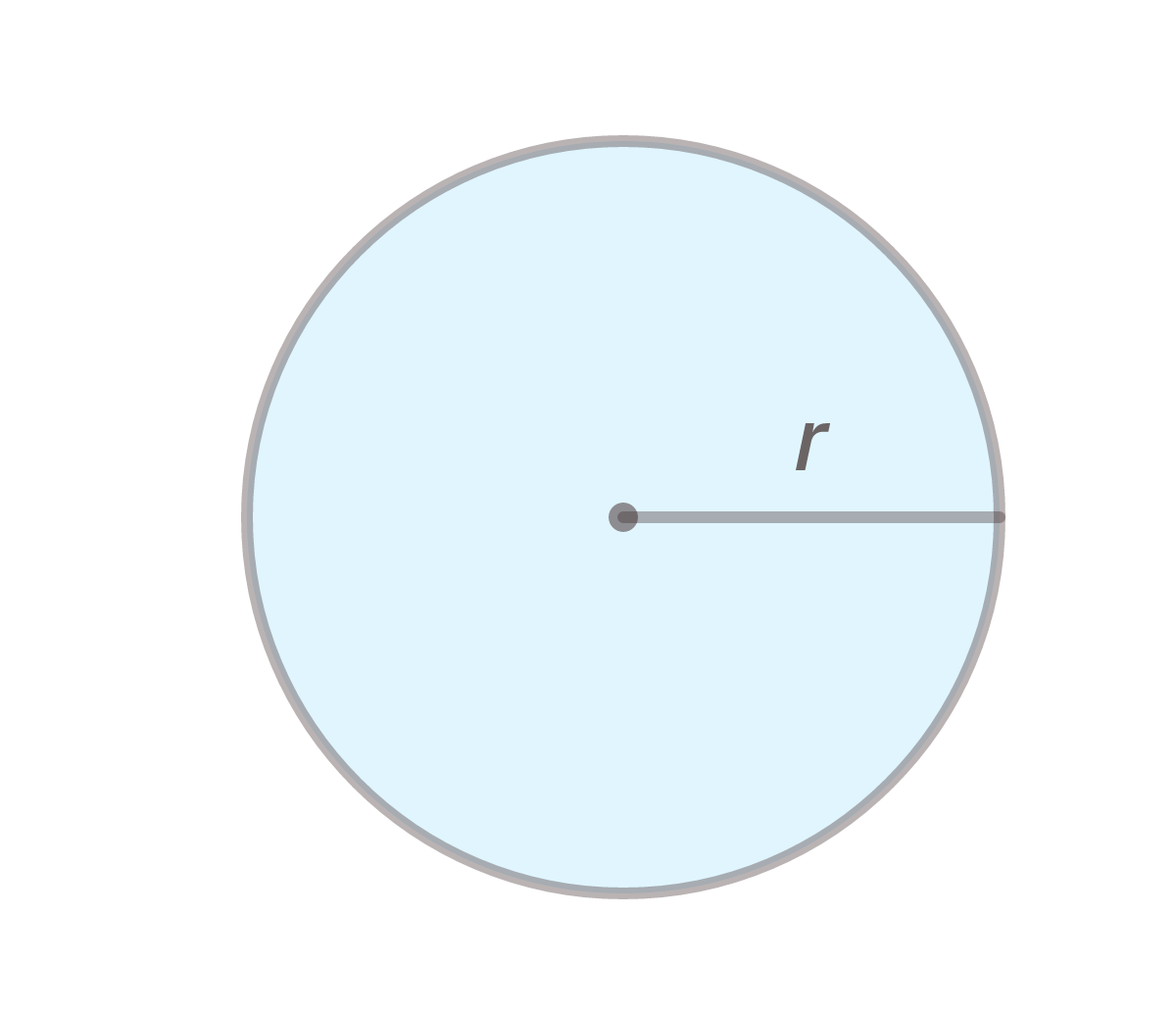
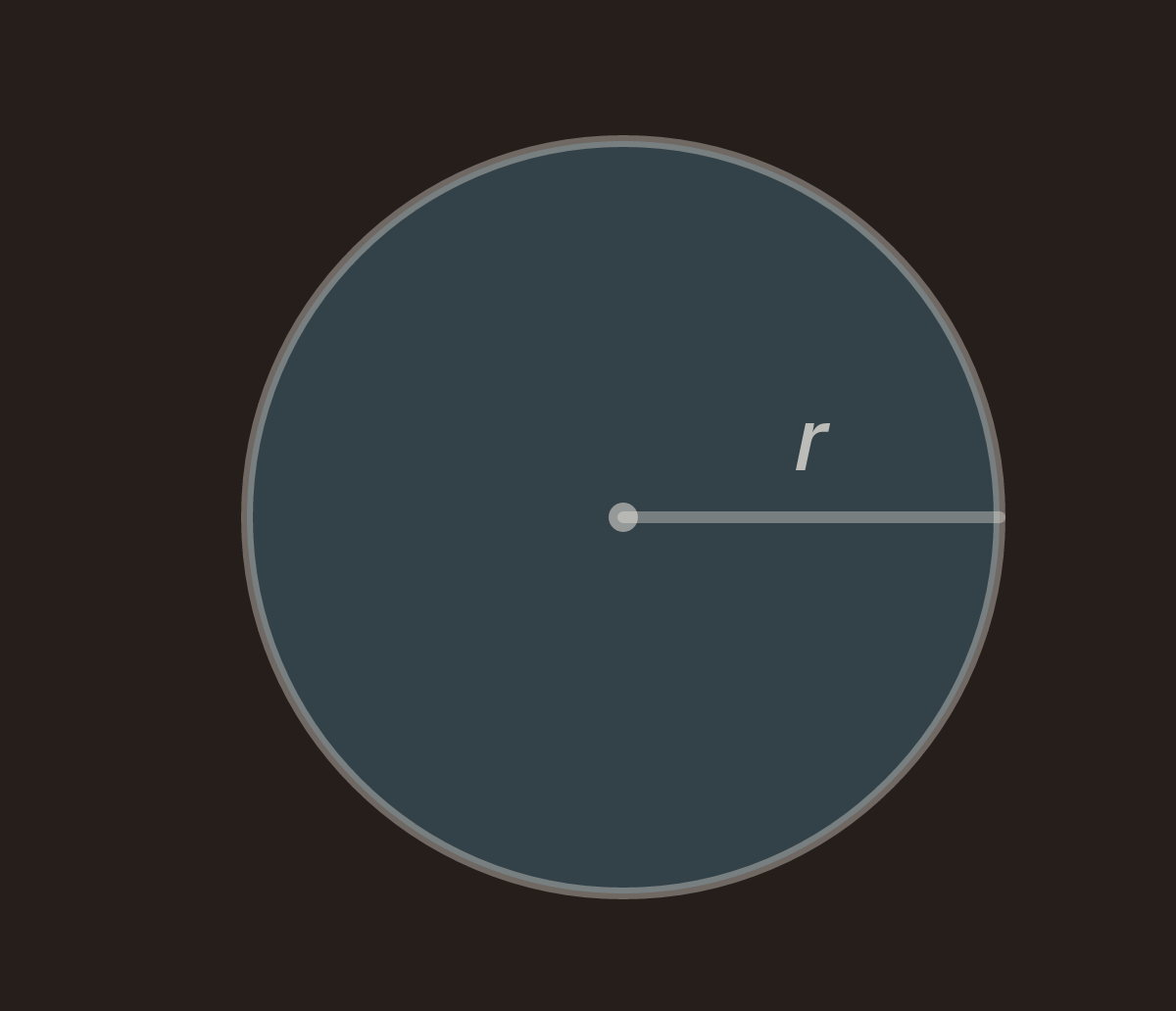
Solve for
A≈28.2743cm²
A equals π times 3 squared, equals π times 9, is approximately 28.2743 cm²
Den här sidan finns på svenska. Byt till svenska
Theorem — what does that mean?
Pi times the radius squared — and if you have the diameter, halve it before you start.
In Swedish: Cirkelns area
A
Pi times the radius squared. With the diameter instead, halve it first.
A≈28.2743cm²
A equals π times 3 squared, equals π times 9, is approximately 28.2743 cm²
You are given
A = ?
Round to 1 decimal.
Pick the unit your lengths are in. Areas are then labelled in square units and volumes in cubic units; nothing is converted.
Cut the circle into slices and lay them out alternately, one pointing up, the next pointing down. What emerges is a shape that looks more and more like a rectangle the thinner the slices are.
The rectangle’s height is the radius r. Its width is half the
circumference, since half the arc ends up on top and half
underneath: 2πr / 2 = πr. So the area is πr · r = πr².
This is a convincing argument rather than a formal proof — showing that the limit really is a rectangle takes more machinery — but it does show why π and the square turn up where they do.
A round rug. The radius is 3 dm. The area is π · 3² = 9π ≈ 28.3 dm².
It is worth writing the answer exactly as 9π first and rounding last. That is how the textbooks do it, and it keeps rounding error from travelling through several steps.
From the diameter. A 32 cm pizza has a radius of 16 cm: π · 16² = 256π ≈ 804 cm².
The radius is squared, and that changes the intuition. A 32 cm pizza is not slightly bigger than a 16 cm one — it is four times the pizza:
| Diameter | Radius | Area |
|---|---|---|
| 16 cm | 8 cm | ≈ 201 cm² |
| 32 cm | 16 cm | ≈ 804 cm² |
It works the other way too. To double the area you only need to multiply the radius by √2, about 41% more.
How precise is π in the card above?
The calculation uses the browser’s Math.PI, good to about fifteen digits. Rounding happens only on the
final line.
How do I find the area of a ring?
Work out the outer circle’s area and subtract the inner one: π(R² − r²).
| Solve for | Rearranged | With the numbers | Comes to |
|---|---|---|---|
| r | 3 cm | ||
| A | πr² | π·3² | 28.27 cm² |
Table
| Unit | In square metres |
|---|---|
| mm² | 0.000001 |
| cm² | 0.0001 |
| in² | 0.00064516 |
| dm² | 0.01 |
| ft² | 0.09290304 |
| yd² | 0.83612736 |
| m² | 1 |
| a | 100 |
| acre | 4,046.8564224 |
| ha | 10,000 |
| km² | 1,000,000 |
| mi² | 2,589,988.11034 |
Table
| Capital | Lowercase | Name | Used for |
|---|---|---|---|
| Α | α | alpha | Angles |
| Β | β | beta | Angles |
| Γ | γ | gamma | Angles |
| Δ | δ | delta | Change (Δ), as in ΔT and Δx |
| Ε | ε | epsilon | A small positive number |
| Ζ | ζ | zeta | — |
| Η | η | eta | Efficiency |
| Θ | θ | theta | Angles, such as the central angle |
| Ι | ι | iota | — |
| Κ | κ | kappa | — |
| Λ | λ | lambda | Wavelength |
| Μ | μ | mu | Coefficient of friction and the mean; the prefix micro |
| Ν | ν | nu | — |
| Ξ | ξ | xi | — |
| Ο | ο | omicron | — |
| Π | π | pi | A circle's circumference divided by its diameter, about 3.14 |
| Ρ | ρ | rho | Density |
| Σ | σ | sigma | Standard deviation (σ) and sum (Σ) |
| Τ | τ | tau | — |
| Υ | υ | upsilon | — |
| Φ | φ | phi | Angles |
| Χ | χ | chi | The chi-squared test (χ²) |
| Ψ | ψ | psi | — |
| Ω | ω | omega | The ohm, the unit of resistance (Ω); angular velocity (ω) |
Table
| Symbol | Name | Means | Example |
|---|---|---|---|
| Equality and inequality | |||
| = | equals sign | Both sides have the same value. | 2 + 3 = 5 |
| ≠ | not equal to | The two sides have different values. | 2 + 2 ≠ 5 |
| ≈ | approximately equal to | Nearly equal, usually after rounding. | π ≈ 22/7 |
| < | less than | The left side is smaller than the right. | 3 < 5 |
| > | greater than | The left side is larger than the right. | 5 > 3 |
| ≤ | less than or equal to | The left side is smaller than or equal to the right. | x ≤ 10 |
| ≥ | greater than or equal to | The left side is larger than or equal to the right. | x ≥ 0 |
| Operations | |||
| ± | plus-minus | Both plus and minus: two values at once. | x = ±3 |
| · | multiplication dot | Times. The usual sign in the formulas here. | 3 · 4 = 12 |
| × | multiplication sign | Times, the same as ·. | 3 × 4 = 12 |
| ÷ | division sign | Divided by, the same as /. | 12 ÷ 4 = 3 |
| √ | square root | The number that multiplied by itself gives the number under the sign, never negative. | √16 = 4 |
| ∛ | cube root | The number that multiplied by itself three times gives the number under the sign. | ∛27 = 3 |
| |x| | absolute value | A number's distance from zero, always zero or positive. | |−3| = 3 |
| ∑ | summation sign | The sum of all the terms of one kind. | ∑ xᵢ = x₁ + x₂ + … + xₙ |
| Δ | delta | Change: the final value minus the initial value. | Δx = x₂ − x₁ |
| % | percent | Hundredths. | 5% = 5/100 |
| ‰ | per mille | Thousandths. | 5‰ = 5/1000 |
| Geometry | |||
| ∠ | angle | The angle with its vertex at the middle letter. | ∠ABC = 90° |
| ⊥ | perpendicular to | The lines meet at a right angle. | AB ⊥ CD |
| ∥ | parallel to | The lines run in the same direction and never meet. | AB ∥ CD |
| ° | degree | The unit of angle: a full turn is 360°. Also in temperatures, as in 20 °C. | 90° |
| Constants | |||
| π | pi | A circle's circumference divided by its diameter, about 3.14. | A = πr² |
| ∞ | infinity | Larger than every number. Not a number itself, but a direction. | x → ∞ |
Last reviewed October 6, 2026 ·How pages are reviewed
Sheets that ask this formula, with their answer keys. Open one to see the questions or print it.
Eight areas and eight circumferences. Answers round to one decimal, so a calculator is allowed and the sheet says so.
The same drawing, measured in the other ways it can be measured.
Copy the code into your page where the formula card should appear. It loads from lovetocalc.com, so it stays current on its own — all we ask is that the credit line comes with it.