Vertical angles
The relation
α
Where two straight lines cross, the angles across from each other are equal. No parallel lines are needed.
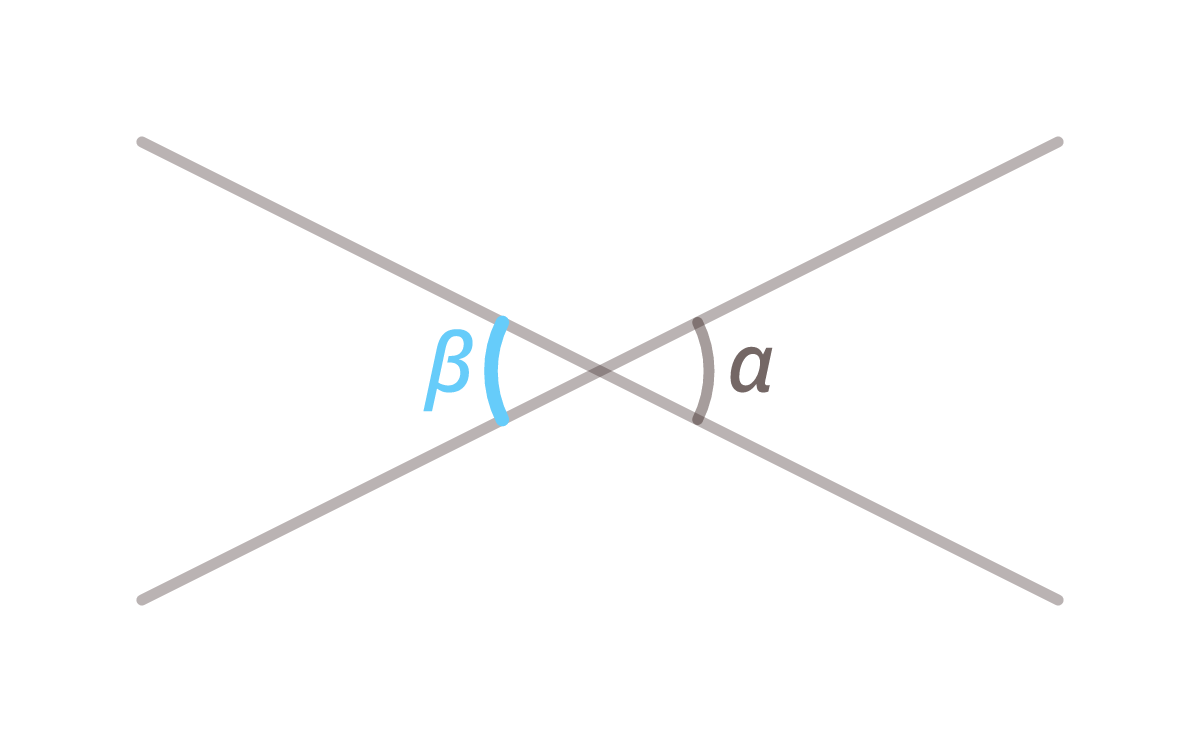
Solve for
β=65
β equals 65 degrees
Den här sidan finns på svenska. Byt till svenska
Theorem — what does that mean?
Where two straight lines cross, the two angles across from each other are equal. The lines do not have to be parallel.
In Swedish: Vertikalvinklar
α
Where two straight lines cross, the angles across from each other are equal. No parallel lines are needed.
β=65
β equals 65 degrees
You are given
Two crossing lines make four angles. The two that sit across from each other, touching only at the crossing, are vertical angles (also called vertically opposite angles), and they are equal. The two that sit side by side on one line are not equal in general; they add up to 180°.
Call the angle across from α by β, and one of the neighbours γ. Then α and γ lie on a straight line, so α + γ = 180°. The angles β and γ lie on the other straight line, so β + γ = 180°. Both sums are 180°, so α + γ = β + γ, and taking γ from both sides leaves α = β.
Two lines cross and one angle is 65°. The angle across from it is 65°. Each neighbour is 180° − 65° = 115°, and the other vertical pair is 115° and 115°. The four angles add up to 65° + 115° + 65° + 115° = 360°, a full turn.
Backwards: if a pair of vertical angles are written 3x and x + 50 (in degrees), then 3x = x + 50, so x = 25 and each angle is 75°.
All the pairs at a transversal are on angles and parallel lines. The two angles between parallel lines on one side add up to 180°: co-interior angles.
| Solve for | Rearranged | With the numbers | Comes to |
|---|---|---|---|
| α | β | 65° | 65 |
| β | α | 65° | 65 |
Last reviewed October 13, 2026 ·How pages are reviewed
Sheets that ask this formula, with their answer keys. Open one to see the questions or print it.
Sixteen questions on the angle sum of triangles, quadrilaterals and polygons, and on vertical angles. Mostly a missing angle is asked for.
Copy the code into your page where the formula card should appear. It loads from lovetocalc.com, so it stays current on its own — all we ask is that the credit line comes with it.