Angle sum of a polygon
The relation
S
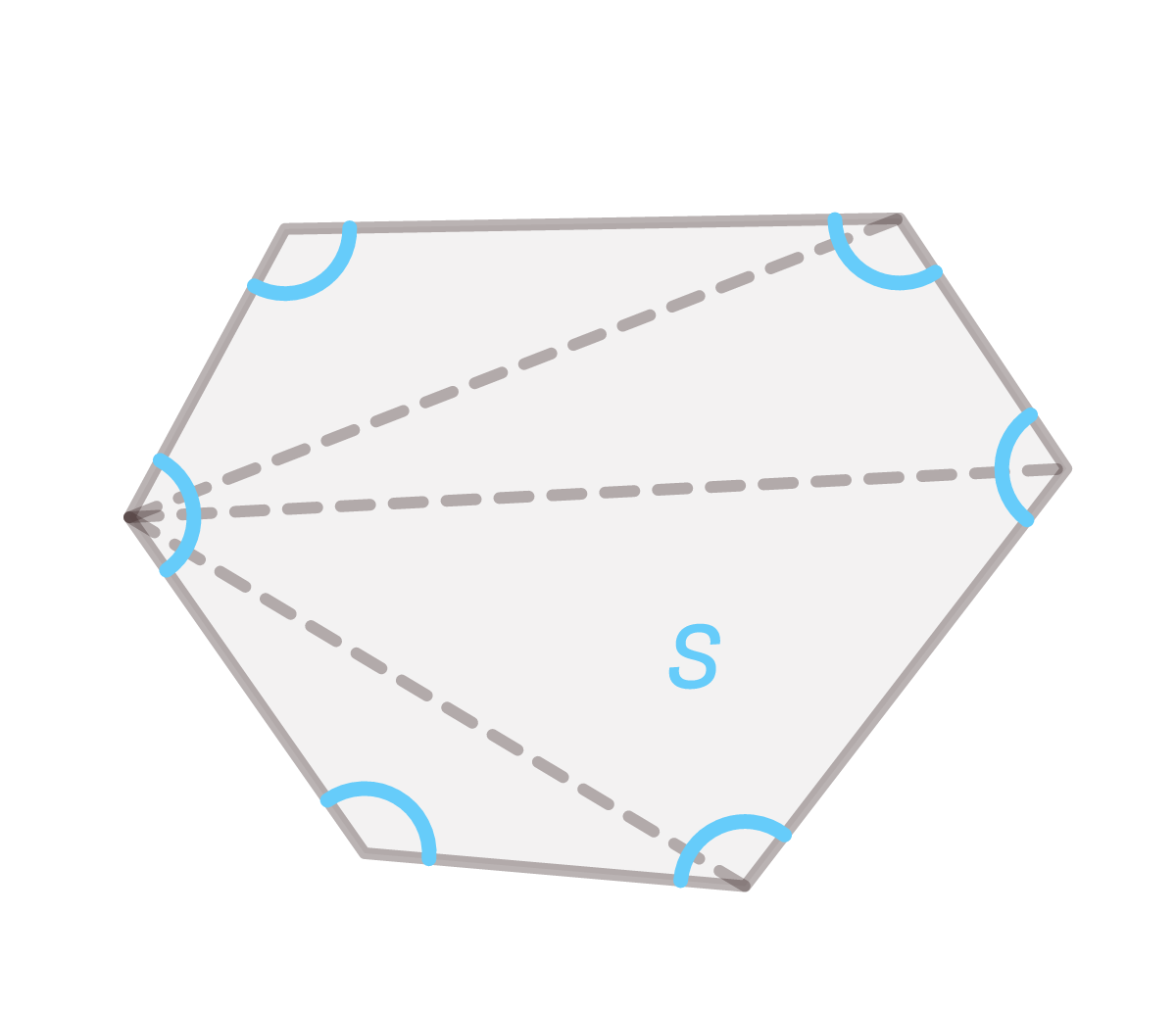
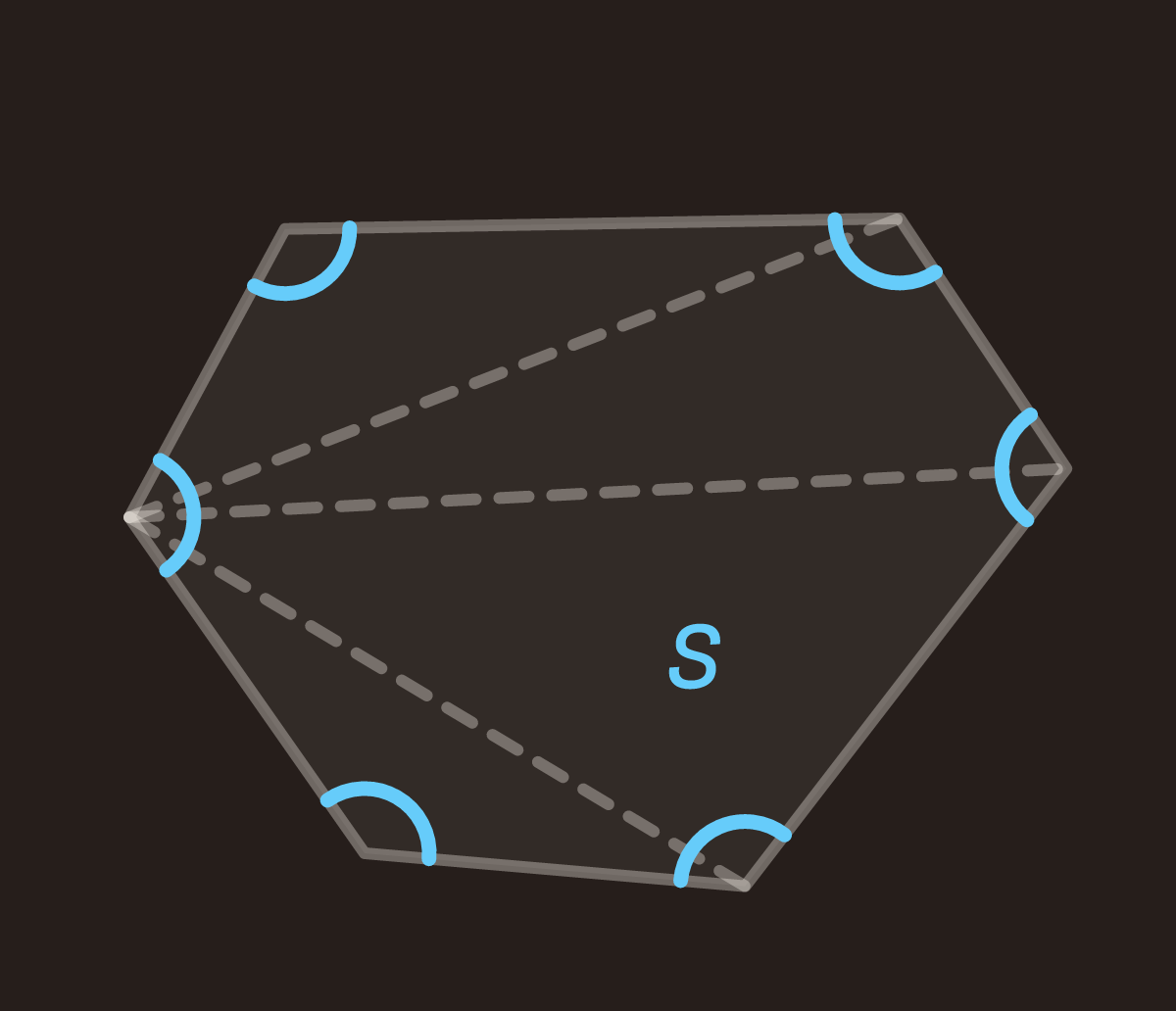
Every corner past the third adds another triangle, and every triangle another 180°.
Solve for
S=540
S equals (5 minus 2) times 180 degrees, equals 3 times 180 degrees, equals 540 degrees
Den här sidan finns på svenska. Byt till svenska
Theorem — what does that mean?
Every corner past the third adds another triangle, and every triangle another 180°. Hence the minus two.
In Swedish: Vinkelsumman i en månghörning
S
Every corner past the third adds another triangle, and every triangle another 180°.
S=540
S equals (5 minus 2) times 180 degrees, equals 3 times 180 degrees, equals 540 degrees
You are given
n = ?
n is the number of corners, which in any polygon equals the number of sides. A pentagon therefore has an angle sum of (5 − 2) · 180 = 540°, and an octagon (8 − 2) · 180 = 1,080°.
The theorem says nothing about how large the individual angles are — only what they come to together. In a regular figure they are also equal.
Pick a corner of a convex polygon and draw a diagonal to every other corner except its two neighbours. The figure splits into triangles — two fewer than the number of corners, because the two neighbouring corners give no triangle of their own.
Each triangle contributes 180°, and together they cover every angle of the polygon without overlapping. So S = (n − 2) · 180°.
The check is the two cases you already know: n = 3 gives 180° and n = 4 gives 360°.
If the figure is regular every angle is the same, so each one is
A regular hexagon therefore has an angle of 4 · 180 / 6 = 120°, and a regular pentagon 3 · 180 / 5 = 108°. That is why hexagons tile edge to edge with no gaps — three times 120° is a full turn — while pentagons do not.
Forwards. A decagon: (10 − 2) · 180 = 1,440°.
A single angle. A regular octagon has an angle of 6 · 180 / 8 = 135°.
Backwards. A polygon has an angle sum of 1,800°. Then n − 2 = 1,800 / 180 = 10, so the figure has 12 corners.
Does the formula hold for concave polygons?
Yes, as long as the figure does not cross itself. The angle at an inward-pointing corner then counts as
greater than 180°, and the sum still works out.
Why are the exterior angles 360°?
Because you turn through one full turn walking around a convex figure, however many corners it has.
That is a different theorem, and one of the few where the answer does not depend on n.
Which regular figures tile a floor?
Triangles, squares and hexagons — the only ones whose angle divides 360° evenly. The pentagon’s 108°
does not.
| Solve for | Rearranged | With the numbers | Comes to |
|---|---|---|---|
| n | S180° | 540°180° | 5 |
| S | (n | (5 | 540 |
Last reviewed October 6, 2026 ·How pages are reviewed
Sheets that ask this formula, with their answer keys. Open one to see the questions or print it.
Sixteen questions on the angle sum of triangles, quadrilaterals and polygons, and on vertical angles. Mostly a missing angle is asked for.
Copy the code into your page where the formula card should appear. It loads from lovetocalc.com, so it stays current on its own — all we ask is that the credit line comes with it.