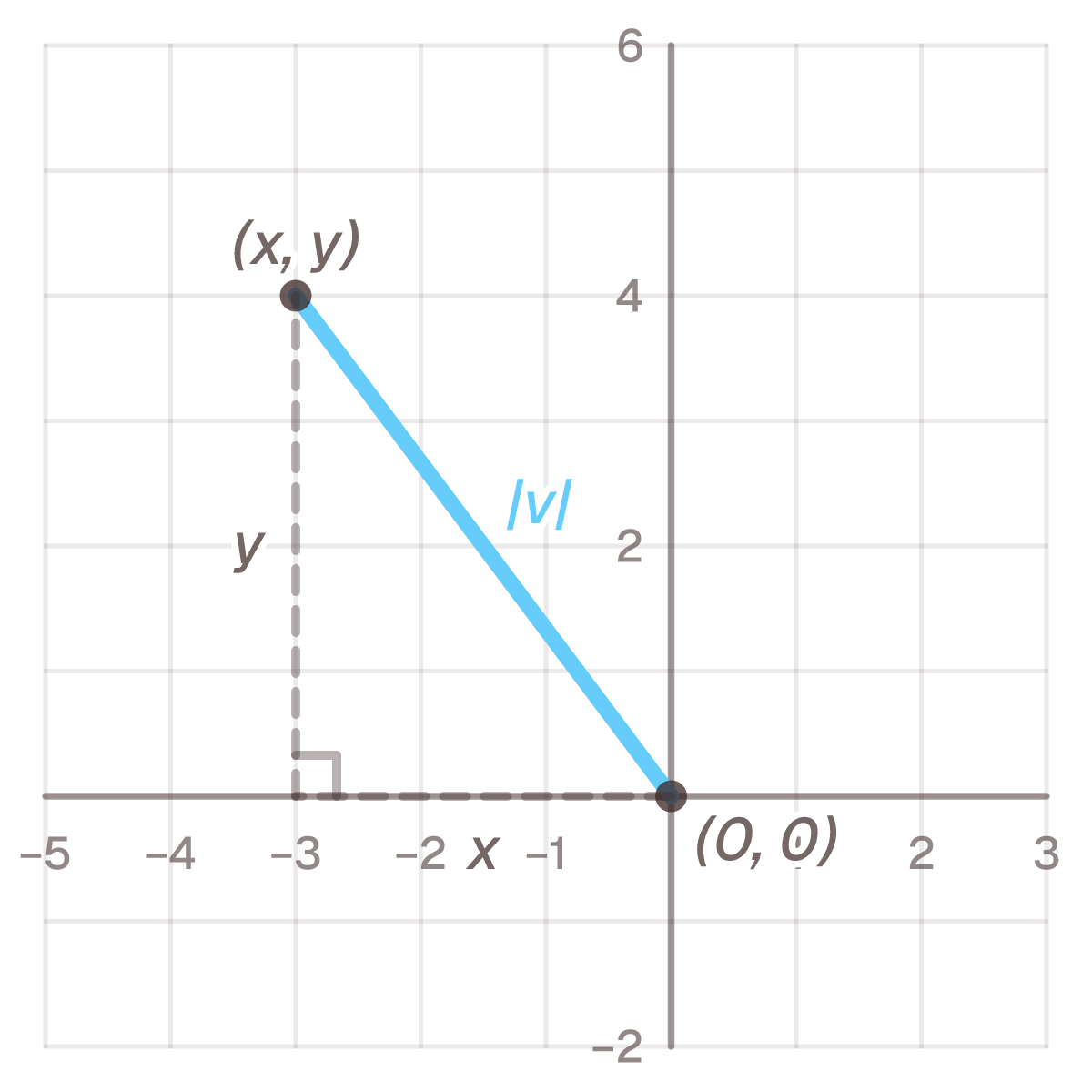
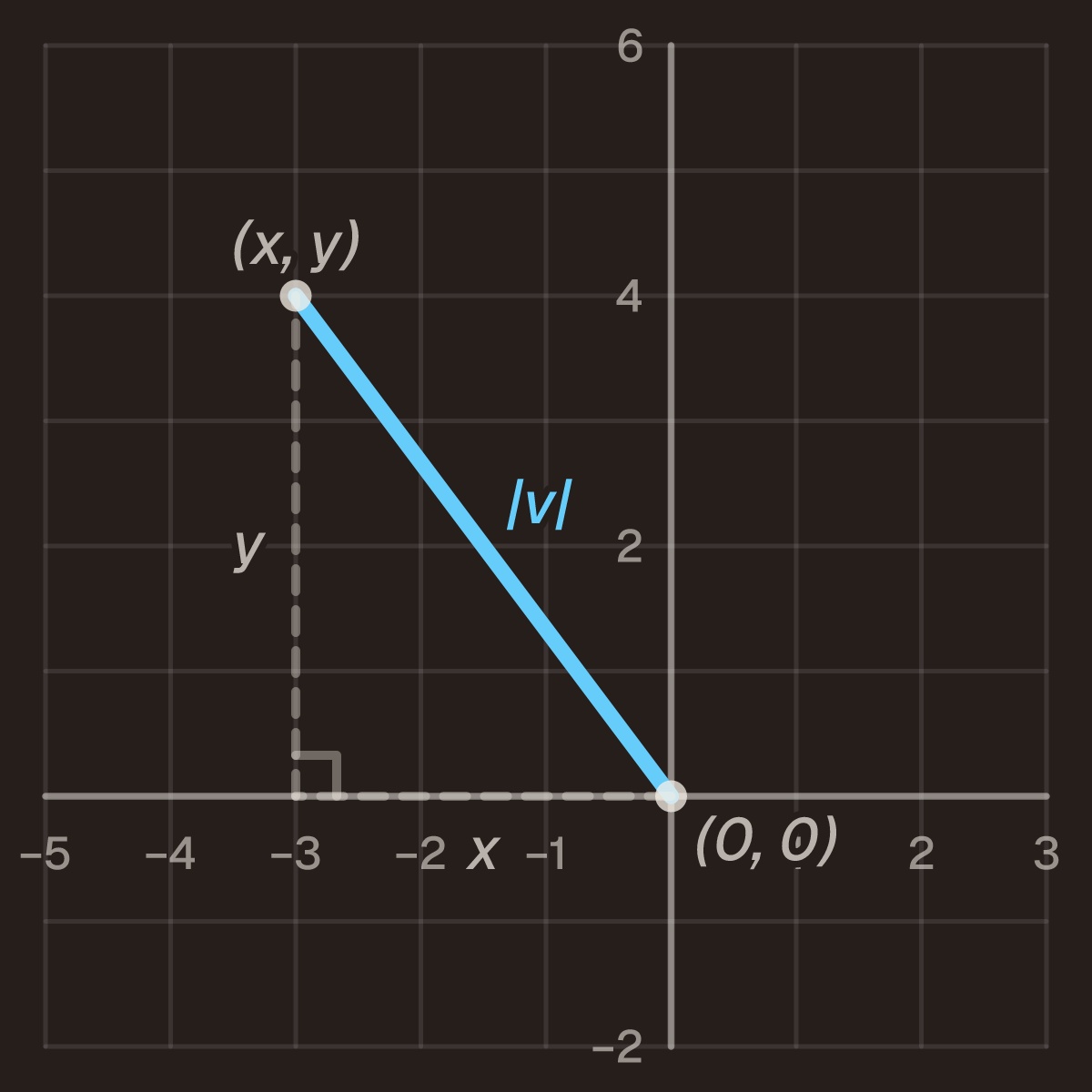
A vector v = (x, y) goes x steps across and y steps up. Its length, or magnitude, is written |v|. The
vector (−3, 4) has magnitude
|v| = √((−3)² + 4²) = √(9 + 16) = √25 = 5.
It is Pythagoras’ theorem: the components are
the legs of a right-angled triangle and the vector is its hypotenuse.
The negative component
A component can be negative; a length cannot. Squaring takes care of it — (−3)² is 9, just as 3² is. But
on a calculator it goes wrong easily:
| Typed |
Gives |
|v| |
| (−3)² + 4² |
9 + 16 = 25 |
5 |
| −3² + 4² |
−9 + 16 = 7 |
√7 ≈ 2.65 |
Without the brackets only the 3 is squared, and the minus is put on afterwards. The answer looks like a
plausible length but is wrong. Always put a negative component in brackets before squaring it.
An answer that is not whole
The vector (2, 5) has magnitude √(4 + 25) = √29 ≈ 5.39. Most vectors give a root; the whole numbers
above are a special case.
The vector between two points
A vector from the point (1, 2) to (4, 6) has components (4 − 1, 6 − 2) = (3, 4), and magnitude 5. It is
the same thing as the
distance between two points.
Common mistakes
- Leaving out the brackets on a negative component. −3² is −9 on a calculator; (−3)² is 9.
- Adding the components before squaring. √((x + y)²) is |x + y|, not the magnitude.
- Forgetting the root. x² + y² is the magnitude squared.
Common questions
Does it work in three dimensions?
Yes, with one more term: |v| = √(x² + y² + z²). It is Pythagoras twice.
Can I work backwards to a component?
Yes, but there are two answers: x = √(|v|² − y²) or its negative. The card above gives the positive one
and names the other.