Area of an ellipse
The relation
A
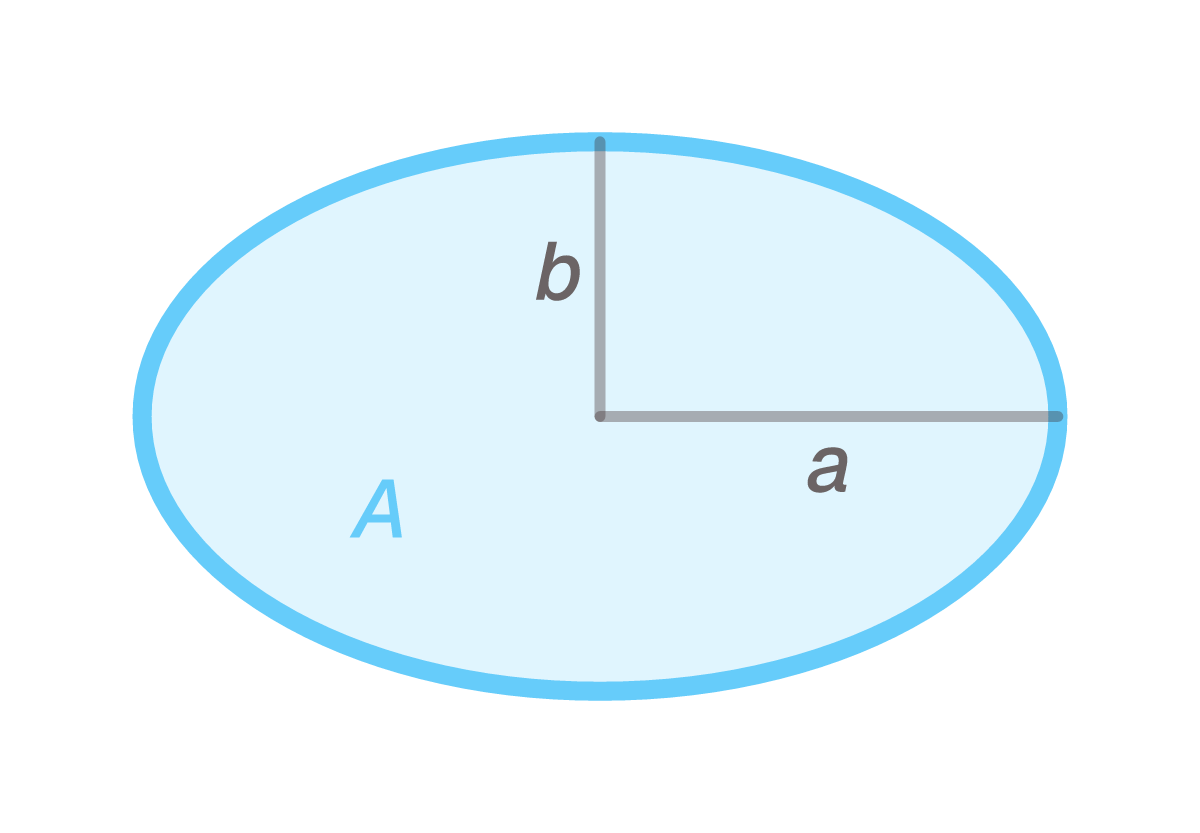
Pi times the two semi-axes. Make them equal and it is the circle again.
Solve for
A≈47.1239cm²
A equals π times (5 times 3), equals π times 15, is approximately 47.1239 cm²
Den här sidan finns på svenska. Byt till svenska
Theorem — what does that mean?
Pi times the two semi-axes. Make them equal and you have the area of a circle back.
In Swedish: Ellipsens area
A
Pi times the two semi-axes. Make them equal and it is the circle again.
A≈47.1239cm²
A equals π times (5 times 3), equals π times 15, is approximately 47.1239 cm²
You are given
Round to 1 decimal.
Pick the unit your lengths are in. Areas are then labelled in square units and volumes in cubic units; nothing is converted.
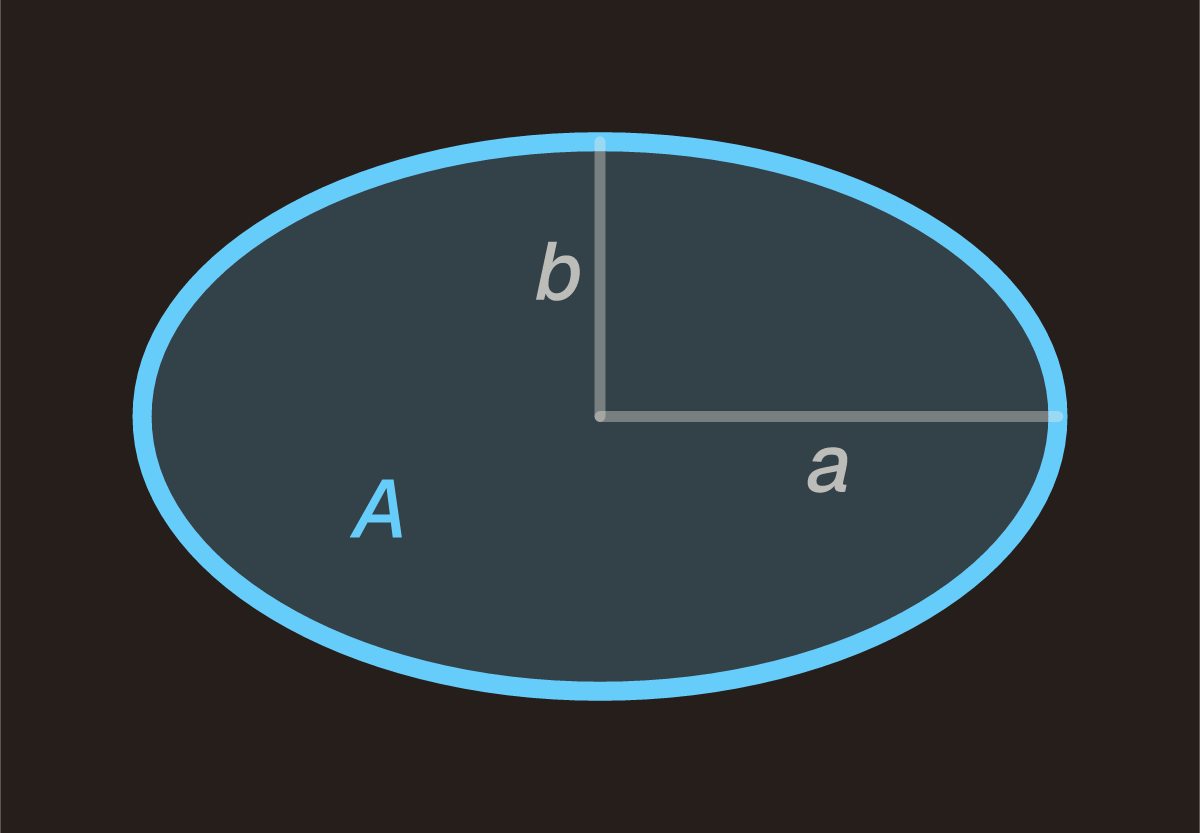
a is the semi-major axis — half the length of the ellipse — and b the semi-minor, half its width. An ellipse 10 cm long and 6 cm wide therefore has a = 5 and b = 3, and an area of 15π ≈ 47.1 cm².
It is the semi-axes in the formula, not the full ones. Put the length and the width in and the answer comes out four times too large.
Set a = b = r and the formula becomes π · r · r = πr², the area of a circle. That is a good way to check you have copied it down correctly: a formula for ellipses that does not give the circle’s area when the axes are equal is wrong.
You can also read the ellipse as a stretched circle. Pull a circle of radius b out to a/b times its width in one direction and every area is multiplied by that same factor a/b, and πb² · a/b = πab.
Forwards. An ellipse with semi-axes of 7 cm and 4 cm has an area of 7 · 4 · π = 28π ≈ 88.0 cm².
From length and width. An oval table is 180 cm long and 100 cm wide. The semi-axes are 90 cm and 50 cm, so the area is 90 · 50 · π = 4,500π ≈ 14,137 cm², about 1.41 m².
Backwards. The area is 60π cm² and one semi-axis is 10 cm. The other is 60π / (π · 10) = 6 cm — the π cancels.
What is the perimeter of an ellipse?
There is no simple exact formula. A common approximation is π · (3(a + b) − √((3a + b)(a + 3b))), due to
Ramanujan, and it is very close for every ellipse you meet in practice.
What are the foci for?
They define the ellipse: the distances from the two foci to any point on the curve always add up to the
same total. They are not needed for the area. In a planetary orbit the Sun sits at one of them.
How do I draw an ellipse without a computer?
Put a loop of string around two pins and pull it taut with a pencil. The pins are the foci, and the
length of the string sets the size.
| Solve for | Rearranged | With the numbers | Comes to |
|---|---|---|---|
| a | Aπb | 47.12π·3 | 5 cm |
| b | Aπa | 47.12π·5 | 3 cm |
| A | πab | π·5·3 | 47.12 cm² |
Last reviewed October 6, 2026 ·How pages are reviewed
Copy the code into your page where the formula card should appear. It loads from lovetocalc.com, so it stays current on its own — all we ask is that the credit line comes with it.