Perimeter of a regular polygon
The relation
P
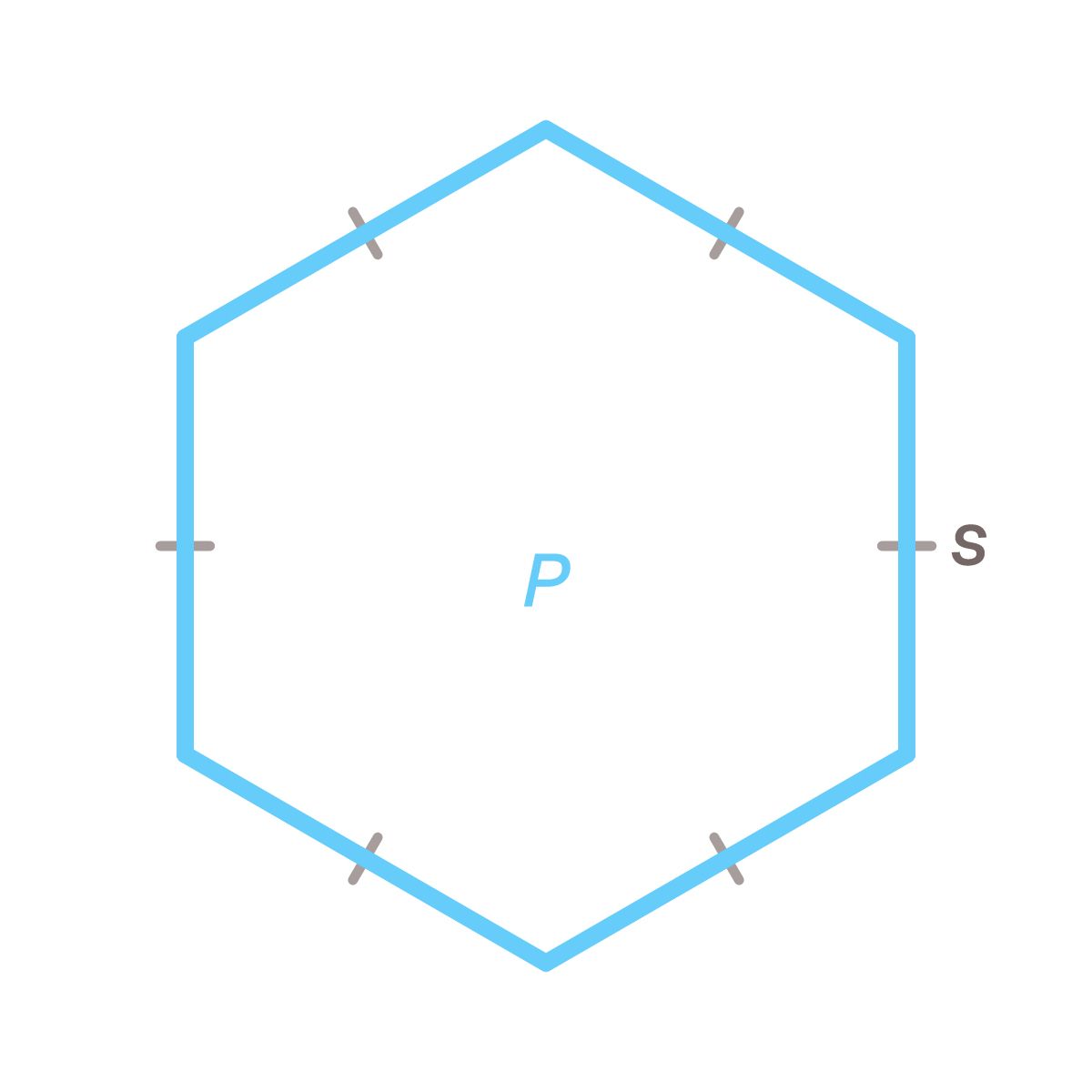
All the sides are the same length, so the way round is that length times how many.
Solve for
P=24
P equals 6 times 4, equals 24
Den här sidan finns på svenska. Byt till svenska
Definition — what does that mean?
Every side is the same length, so the way round is that length times how many. If the sides differ you add them one at a time.
In Swedish: Regelbunden månghörnings omkrets
P
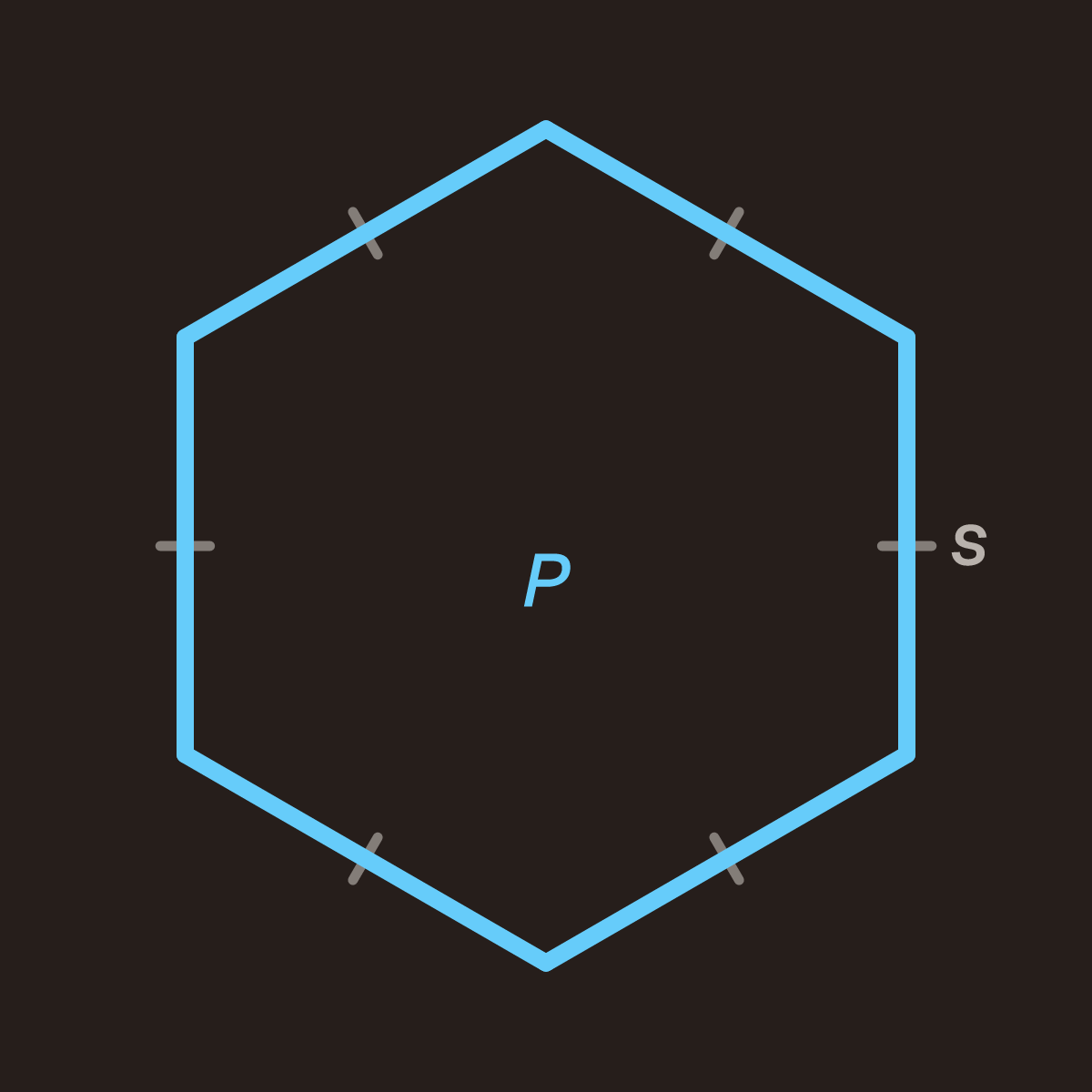
All the sides are the same length, so the way round is that length times how many.
P=24
P equals 6 times 4, equals 24
You are given
n is the number of sides and s the length of one of them. A regular hexagon with a side of 4 cm has a perimeter of 6 · 4 = 24 cm.
That sounds too simple to be a formula, but nothing more is needed: a perimeter is the sum of the sides, and when every side is the same length the sum becomes a multiplication.
Then there is no formula — only the addition. A quadrilateral with sides of 3, 5, 4 and 6 cm has a perimeter of 3 + 5 + 4 + 6 = 18 cm.
It is worth saying out loud, because a book of formulas can otherwise give the impression that every figure has one. The regular polygon does; the irregular one does not.
A regular polygon has equal sides and equal angles. A rhombus that is not a square has equal sides but not equal angles, so it is not regular — yet its perimeter is still 4s, because a perimeter depends only on the sides.
The angles do matter for the area, which needs the apothem, and for the angle sum.
Forwards. A regular octagon with a side of 7 cm: 8 · 7 = 56 cm.
Backwards, the side. An equilateral triangle has a perimeter of 33 cm. The side is 33 / 3 = 11 cm.
Backwards, the count. A regular polygon has a perimeter of 60 cm and a side of 5 cm. It has 60 / 5 = 12 sides.
A roll of fencing. You are fencing a regular pentagon with a side of 8 m. That takes 5 · 8 = 40 m of fence, plus whatever the joins eat.
What are polygons with many sides called?
Triangle and quadrilateral from Latin; pentagon, hexagon, heptagon, octagon and so on from Greek. Past
ten or so most people say “regular 12-gon” and move on.
What happens as the number of sides grows?
The figure approaches a circle. The perimeter n · s approaches the circumference of a
circle, 2πr, which is exactly how
Archimedes estimated π — by working out the perimeters of polygons with more and more sides.
Does the formula work for a star shape?
Yes, if every edge is the same length: a five-pointed star has ten edges, so the perimeter is 10s. It is
the number of edges that counts, not the number of points.
| Solve for | Rearranged | With the numbers | Comes to |
|---|---|---|---|
| n | Ps | 244 | 6 |
| s | Pn | 246 | 4 |
| P | ns | 6·4 | 24 |
Last reviewed October 6, 2026 ·How pages are reviewed
Sheets that ask this formula, with their answer keys. Open one to see the questions or print it.
Sixteen questions on the perimeter of rectangles, squares, triangles and regular polygons. Sometimes a side is asked for when the perimeter is given.
Copy the code into your page where the formula card should appear. It loads from lovetocalc.com, so it stays current on its own — all we ask is that the credit line comes with it.