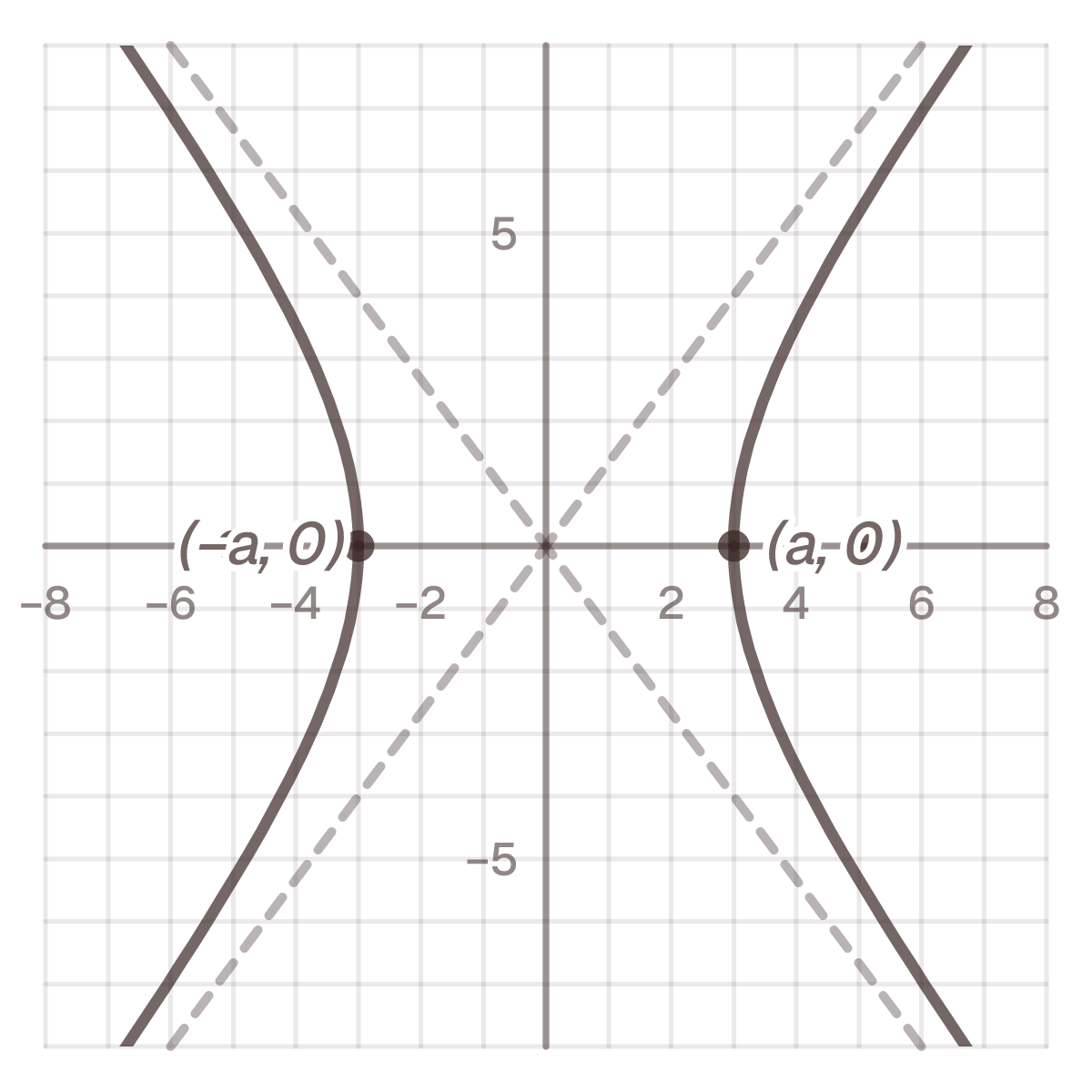
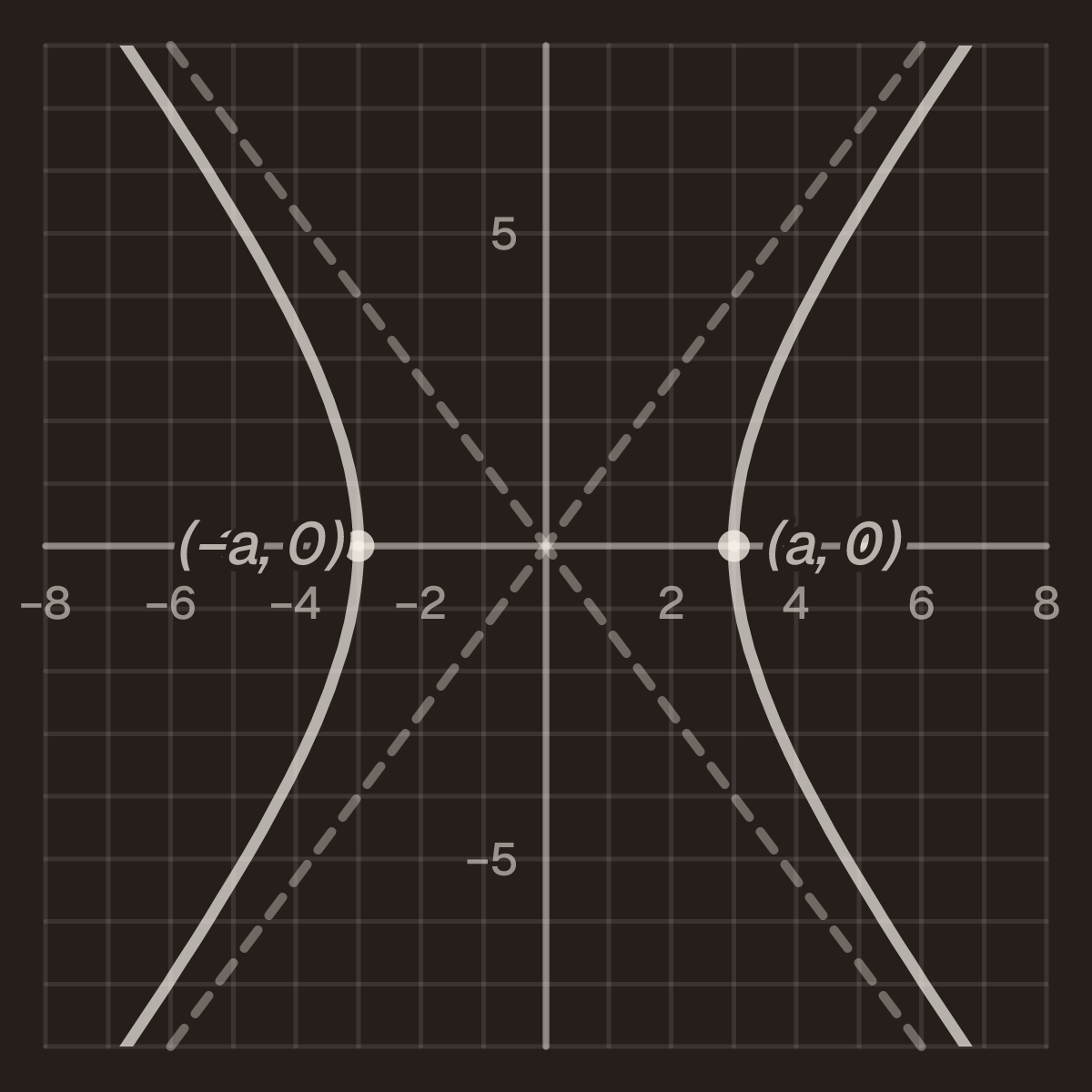
The equation
- x²/a² − y²/b² = 1
The hyperbola is centred at the origin and has two branches, one to the right and one to the left. The branches start at the vertices (±a, 0) and bend away from the y-axis. The curve does not cross the y-axis: with x = 0 the left side is −y²/b², which cannot be 1.
The hyperbola x²/9 − y²/16 = 1 has a = 3 and b = 4. The vertices are at (±3, 0). The point (5, 16/3) lies on it, because 25/9 − 16/9 = 9/9 = 1.
The asymptotes
Far out, the branches close in on two straight lines, the asymptotes:
y = ±(b/a) · x
For x²/9 − y²/16 = 1 they are y = ±(4/3)x. One way to remember them: replace the 1 by 0 in the equation, so that x²/9 = y²/16, and solve for y.
The foci: a plus, not a minus
A hyperbola is every point where the difference of the distances to two foci is 2a. The foci are at (±c, 0), where
c² = a² + b²
This is where the hyperbola differs from the ellipse, and the sign is easy to carry over from the wrong curve:
| Curve | Equation | c² | Foci |
|---|---|---|---|
| hyperbola | x²/9 − y²/16 = 1 | 9 + 16 = 25 | (±5, 0) |
| ellipse | x²/25 + y²/9 = 1 | 25 − 9 = 16 | (±4, 0) |
Check with the point (5, 16/3): its distance to (−5, 0) is √(100 + 256/9) = 34/3, and to (5, 0) it is 16/3. The difference is 18/3 = 6 = 2a.
When y² comes first
The sign decides which way the branches open. y²/16 − x²/9 = 1 opens up and down, with vertices at (0, ±4) and foci at (0, ±5). The asymptotes are y = ±(4/3)x again, because they come from the same x²/9 = y²/16.
An equation such as 16x² − 9y² = 144 is divided by 144 first: x²/9 − y²/16 = 1, the same hyperbola as above.
Common mistakes
- c² = a² − b². That is the ellipse’s. For a hyperbola it is a plus.
- The asymptotes’ slope upside down. It is b/a for x²/a² − y²/b² = 1, not a/b.
- Looking for a y-intercept. When x² comes first there is none.
- Reading the denominator as a. Under x² stands a²; the vertex is at its root.
Common questions
Is y = 1/x a hyperbola?
Yes, turned an eighth of a turn and with the axes as asymptotes. It is not in the form
x²/a² − y²/b² = 1, but turned through 45° it lands there, with a = b = √2.
How is it different from an ellipse?
The minus sign. With a plus the curve is closed, an
ellipse. With a minus it is two open
branches.
What do a and b mean, when the curve does not pass through (0, b)?
a is the distance from the centre to a vertex. b has no point on the curve, but it sets the asymptotes’
slope b/a and, together with a, the foci.