Pick the unit your lengths are in. Areas are then labelled in square units and volumes in cubic units; nothing is converted.
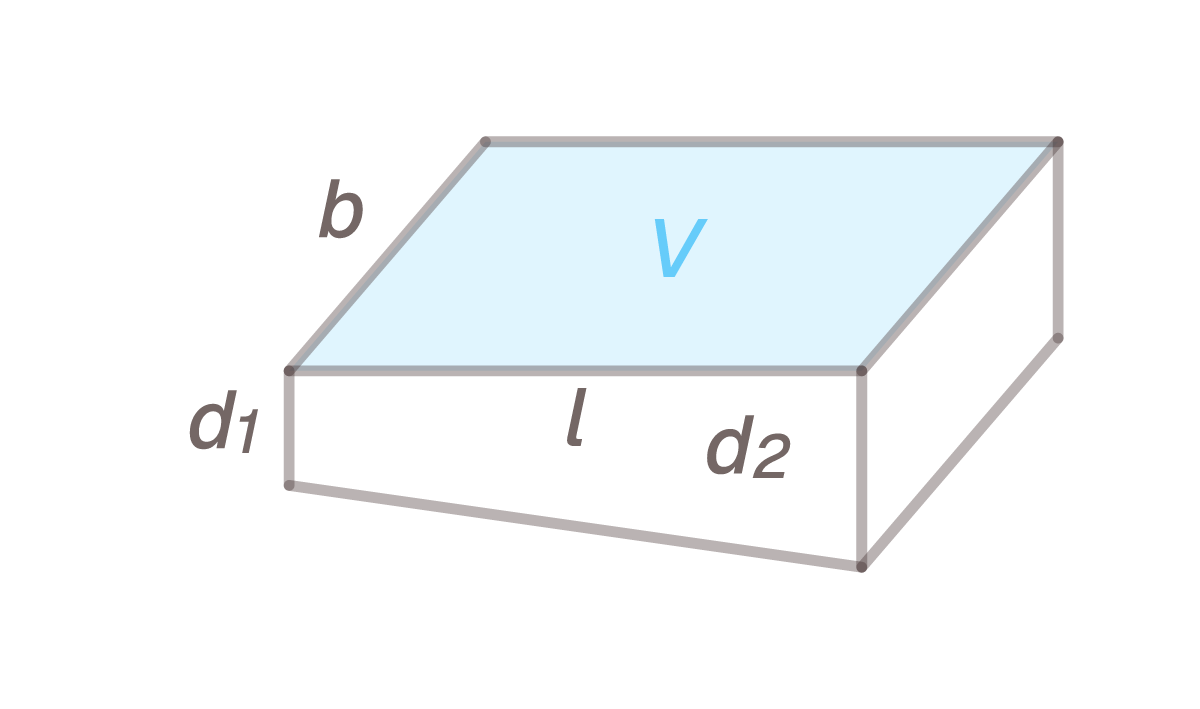
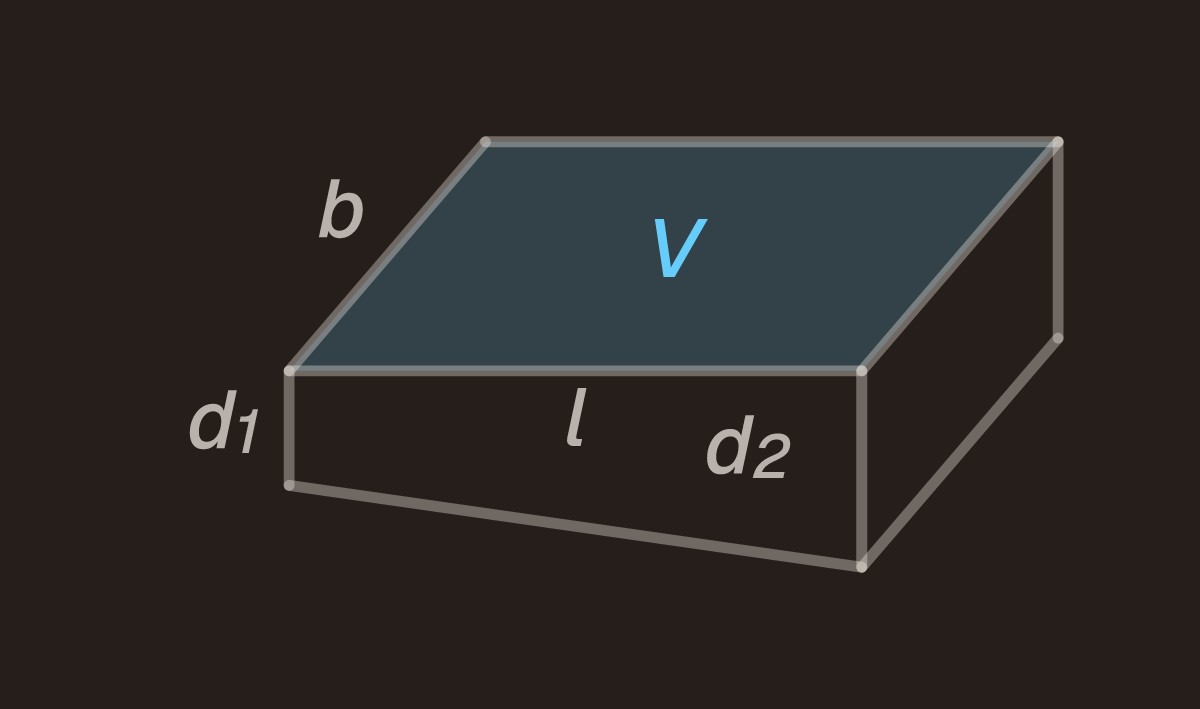
A pool with a flat bottom is a box, and its volume is length times width times depth. When the bottom
slopes you use the mean depth instead: the depth at the shallow end plus the depth at the deep end,
divided by two.
A pool of 8 × 4 m that is 1.2 m deep at one end and 1.8 m at the other holds
8 · 4 · 1.5 = 48 m³, that is 48,000 litres.
Why the mean depth is enough
Seen from the side the pool is a trapezoid: two parallel sides, d₁ and d₂, with the length between them.
A trapezoid’s area is the mean of the parallel sides times the height — and the pool is that trapezoid,
pulled out to its width.
So a sloping bottom holds exactly as much as a flat bottom at the average depth. That holds as long as
the slope is even all the way; if the pool has a flat section and steps, work out each part and add.
Other shapes
A round pool is a cylinder: π times the radius squared, times the depth. An oval is a rectangle plus two
half circles, or an ellipse.
Never measure the outside of the pool. It is the water you are measuring, so use the inside
dimensions — and the top is the water line, not the coping.
Worked examples
Small pool. 6 × 3 m, 1.0 and 1.6 m deep: 6 · 3 · 1.3 = 23.4 m³ = 23,400 litres.
Flat bottom. 4 × 2 m, 1.2 m throughout: 4 · 2 · 1.2 = 9.6 m³.
Round pool. Radius 1.8 m, depth 1.1 m: π · 1.8² · 1.1 ≈ 11.2 m³.
Backwards. 30 m³ in a pool of 8 × 3 m means a mean depth of 30 / (8 · 3) = 1.25 m.
Common mistakes
- Using the deepest depth. It gives too much water, and therefore too much chemical.
- Measuring the outside. Use the inside dimensions — it is the volume of water that counts.
- Forgetting that a cubic metre is a thousand litres. Dosing instructions are usually per cubic
metre or per ten thousand litres.
- Counting steps as part of the bottom. Steps displace water. Work them out separately and subtract.
Common questions
How many litres is a cubic metre?
A thousand. A 48 m³ pool holds 48,000 litres, and that is the figure dosing instructions work from.
How do I work out a round pool?
As a cylinder: π times the radius squared, times the depth. The mean depth works there too if the
bottom slopes.
Do I measure to the water line or the coping?
The water line. A pool is rarely filled to the brim, and the difference is several hundred litres in
an ordinary pool.