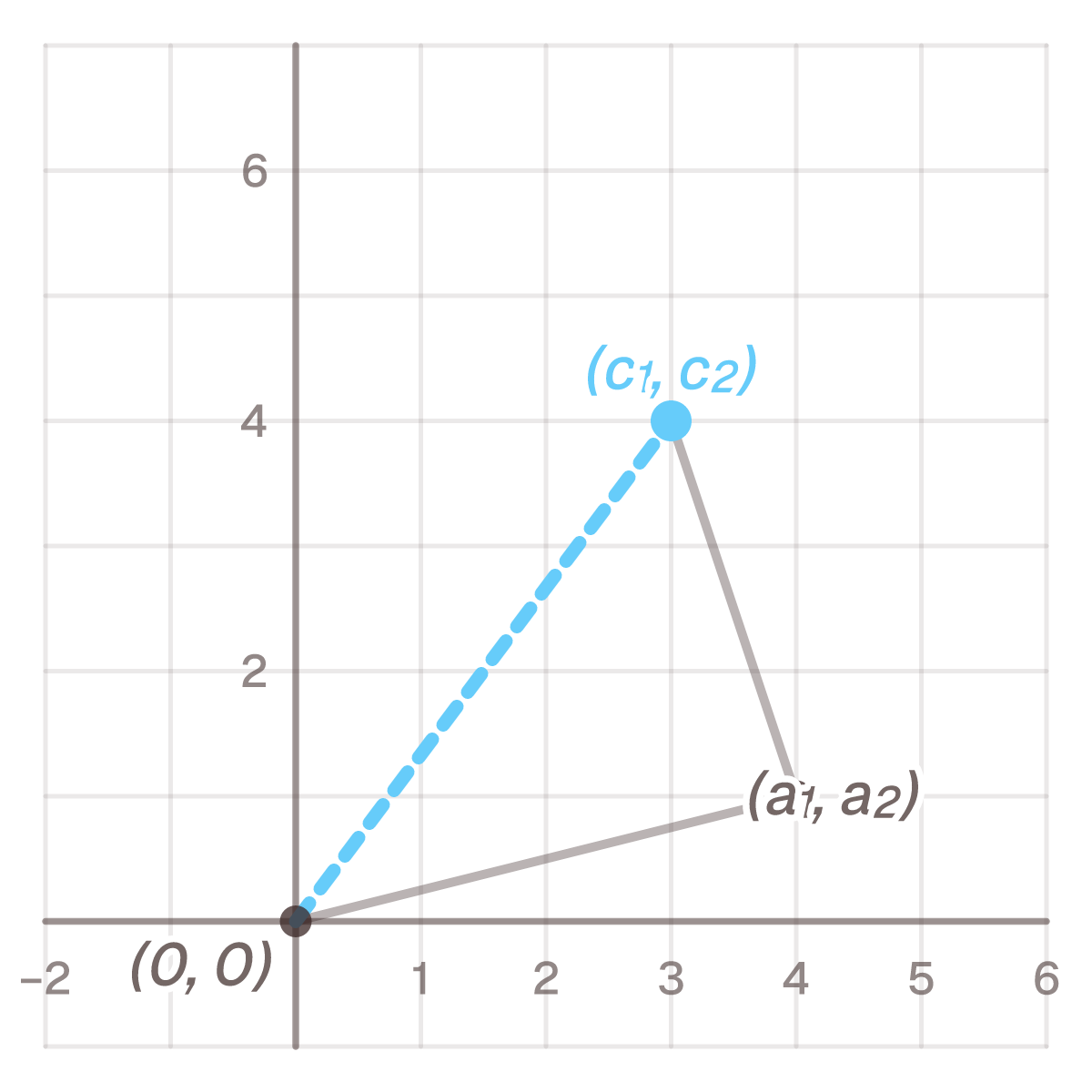
- a + b = (a₁ + b₁, a₂ + b₂)
- (c₁, c₂) = (a₁, a₂) + (b₁, b₂)
For a = (a₁, a₂) and b = (b₁, b₂), add the first coordinates together and the second coordinates
together. On the card above, the sum’s coordinates are called c₁ and c₂.
With a = (4, 1) and b = (−1, 3):
a + b = (4 + (−1), 1 + 3) = (3, 4)
Subtraction
a − b is a + (−b), and −b is b with both signs changed:
a − b = (a₁ − b₁, a₂ − b₂)
With the vectors above, a − b = (4 − (−1), 1 − 3) = (5, −2).
Subtraction is also how the card works backwards. When the sum and one of the vectors are known, the
other is a difference: a = (c₁ − b₁, c₂ − b₂).
The vector between two points
The vector from point A to point B is B − A, coordinate by coordinate. From A = (1, 2) to B = (5, −1)
it is (5 − 1, −1 − 2) = (4, −3). Its length comes from the
magnitude of a vector: √(4² + 3²) = 5.
The triangle rule
Draw a from the origin and b on from the tip of a. The arrow from the origin to where b ends is a + b,
which is what the figure shows. The order does not matter: a + b = b + a, because a₁ + b₁ = b₁ + a₁
and a₂ + b₂ = b₂ + a₂. Drawing both orders gives a parallelogram with the sum as its diagonal.
In space
A vector in space has a third coordinate, and it is added the same way:
(1, −2, 4) + (3, 5, −1) = (4, 3, 3)
Common mistakes
- Losing a minus sign. 4 + (−1) is 3, not 5. Write a negative coordinate in brackets.
- Adding the lengths. |a + b| equals |a| + |b| only when the vectors point the same way. Here
|a + b| = 5, while |a| + |b| = √17 + √10 ≈ 7.3.
- Pairing the wrong coordinates. First goes with first and second with second.
- The wrong order in a subtraction. The vector from A to B is B − A, not A − B.
Common questions
Can a vector and a number be added?
No. The sum is defined for two vectors with the same number of coordinates. A number can be
multiplied by a vector instead; see
scalar multiplication of a vector.
What is the zero vector?
(0, 0), the vector with no length. Adding it changes nothing: a + (0, 0) = a. Every vector has an
opposite that adds up to it: a + (−a) = (0, 0).
Where is vector addition used in physics?
Forces, velocities and displacements add as vectors. Two forces on the same object have a resultant
that is their vector sum, worked out coordinate by coordinate.