Pick the unit your lengths are in. Areas are then labelled in square units and volumes in cubic units; nothing is converted.
An equilateral triangle has three equal sides and three 60° angles, so a single measurement fixes the
whole figure — and with it the area. A triangle with a side of 6 cm has an area of
36 · 1.732 / 4 ≈ 15.6 cm².
The ordinary area formula A = b · h / 2 still
holds, of course, but it needs the height. The formula here has the height built in.
Where the square root of three comes from
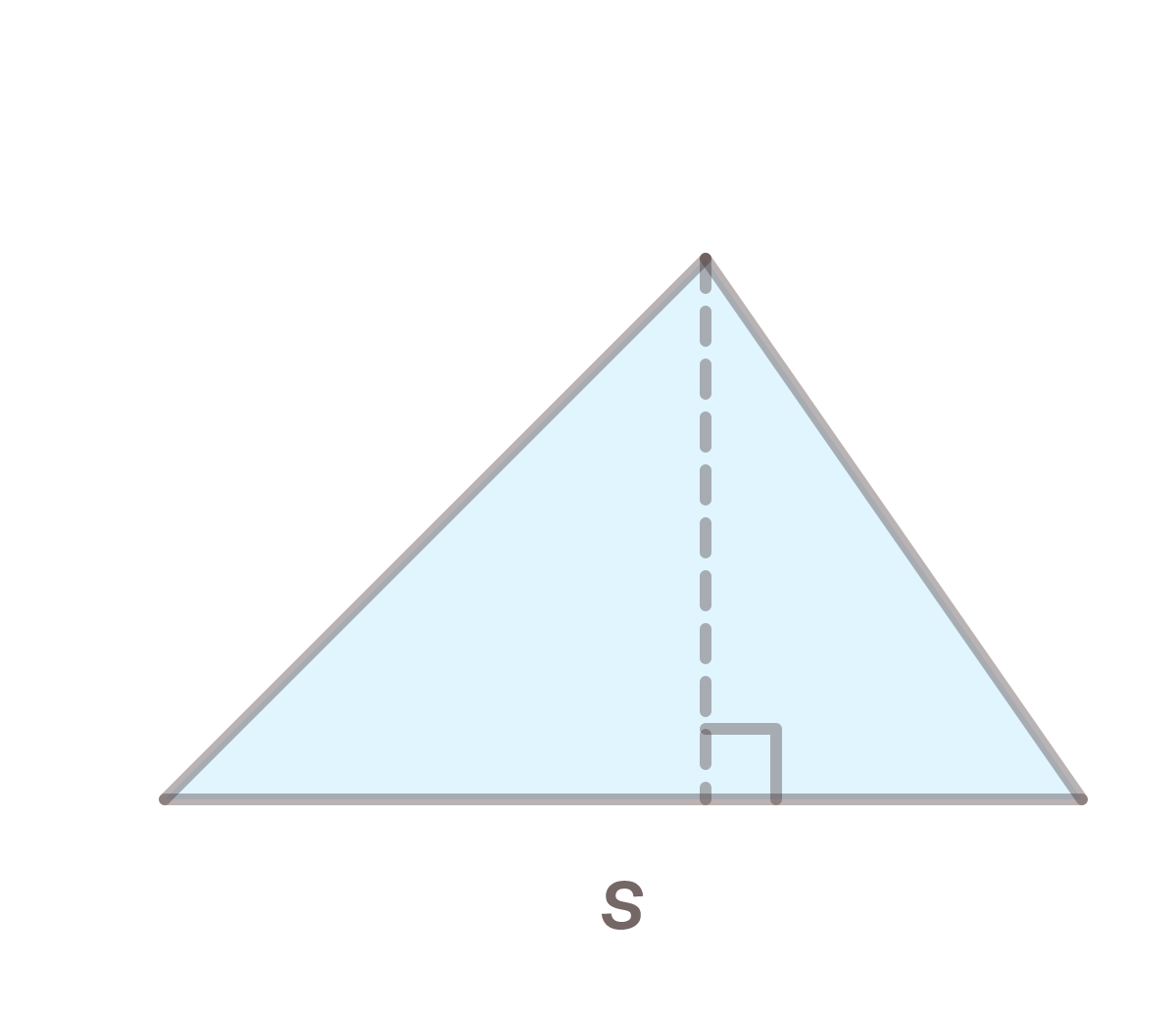
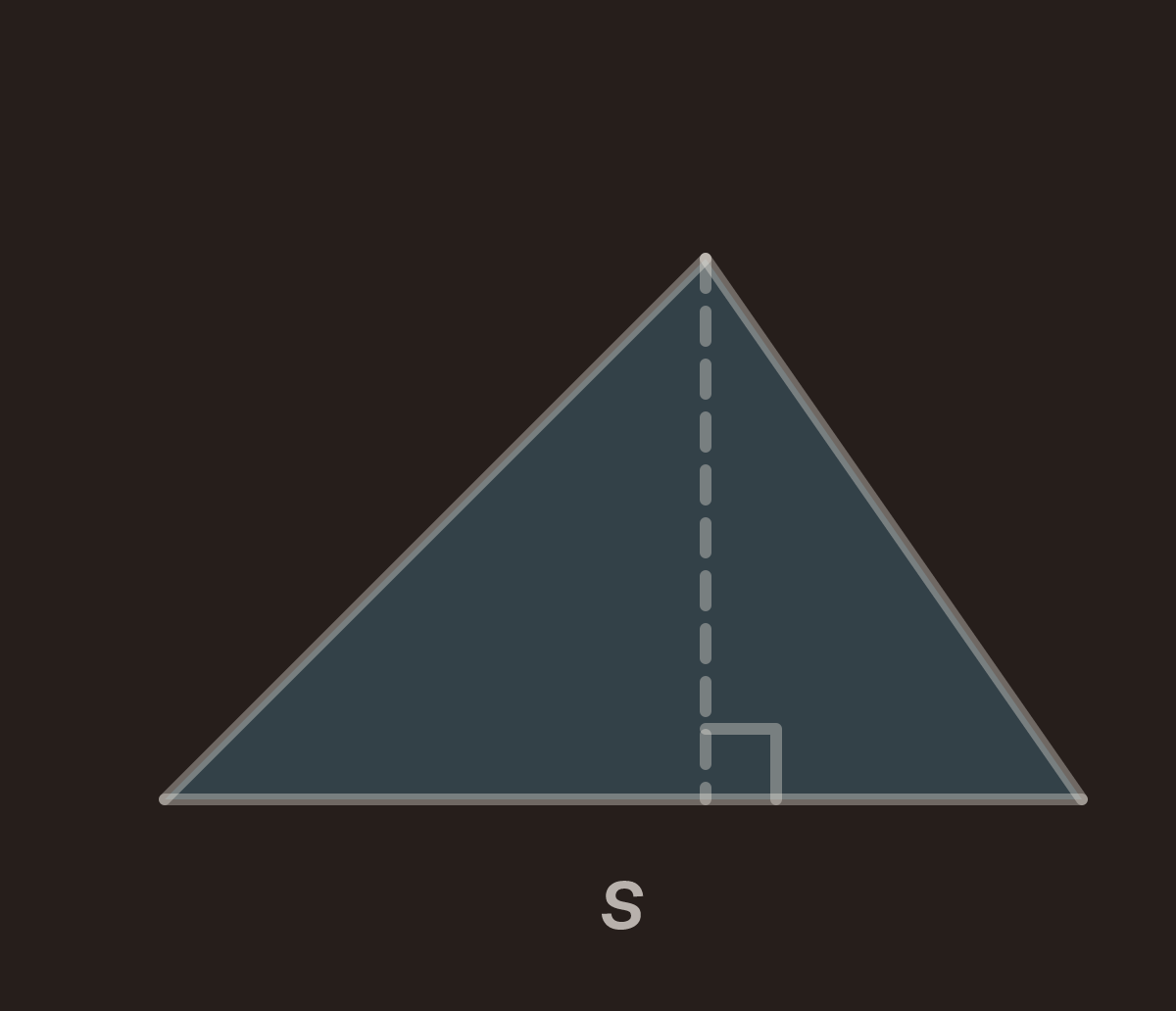
The height splits an equilateral triangle into two 30-60-90 triangles.
The base of such a half is s/2 and the hypotenuse is s, so the
Pythagorean theorem gives the height:
- h² = s² − (s/2)² = s² − s²/4 = 3s²/4
- h = s · √3 / 2 ≈ 0.866 · s
Put that into A = s · h / 2 and you get s² · √3 / 4. The height is always about 87% of the side, which
is worth remembering on its own.
The decimals never end
√3 is irrational, 1.7320508…, and cannot be written as a fraction or a terminating decimal. The area of
an equilateral triangle with a whole side is therefore never a whole number of square centimetres — it
comes out as 15.588457… and gets rounded. Write the exact answer as 9√3 cm² when the question asks
for exact form, and round only when you are about to measure something.
Worked examples
Side 4 cm. A = 16 · √3 / 4 = 4√3 ≈ 6.9 cm².
Side 10 m. A = 100 · √3 / 4 = 25√3 ≈ 43.3 m².
Through the height. A side of 8 dm gives h = 8 · 0.866 = 6.93 dm, and A = 8 · 6.93 / 2 ≈ 27.7 dm²
— the same answer as 64√3/4.
Backwards. An equilateral triangle has an area of 50 cm². Then s² = 4 · 50 / √3 ≈ 115.5 and
s ≈ 10.7 cm.
Common mistakes
- Using the side as the height. The height is 0.866 · s, not s. A = s²/2 gives an answer 15% too
large.
- Forgetting to square. It is s² that is multiplied by √3/4, not s.
- Rounding √3 to 1.7. That is an error of almost two per cent. Use 1.732, or the root key.
- Assuming it works for any triangle. It holds only when all three sides are equal. For the general
case there is Heron’s formula.
Common questions
How do I find the perimeter?
The perimeter is 3s, three equal sides. An equilateral triangle with a side of 6 cm has a perimeter of
18 cm.
What is the height of an equilateral triangle?
h = s · √3 / 2, about 0.866 times the side. It is the same √3 as in the area formula, which is no
coincidence — the area is s · h / 2.
Can I go backwards from the area to the side?
Yes: s = √(4A/√3). The card solves that direction too, though the answer is almost always a decimal.