Pick the unit your lengths are in. Areas are then labelled in square units and volumes in cubic units; nothing is converted.
What the theorem says
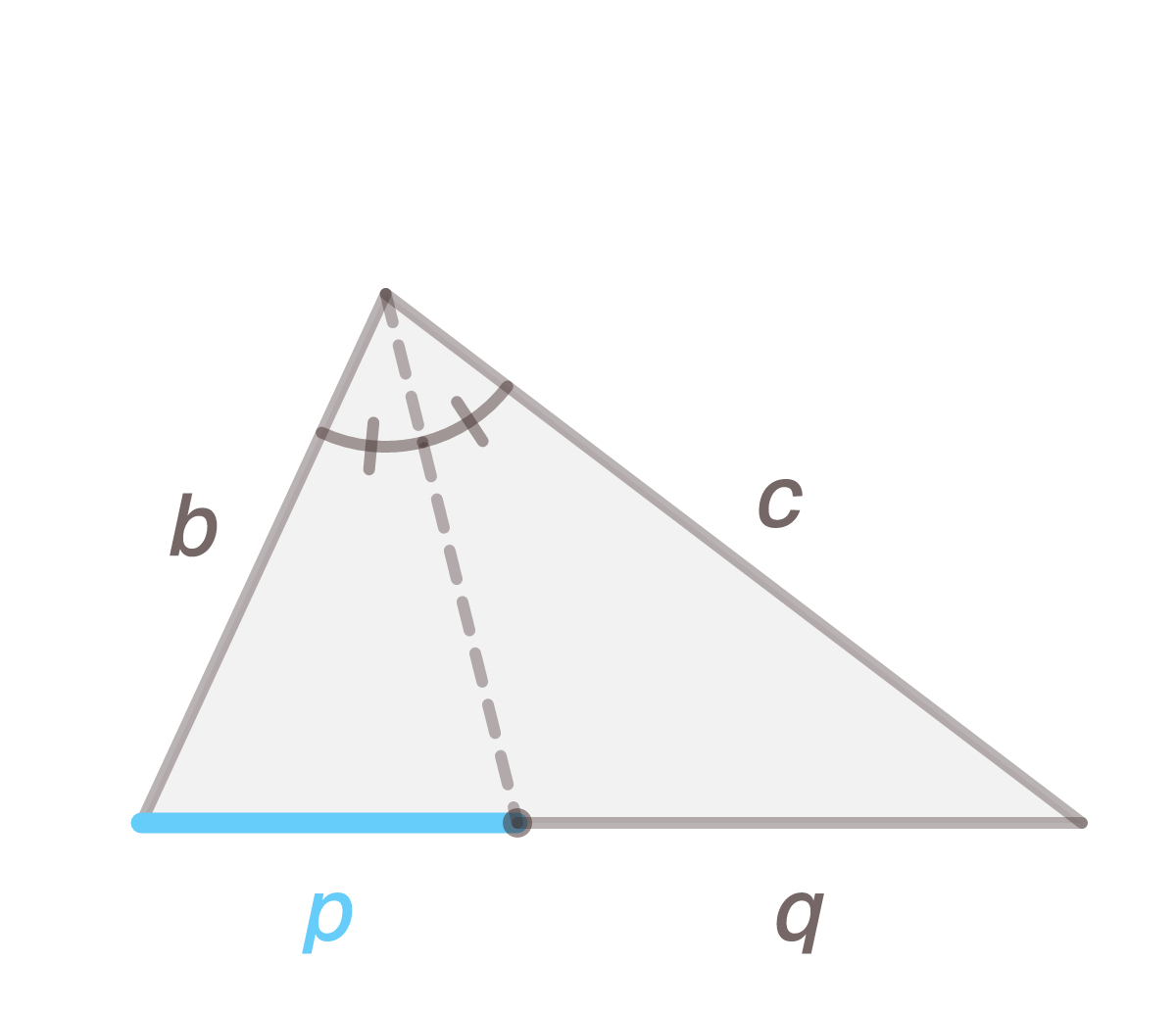
Draw the bisector from a vertex — the line that cuts the angle there in half — and it meets the opposite
side at a point. That point divides the side into two segments p and q, and they stand in the same ratio
as the two sides b and c meeting at the vertex.
With sides of 6 cm and 8 cm and one segment of 4 cm, the other is 4 · 6 / 8 = 3 cm. The
bisector leans towards the shorter side.
Why it holds
The short proof goes through areas. The bisector splits the triangle into two pieces, and the point where
it meets the base lies as far from side b as from side c. The two pieces therefore have equal heights
against those sides, so their areas are in the ratio b : c. Those same two pieces also share the
original triangle’s height, so their areas are in the ratio p : q. Two expressions for one quotient give
p/q = b/c.
There is a similarity proof as well, but it needs
an auxiliary line drawn parallel to the bisector.
How to use it
The theorem ties four lengths together, so three known give the fourth. A common case is knowing both
sides and the whole base and wanting to know where the bisector lands:
- Call the parts of the base p and q, with p + q = the whole base.
- Set p/q = b/c.
- Solve. With b : c = 3 : 5 and a base of 24, the parts are 9 and 15.
So the bisector does not meet the middle of the base, except when the triangle is isosceles.
Worked examples
The missing segment. q = 6, b = 10, c = 12 gives p = 6 · 10 / 12 = 5.
The missing side. p = 6, q = 4, c = 10 gives b = 10 · 6 / 4 = 15.
Isosceles. b = c means p = q — the bisector from the apex meets the midpoint of the base. In that
case it is the same line as the height and the median.
Check. 3/4 = 0.75 and 6/8 = 0.75 — it holds.
Common mistakes
- Pairing the wrong segment with the wrong side. The segment nearest a vertex belongs to the side
through that vertex, not to the one opposite.
- Thinking the bisector halves the side. It does that only when the two sides are equal.
- Confusing bisector, median and height. The bisector halves the angle, the median hits the midpoint,
the height stands perpendicular.
- Applying it to the external bisector unchanged. The external bisector divides the extension of the
side, not the side itself.
Common questions
What is a bisector?
The line that divides an angle into two equal parts. A triangle’s three bisectors meet at one point,
the centre of the inscribed circle.
How long is the bisector itself?
That needs a formula of its own, which is not the card on this page. This theorem is about where the
bisector lands, not about how long it is.
Does it hold in every triangle?
Yes, in any triangle and from any vertex. No angle or side length is an exception.