Pick the unit your lengths are in. Areas are then labelled in square units and volumes in cubic units; nothing is converted.
The theorem
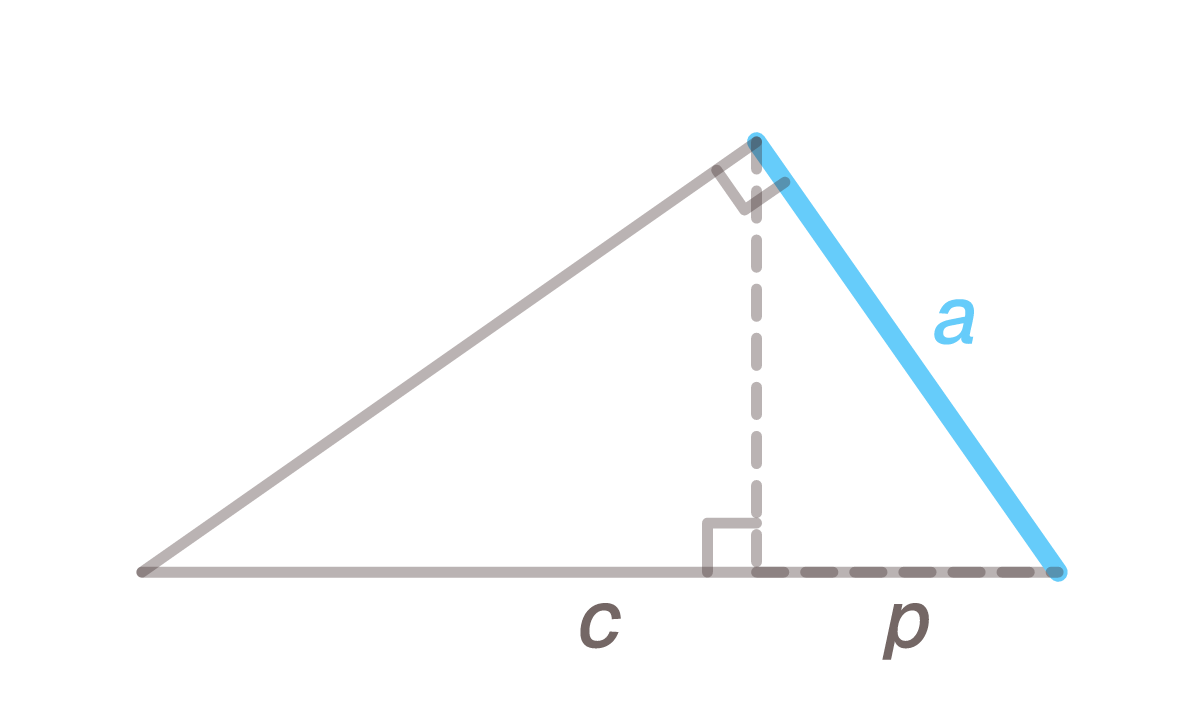
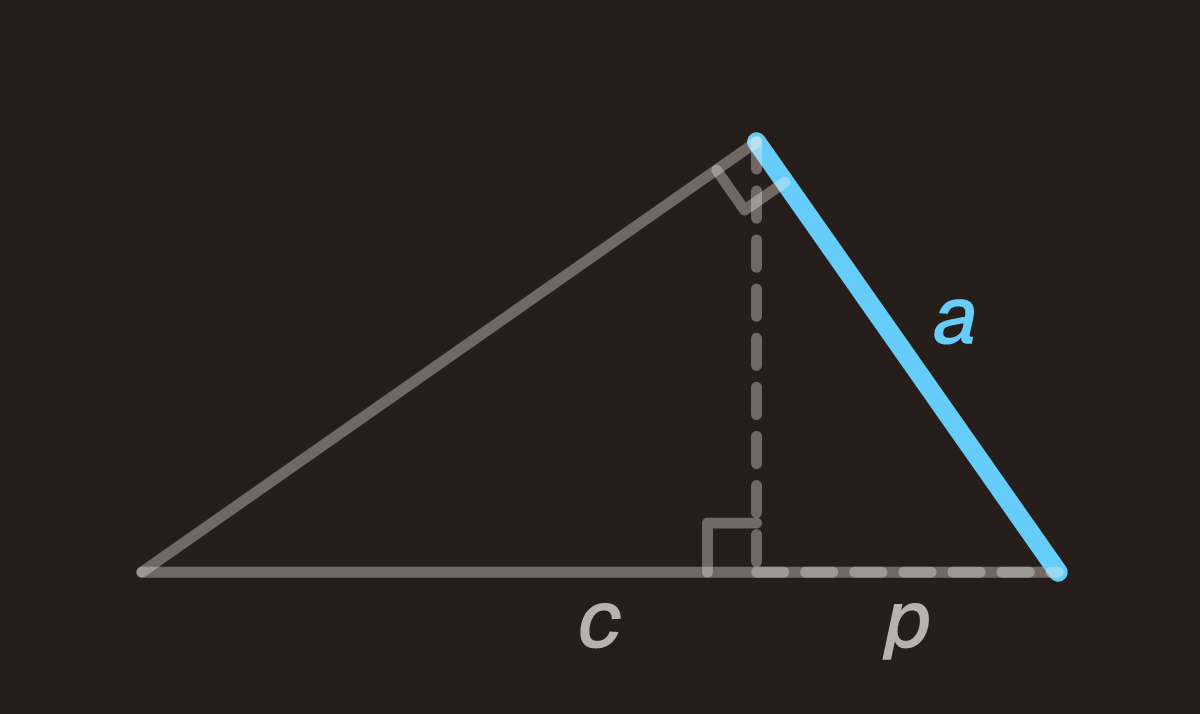
Draw the altitude from the right angle down to the hypotenuse c. It cuts the hypotenuse into two pieces.
The piece p is the one next to the leg a, directly under it, and the leg theorem says that a² = pc. The
other leg works the same way with the other piece: b² = qc. The theorem is also called Euclid’s theorem
or the cathetus theorem, after the old word for a leg.
Holds when the triangle is right-angled and p is the piece of the hypotenuse that the altitude from the
right angle cuts off next to the leg a.
The hypotenuse is 25 cm and the piece under the leg is 4 cm. Then
a² = 4 · 25 = 100, so a = 10 cm.
The right piece for the right leg
The hypotenuse has two pieces, and the one that goes with the leg a is the one next to a. Take the other
piece, 25 − 4 = 21 cm, and you get the other leg:
| Substituted |
Result |
| 4 · 25, the piece next to a |
a = 10 cm |
| 21 · 25, the piece next to b |
√525 ≈ 22.9 cm, which is b |
Both numbers are legs of the same triangle, so the answer does not give the mistake away. The leg and its
piece meet at the same end of the hypotenuse: follow the leg down to the hypotenuse, and the piece starts
there.
The hypotenuse from a leg and a piece
The leg is 6 cm and the piece under it is 4 cm. Then 36 = 4 · c, so c = 9 cm, and the other piece is
9 − 4 = 5 cm.
The piece has to be shorter than the leg. If it were as long or longer, c = a²/p would come out shorter
than the leg, and the hypotenuse is the longest side.
A proof of the Pythagorean theorem
The leg theorem for both legs gives a² = pc and b² = qc. Add them:
a² + b² = pc + qc = (p + q)c = c · c = c²
That is the Pythagorean theorem. The leg theorem
itself is proved with similar triangles: the small
triangle next to a and the whole triangle have the same angles, so a / c = p / a, and cross-multiplying
gives a² = pc.
The leg theorem and the geometric mean theorem
The same figure gives the geometric mean theorem,
h² = pq. With both theorems and two known measurements you can work out the whole triangle: p = 4 and
c = 25 give q = 21, a = 10, b = √525 ≈ 22.9 and h = √(4 · 21) ≈ 9.2.
Common mistakes
- The wrong piece. The piece that goes with a lies next to a, not opposite it.
- Using a piece instead of the whole hypotenuse. It is p times the whole of c, not p times q.
- Forgetting the root. pc is a², not a.
Common questions
What are p and q?
The two pieces the altitude from the right angle cuts the hypotenuse into. p lies next to the leg a and
q next to the leg b, so p + q = c.
Does it hold in a triangle that is not right-angled?
No. The proof rests on the small triangle and the whole triangle having the same angles, and that needs
the right angle.