What the theorem says
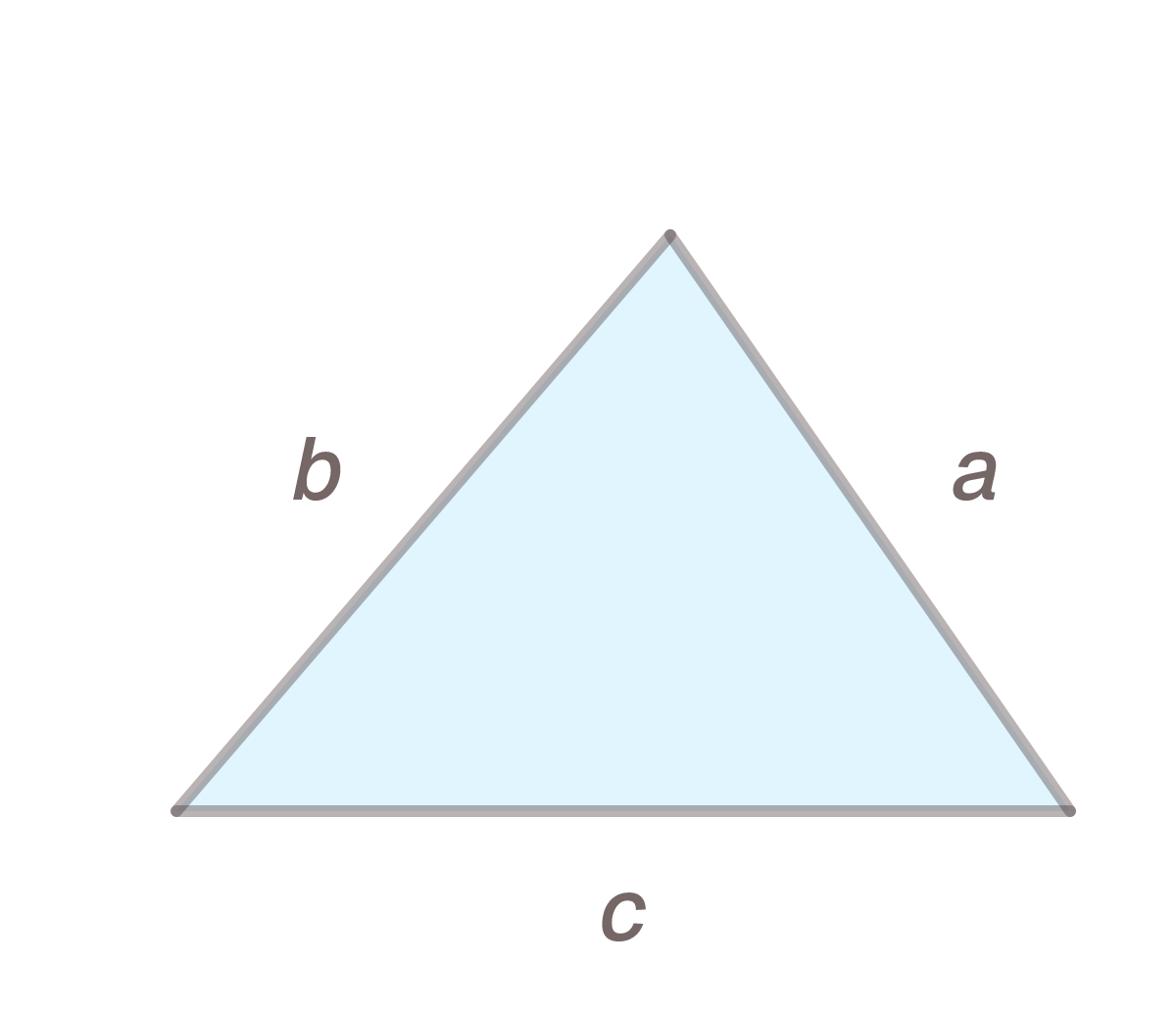
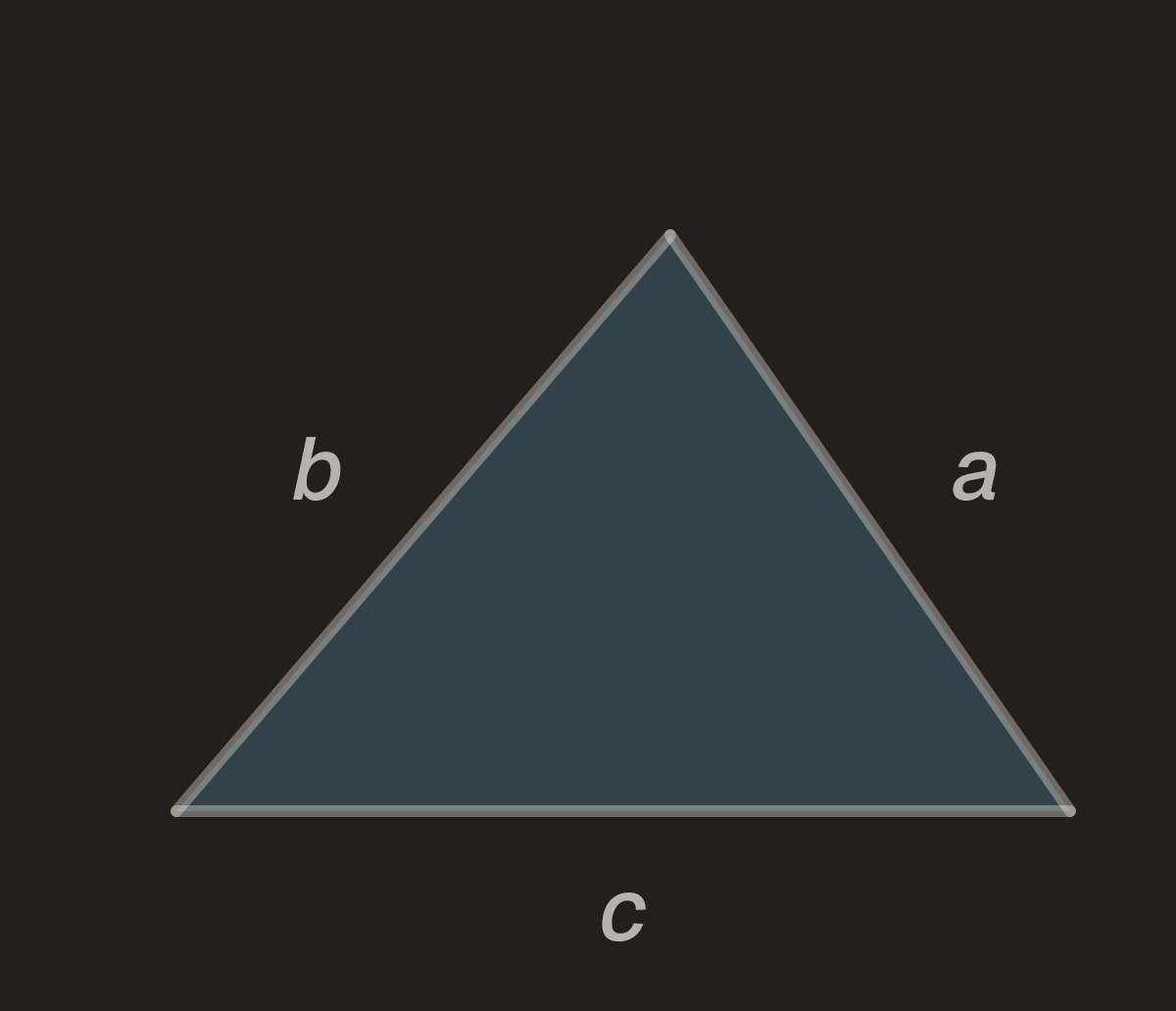
- A = √(p(p − a)(p − b)(p − c)), where p = (a + b + c) / 2
Half the perimeter p is called the triangle’s semiperimeter. Subtract each side from it in turn, multiply the three differences by p itself, take the square root — and there is the area, without ever having measured a height.
For a triangle with sides 3, 4 and 5, p = 6 and the area is √(6 · 3 · 2 · 1) = √36 = 6. That checks out: the triangle is right-angled and 3 · 4 / 2 = 6.
Step by step
Sides 7, 8 and 9:
- Half the perimeter. p = (7 + 8 + 9) / 2 = 12.
- The differences. 12 − 7 = 5, 12 − 8 = 4, 12 − 9 = 3.
- The product. 12 · 5 · 4 · 3 = 720.
- The root. √720 ≈ 26.83 square units.
The order of the sides makes no difference — the product is the same however you shuffle them.
Why there is no card for the sides
The computation runs one way only. Three sides give an area, but an area and two sides generally fit two different triangles, one where the angle between the two sides is acute and one where it is obtuse. A card solving backwards would have to pick one of them and say nothing about the other, and this collection does not do that. So the page states the formula and works the examples by hand.
If you have two sides and the angle between them, the sine area rule is easier, and with a base and a height the ordinary area formula is easiest of all.
Worked examples
Equilateral. Sides 6, 6, 6 give p = 9 and A = √(9 · 3 · 3 · 3) = √243 ≈ 15.59 — the same answer as s²√3/4.
Isosceles. 5, 5, 8 gives p = 9 and A = √(9 · 4 · 4 · 1) = 12.
The plot. A triangular plot measures 40 m, 55 m and 70 m. p = 82.5 and A = √(82.5 · 42.5 · 27.5 · 12.5) ≈ 1,098 m².
An impossible triangle. 2, 3 and 9 give p = 7 and a negative factor 7 − 9 = −2. The product goes negative and the root is undefined, because the triangle does not exist.
Common mistakes
- Forgetting to halve the perimeter. p is half the perimeter. Using the whole one makes the answer far too large.
- Subtracting the sides from each other. Each factor is p minus a side, not one side minus another.
- Rounding p too early. Half the perimeter often ends in .5; carry it through the whole calculation.
- Using the formula on three lengths that are not a triangle. Any two sides have to be longer than the third.
Common questions
Who was Heron?
Heron of Alexandria, an engineer and mathematician of the first century AD. The formula appears in his
Metrica, though it was probably known to Archimedes already.
Does it work for obtuse triangles?
Yes, for every triangle that exists. The formula uses only the sides, not the angles.
Can I work backwards to a side?
Not unambiguously. A given area and two sides usually fit two different triangles, so the answer would
be a guess. Use the law of cosines if you have
an angle as well.