Pick the unit your lengths are in. Areas are then labelled in square units and volumes in cubic units; nothing is converted.
The theorem
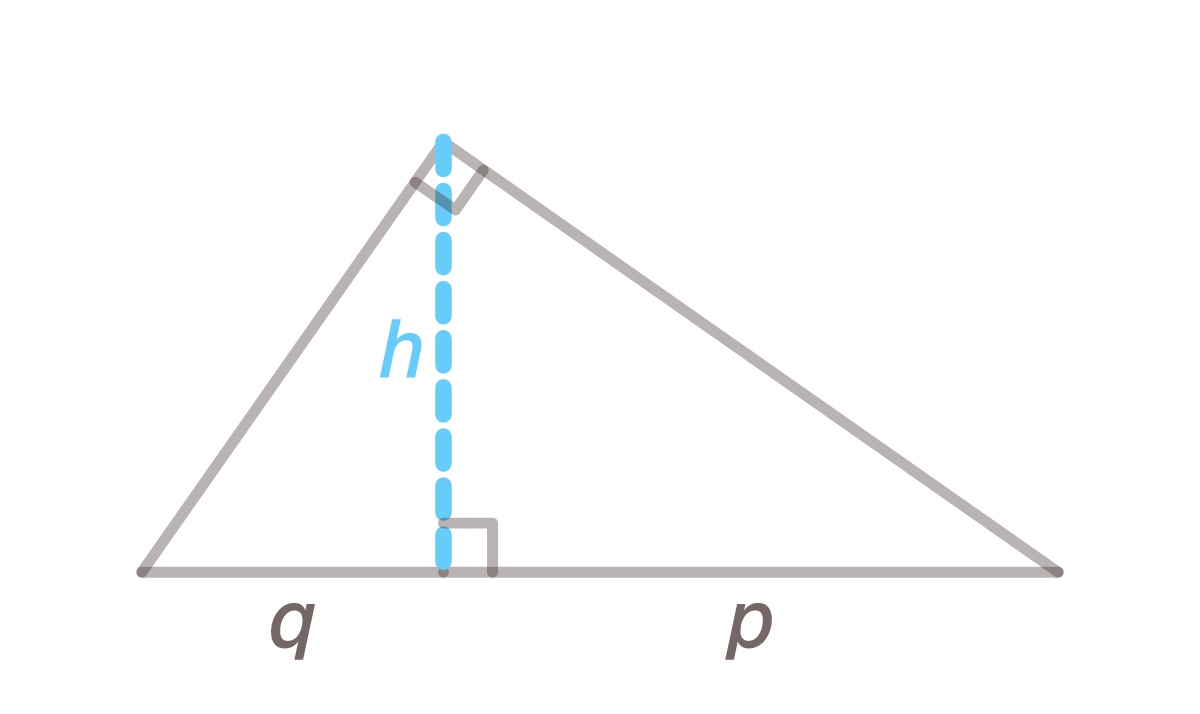
Draw the altitude from the right angle down to the hypotenuse. It cuts the hypotenuse into two pieces, p
and q, and the altitude h satisfies h² = pq.
Holds when the triangle is right-angled and h is the altitude to the hypotenuse, from the corner with the
right angle.
The altitude cuts the hypotenuse into pieces of 4 cm and 9 cm. Then
h² = 4 · 9 = 36, so h = 6 cm.
p and q are pieces of the hypotenuse
The easy mistake is to substitute a leg for one of the pieces. With the leg a = √52 ≈ 7.2 cm in the same
triangle:
| Substituted |
h |
| 4 · 9, the two pieces of the hypotenuse |
6 cm |
| 7.2 · 9, a leg and a piece |
≈ 8.0 cm |
The answer looks plausible but is longer than the leg itself, which the altitude of a right triangle
cannot be. Mark in the figure where the altitude meets the hypotenuse before substituting anything.
When the altitude is known
The altitude is 6 cm and one piece is 3 cm. Then 36 = 3 · q, so q = 12 cm, and the whole hypotenuse is
3 + 12 = 15 cm.
The pieces can be as unequal as you like. The closer the right angle sits to one end of the hypotenuse,
the shorter that piece and the longer the other, and in every position the product pq is the altitude
squared.
Why the theorem holds
The altitude splits the triangle into two smaller right triangles. Both have the same angles as the large
one, so they are similar to each other. One has
the legs q and h, the other h and p, and corresponding sides are in the same ratio:
h / q = p / h
Cross-multiply and you get h² = pq.
The geometric mean theorem and the leg theorem
The same figure gives the leg theorem, a² = pc, and
together with the Pythagorean theorem the three
form a system: two measurements are enough to work out the rest of the triangle.
| Known |
Work out |
| p and q |
h = √(pq), c = p + q |
| h and p |
q = h²/p |
| p and c |
a = √(pc), with the leg theorem |
Common mistakes
- A leg instead of a piece. p and q lie on the hypotenuse.
- Forgetting the root. pq is h², not h.
- The wrong altitude. The theorem is about the altitude from the right angle. The two legs are also
altitudes of the triangle, but not this one.
Common questions
Why is h called the geometric mean of p and q?
Because h = √(pq), which is the definition of the geometric mean of two numbers. The theorem therefore
lets you construct √(pq) with compass and straightedge: draw a semicircle on a segment p + q and raise a
perpendicular at the join.
Does it hold in a triangle that is not right-angled?
No. The proof rests on the two small triangles having the same angles as the large one, and that needs
the right angle.