The principle
Stand two solids on the same plane. If they are the same height, and every plane parallel to the base cuts them in cross-sections of the same area, then they have the same volume.
Holds when both conditions hold: the same height, and the same cross-sectional area at every height. The shape of the cross-sections does not matter, only their area.
Think of a stack of coins. Straight or slanted, they are the same coins and the stack has the same volume. Each coin is a cross-section, and sliding them sideways does not change their area.
The slanted cylinder
An upright cylinder and a slanted one both have radius 3 cm and height 10 cm. Every horizontal cut is a circle of radius 3, so the principle gives the same volume:
V = π · 3² · 10 = 90π ≈ 283 cm³
The thing that is easy to get wrong is the height. The slanted cylinder’s side is longer than 10 cm, but the vertical height is what counts:
| Height used | Volume |
|---|---|
| the vertical height, 10 cm | 90π ≈ 283 cm³ |
| the length of the side, 12 cm | 108π ≈ 339 cm³ |
The same goes for a slanted prism: the volume of a prism is the base area times the vertical height, however far it leans.
Pyramids with the apex anywhere
Two pyramids with the same base area and the same height have the same volume, even if one has its apex straight above the middle of the base and the other far off to the side. At every height the cross-section is a scaled-down copy of the base, scaled down by the same amount in both. That is why the volume of a pyramid, V = Bh/3, holds for every pyramid.
The volume of a sphere
Archimedes compared a hemisphere of radius r with a cylinder of the same radius and height, with a cone, point down, taken out of it. At height t above the base the cross-section is:
- in the hemisphere, a circle of radius √(r² − t²), with area π(r² − t²)
- in the cylinder without the cone, a ring between the radii r and t, with area πr² − πt²
The areas are equal at every height, so the volumes are equal: πr³ − πr³/3 = 2πr³/3. A whole sphere has twice that, 4πr³/3, which is the volume of a sphere.
Common mistakes
- The slanted length instead of the height. Height is measured vertically.
- Equal area at one height is not enough. The cross-sections have to match at every height.
- Thinking the shape has to match. A circle and a square with the same area count as equal.
Common questions
Who was Cavalieri?
Bonaventura Cavalieri, an Italian mathematician who stated the principle in the 17th century. Archimedes
had used the same idea almost two thousand years earlier.
Does the principle work for areas too?
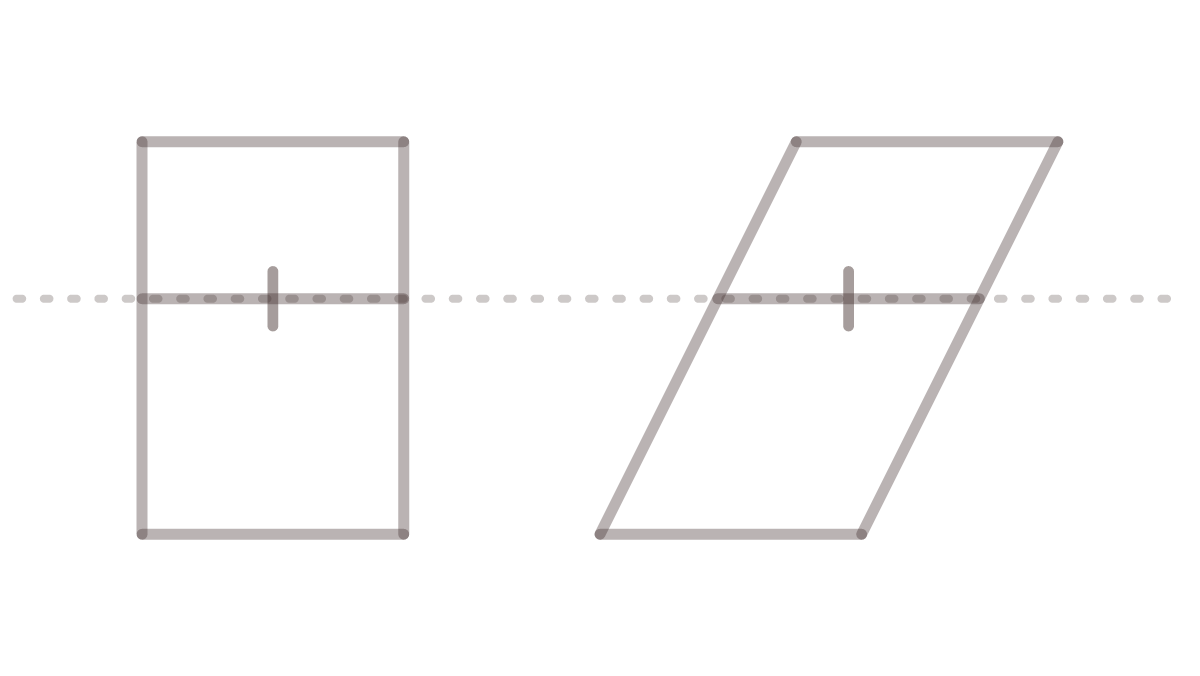
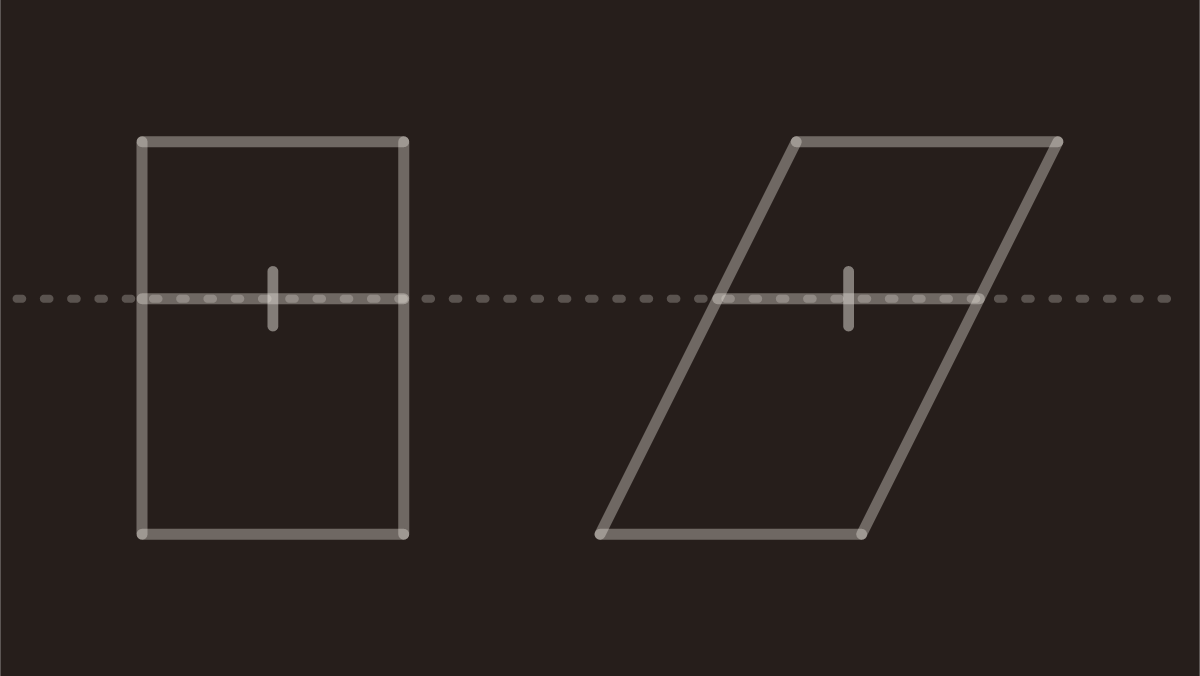
Yes. Two flat figures of the same height, where every horizontal line cuts segments of equal length, have
the same area. So a parallelogram has the same area as a rectangle with the same base and height, as the
figure above shows.