What the theorem says
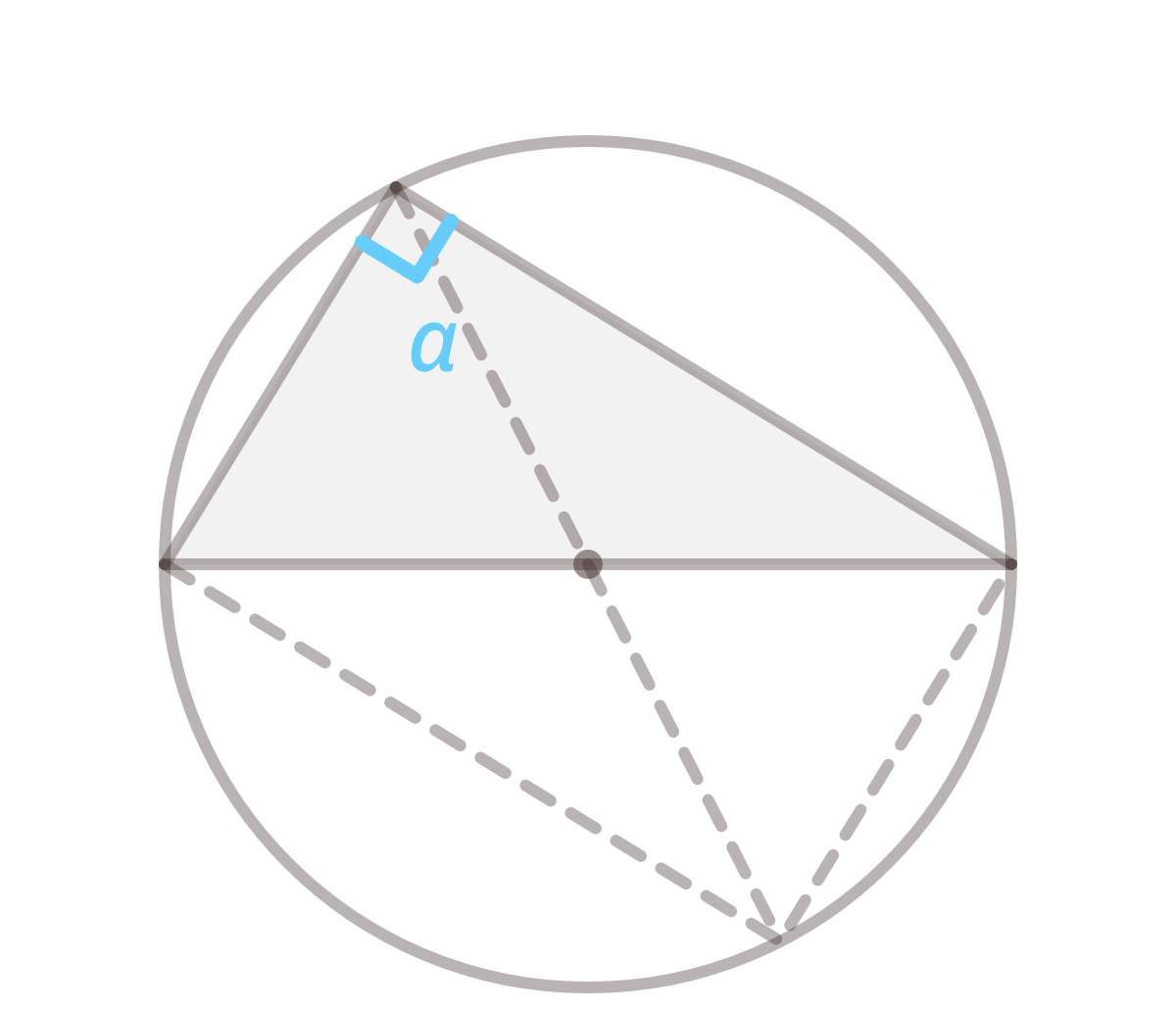
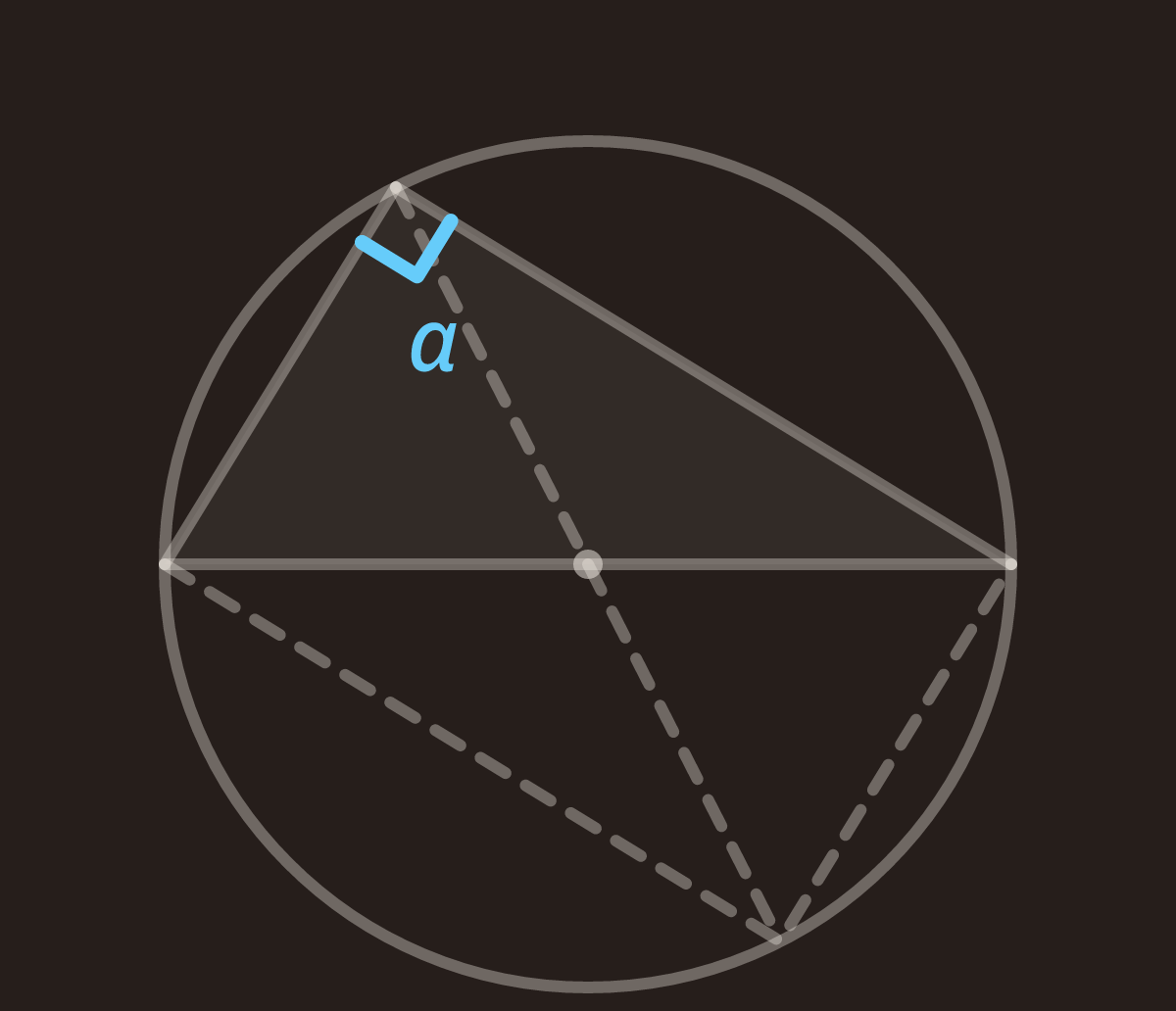
- α = 90°
Draw a diameter in a circle and pick any point on the rim other than the ends of the diameter. The triangle joining the two ends of the diameter to that point is right-angled, and the right angle sits at the point on the rim.
It makes no difference whether the point is directly above the centre or almost at the end of the diameter. The angle is 90° either way.
Why it holds
It is the inscribed angle theorem with one number put in. A diameter splits the circle in half, so the central angle is 180°, and the inscribed angle is half of that: 90°.
There is an even shorter proof. Draw a radius from the centre to the point on the rim. You get two isosceles triangles, since all three segments are radii. Call the base angles a and b. The angle sum gives 2a + 2b = 180°, so a + b = 90° — and a + b is the angle at the rim.
The third proof is the one the figure draws. Mirror the triangle through the centre and you get a quadrilateral with all four corners on the circle. Its two diagonals are both diameters: they are the same length and cut each other in half. A quadrilateral with diagonals like that is a rectangle, and every corner of a rectangle is a right angle. Move the corner in the figure — the rectangle changes shape, but it stays a rectangle.
What it is used for
- Constructing a right angle. With a compass and a straightedge but no set square: draw a circle, draw a diameter, pick a point on the rim. The angle there is right.
- Finding the centre of a circle. The converse holds too: if the angle is right, the hypotenuse lies on a diameter. Two right angles give two diameters, and they cross at the centre.
- Constructing tangents. A tangent is perpendicular to the radius, so a circle drawn over the segment from the centre to an outside point marks the points of tangency.
The converse is also why the midpoint of a right triangle’s hypotenuse is the same distance from all three corners.
Worked examples
The angle. Diameter 10 cm, third corner anywhere on the circle: the angle there is 90°.
The legs. With a hypotenuse of 10 and one leg of 6, the other is √(100 − 36) = 8.
The largest area. Among all triangles on a diameter of 10, the one with its third corner directly above the centre has the largest area: 10 · 5 / 2 = 25.
In reverse. A triangle with sides 5, 12 and 13 is right-angled, so 13 is a diameter of the circle through all three corners. The radius is 6.5.
Common mistakes
- Thinking any chord will do. The segment has to pass through the centre. A chord that does not gives an angle larger or smaller than 90°.
- Putting the right angle in the wrong corner. It sits at the point on the rim, never at the ends of the diameter.
- Expecting an isosceles triangle. It is right-angled, nothing more. Only the point directly above the centre gives an isosceles triangle.
- Forgetting that the point has to be on the circle. Inside, the angle is obtuse; outside, acute.
Common questions
Who was Thales?
Thales of Miletus, around 600 BC, counted as the first to prove a geometric statement rather than
merely observe it.
Does the converse hold?
Yes. If a triangle is right-angled, its hypotenuse lies on a diameter of the circumscribed circle, and
the centre is the midpoint of the hypotenuse.
How does it relate to the inscribed angle theorem?
It is the special case: a central angle of 180° gives an inscribed angle of 90°.