Pick the unit your lengths are in. Areas are then labelled in square units and volumes in cubic units; nothing is converted.
- A = r²/2 · (π·θ/180 − sin θ)
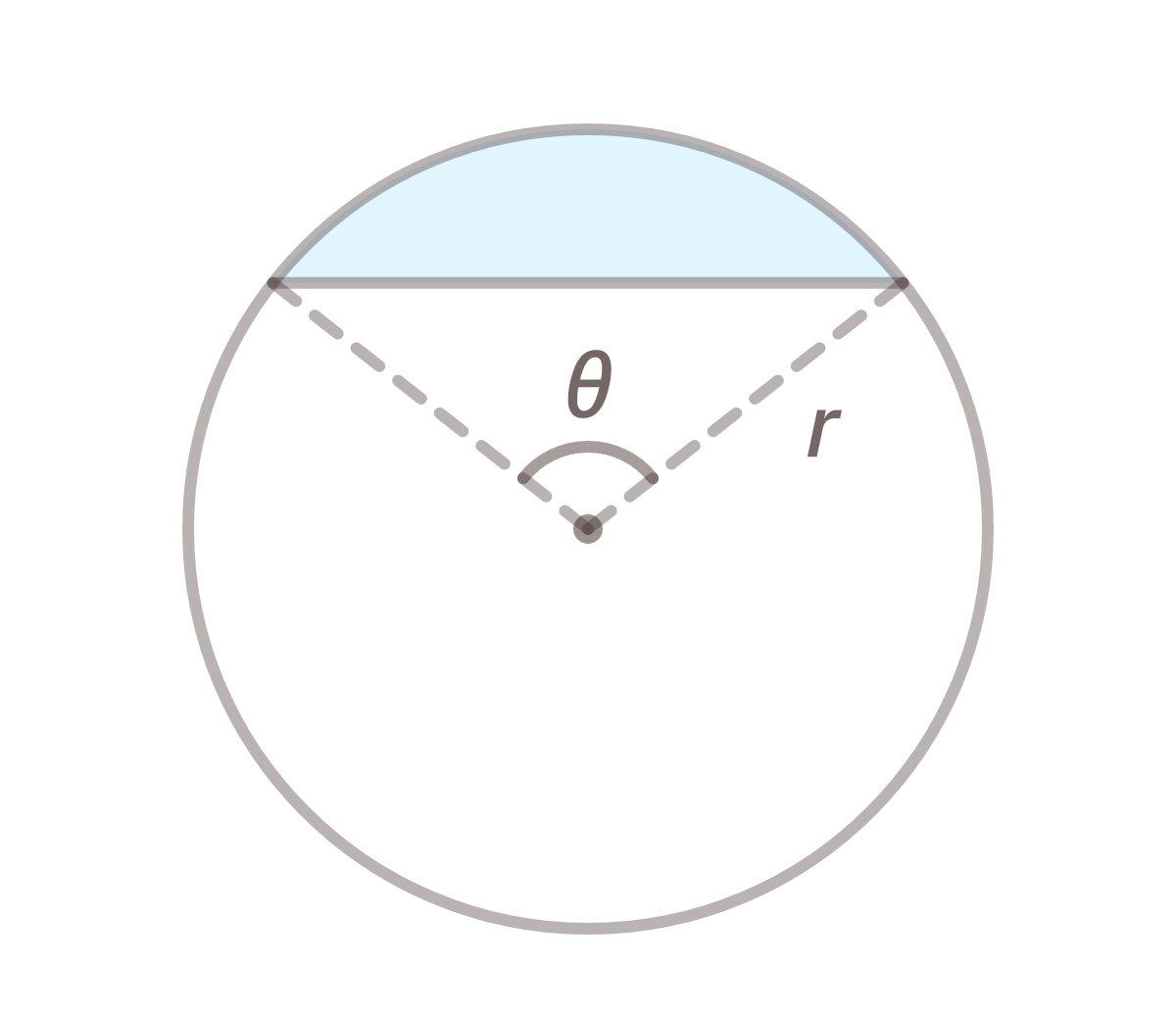
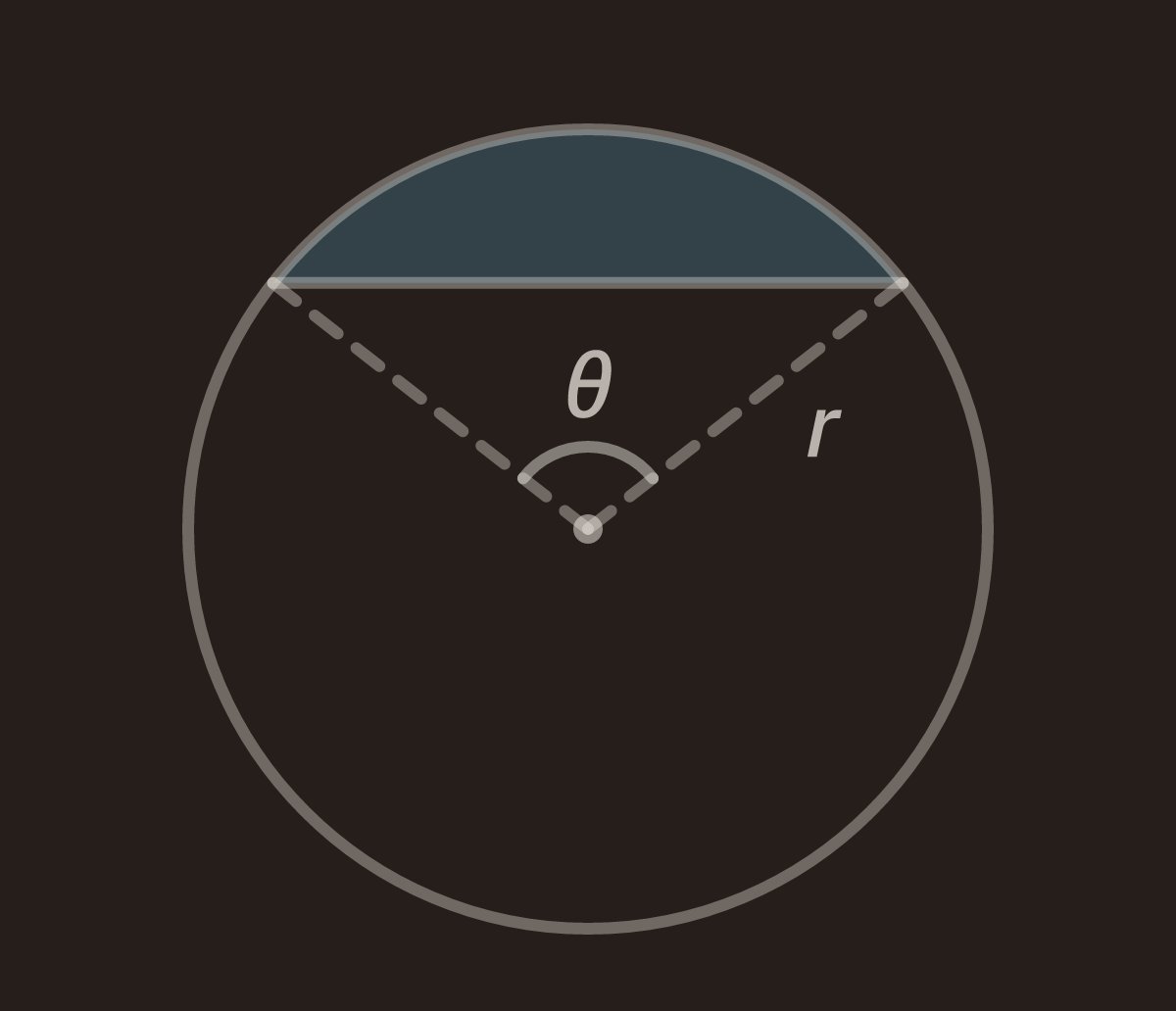
A circular segment is the part of a circle between a chord and the arc. Draw radii to both ends of
the chord and the figure shows itself for what it is: a
sector with a triangle cut away.
With a radius of 6 cm and a central angle of 90° the sector is 28.27 cm², the triangle 18 cm²,
and the segment 10.27 cm².
The two pieces
| Piece |
Formula |
At r = 6, θ = 90° |
| Sector |
π r² · θ/360 |
28.27 |
| Triangle |
r²·sin θ / 2 |
18.00 |
| Segment |
the difference |
10.27 |
The bracket in the formula is that difference, written out. The term π·θ/180 is the angle converted to
radians. With a calculator set to radians the formula is A = r²(θ − sin θ)/2 with θ in radians.
Why the angle is found by search
The angle appears twice: once on its own and once inside a sine, and ordinary algebra cannot isolate it
from that combination. The card therefore solves that direction by searching — trying angles until the
area comes out right.
That is safe here, because θ − sin θ increases all the way from 0° to 360°. Every area belongs to exactly
one angle, so the search cannot land on the wrong one.
Worked examples
Right angle. r = 10, θ = 90°: A = 50 · (1.5708 − 1) = 28.54.
Semicircle. r = 4, θ = 180°: A = 8 · (3.1416 − 0) = 25.13 — half the circle, as it should be,
since the triangle has collapsed to a line.
A thin slice. r = 5, θ = 30°: A = 12.5 · (0.5236 − 0.5) = 0.29. Almost nothing, which matches how
thin that sliver is.
Water in a pipe. A horizontal pipe of radius 0.3 m is filled to a chord spanning 120°.
A = 0.045 · (2.0944 − 0.866) = 0.055 m² of cross-section, so 55 litres per metre of pipe.
Common mistakes
- Forgetting to convert the angle. The term π·θ/180 is there because the angle is in degrees.
Putting degrees straight in makes the angle term fifty-seven times too large.
- Leaving the calculator in the wrong angle mode. sin θ is taken in degrees here. In radian mode the
sine term comes out wrong.
- Taking the sector for the segment. The difference is the triangle, and at small angles it is large
compared with the segment.
- Using the formula for the major piece. For the segment on the other side of the chord, use
360° − θ as the angle.
Common questions
What is the difference between a segment and a sector?
The sector is the slice of pie with its point at the centre. The segment is only the part beyond the
chord.
How do I find the height of the segment?
The height, or sagitta, is h = r(1 − cos(θ/2)). It is not needed for the area but is often what you can
measure.
Can I get the angle from the area by hand?
Not exactly. It takes trial and improvement, which is what the card does.