What the theorem says
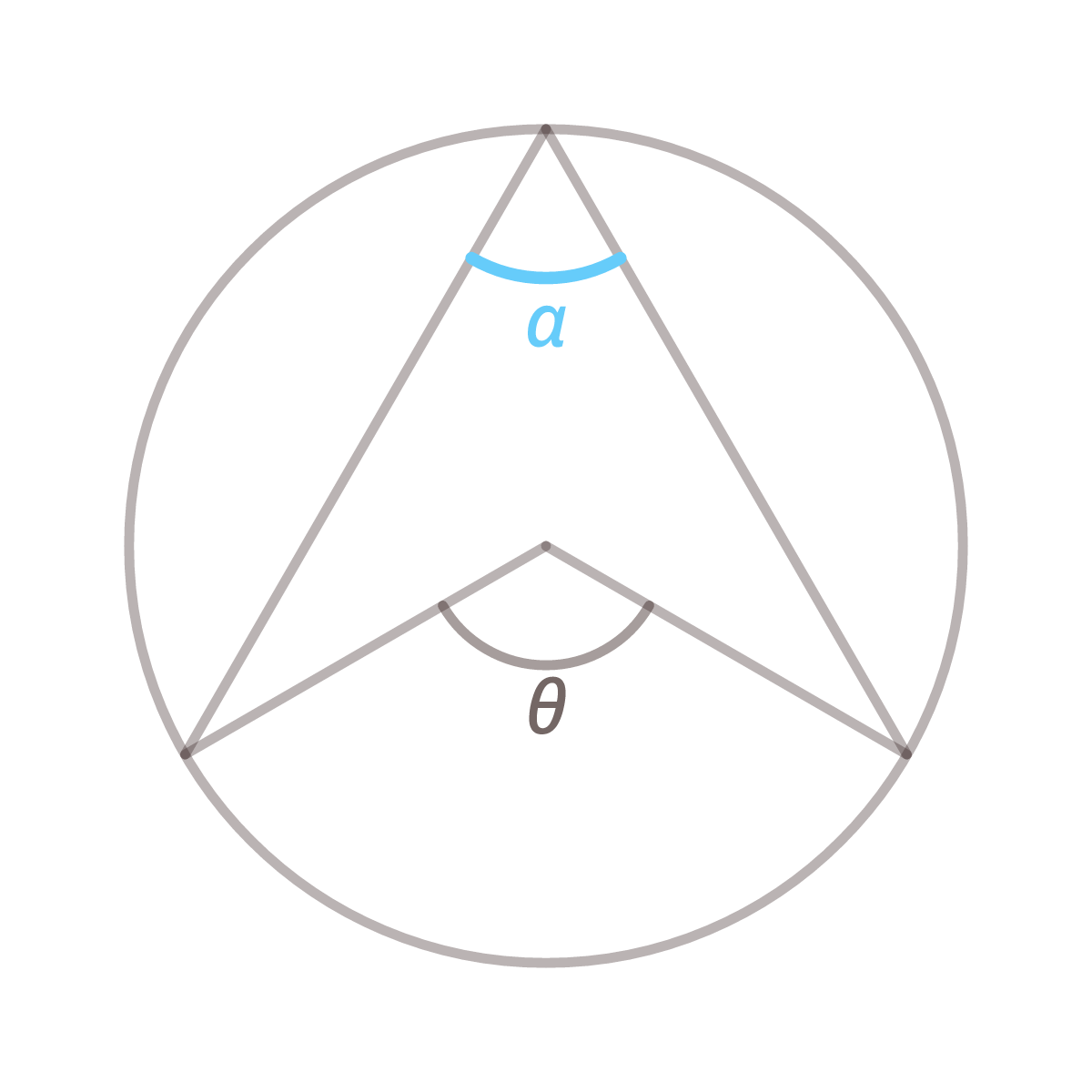
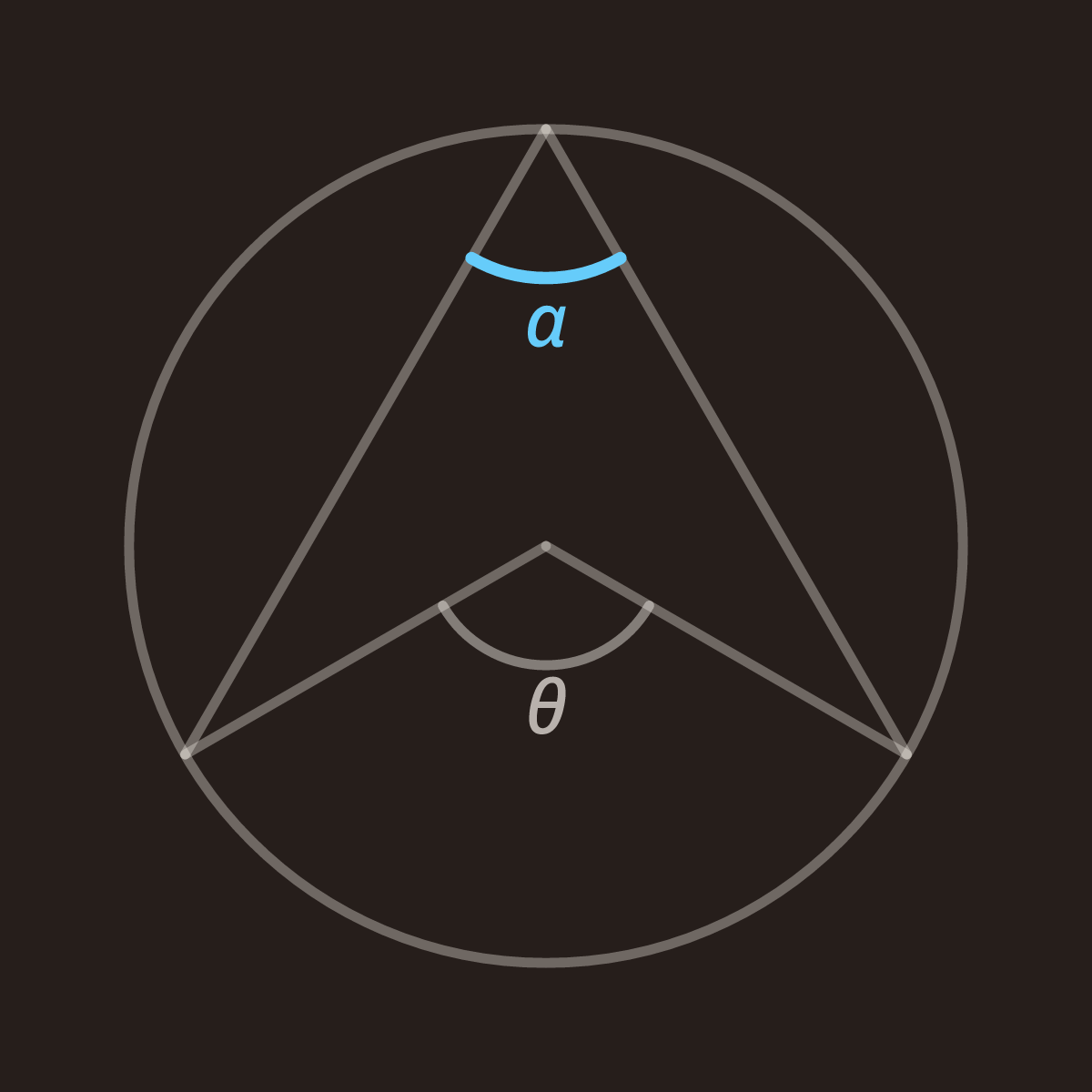
Pick an arc on a circle. Seen from the centre it subtends the central angle θ. Seen from a point on
the rim it subtends the inscribed angle α. The theorem says the central angle is twice the
inscribed angle on the same arc.
An arc covering 80° from the centre is therefore seen as 40° from the edge, wherever on the rim
you stand.
It does not depend on where you stand
Move the point on the rim as you like — as long as it stays on the same side of the arc, the angle does
not change. Every inscribed angle on a given arc is equal.
One useful consequence: if four points lie on a circle, opposite angles of the quadrilateral add to
180°. Such a quadrilateral is called cyclic, and the result is the inscribed angle theorem used twice.
The special case at 180°
If the arc is a semicircle, the central angle is 180° and the inscribed angle is 90°. That is
Thales’ theorem, famous enough to have a name of
its own though it is only this theorem with one number put in.
So a triangle with a diameter as one side and its third corner on the circle is right-angled — handy
when you want to construct a right angle with a compass.
Worked examples
Forwards. A central angle of 120° gives an inscribed angle of 60°.
Backwards. An inscribed angle of 35° belongs to a central angle of 70°.
The semicircle. A central angle of 180° gives an inscribed angle of 90°.
Cyclic quadrilateral. If one angle of a quadrilateral inscribed in a circle is 105°, the opposite
angle is 180 − 105 = 75°.
Common mistakes
- Doubling the wrong way. The inscribed angle is the smaller of the two. An answer larger than the
central angle means you multiplied where you should have divided.
- Comparing angles on different arcs. The theorem holds only when both angles look at the same
arc.
- Forgetting the major arc. A chord splits the circle into two arcs. Take the other one and the
central angle is 360° − θ, with a different inscribed angle.
- Confusing an inscribed angle with an angle inside the circle. The inscribed angle has its vertex
on the circle; a vertex strictly inside follows a different rule.
Common questions
Does it hold if the vertex is on the other side of the chord?
Then the angle looks at the other arc. Its central angle is 360° minus the first, so the two inscribed
angles add to 180°.
How is it proved?
Draw a radius to the vertex of the inscribed angle. That gives one or two isosceles triangles, and the
exterior angle theorem produces the doubling at once.
What is a cyclic quadrilateral?
One whose four corners all lie on a circle. Its opposite angles add to 180°, which follows directly
from this theorem.