Pick the unit your lengths are in. Areas are then labelled in square units and volumes in cubic units; nothing is converted.
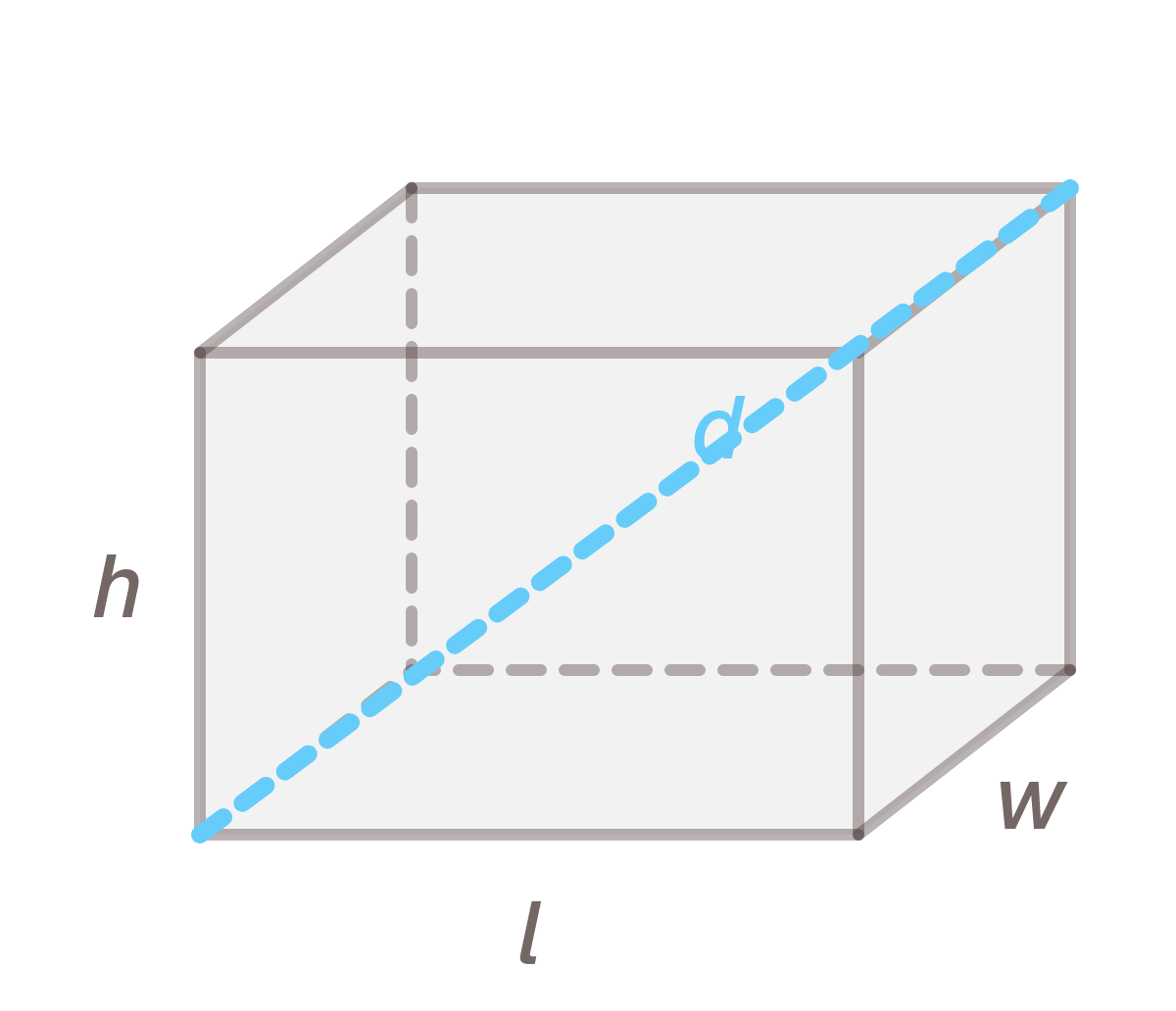
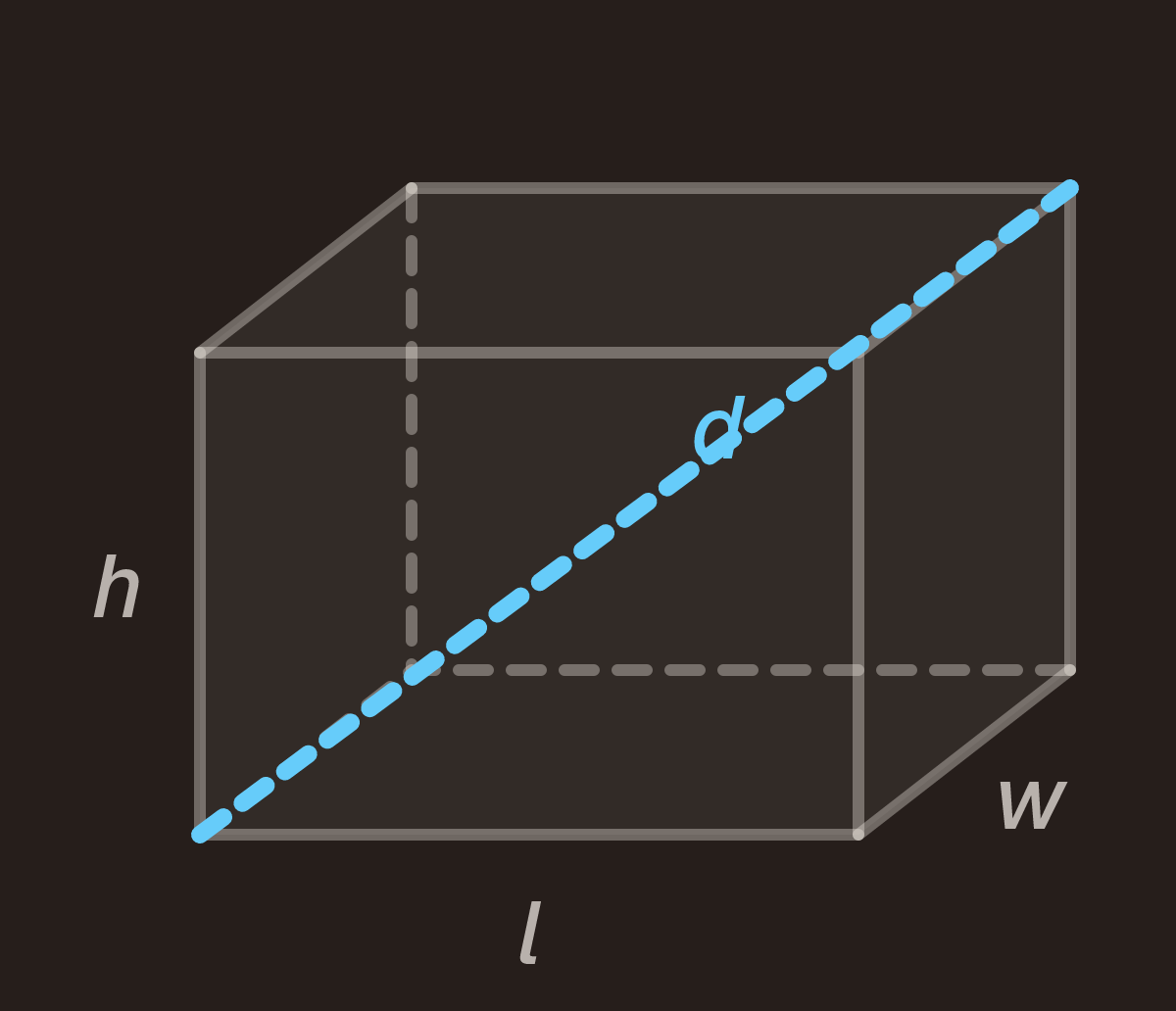
The space diagonal is the line straight through the box, from one bottom corner to the corner furthest
away — diagonally across and one storey up. It is the longest straight line that fits inside
the box.
You reach it with Pythagoras’ theorem, but the
theorem has to be used twice:
- Across the base. The length l and the width w are the legs of a right-angled triangle lying flat on
the base. Its hypotenuse — the base diagonal — is √(l² + w²).
- Up to the corner. That base diagonal and the height h are in turn the legs of a second right-angled
triangle, standing up inside the box. Its hypotenuse is the space diagonal.
Square the second step and the root from the first one disappears, leaving the whole formula on one line:
d² = l² + w² + h²
The step that gets skipped
The first step is an ordinary Pythagoras question: the base diagonal. The second makes this a solid’s
formula, and it is where the answer tends to stop too early. An answer shorter than the height cannot be
the space diagonal.
One way to check: the space diagonal has to be longer than every single edge, and longer than the base
diagonal. If it is not, something has gone wrong in the working.
Worked examples
A box 3 × 4 × 12 cm. The base diagonal is √(3² + 4²) = √25 = 5 cm. The space diagonal is then
√(5² + 12²) = √169 = 13 cm. Straight from the formula: √(9 + 16 + 144) = √169 = 13 cm — the same
number, without the intermediate step.
Working backwards. A cuboid has a space diagonal of 13 cm, a width of 4 cm and a height of 12 cm.
Then l² = 169 − 16 − 144 = 9, so the length is 3 cm.
Will the plank fit in the van? The load space is 2.0 × 1.2 × 1.0 m. The space diagonal is
√(4 + 1.44 + 1) = √6.44 ≈ 2.54 m, so a 2.2 m plank goes in at an angle even though it is longer than
any single measurement. That is a common reason to work this out outside a classroom.
Common mistakes
- Answering with the base diagonal. That is only the first step. The height has to come in too.
- Adding the measurements instead of their squares. 3 + 4 + 12 is 19, not 13. The formula squares each
measurement before adding, and takes the root of the sum.
- Taking the root of each term separately. √9 + √16 + √144 is 3 + 4 + 12 = 19. The root is taken once,
of the sum, at the end.
- Mixing units. Centimetres and metres in the same squaring give a number with no meaning. Convert all
three measurements first.
Common questions
Why is it valid to use Pythagoras twice?
Because both triangles are right-angled. The height of a cuboid is perpendicular to the base, and so to
the base diagonal as well, which is what the theorem requires.
Is it called the space diagonal or the body diagonal?
Both are used, and they mean the same thing. In Swedish it is rymddiagonal, occasionally
kroppsdiagonal.
What is the space diagonal of a cube?
All three measurements are equal, so d = √(3s²) = s√3 ≈ 1.732 · s. A cube with a 10 cm side has a space
diagonal of about 17.3 cm.
Can I find an edge from the diagonal and the other two?
Yes. Subtract the two known edges’ squares from the diagonal’s square and take the root of what is left.
The diagonal has to be longer than the diagonal across the two known edges, or there is nothing left to
take a root of.