What the equation says
- (x − a)² + (y − b)² = r²
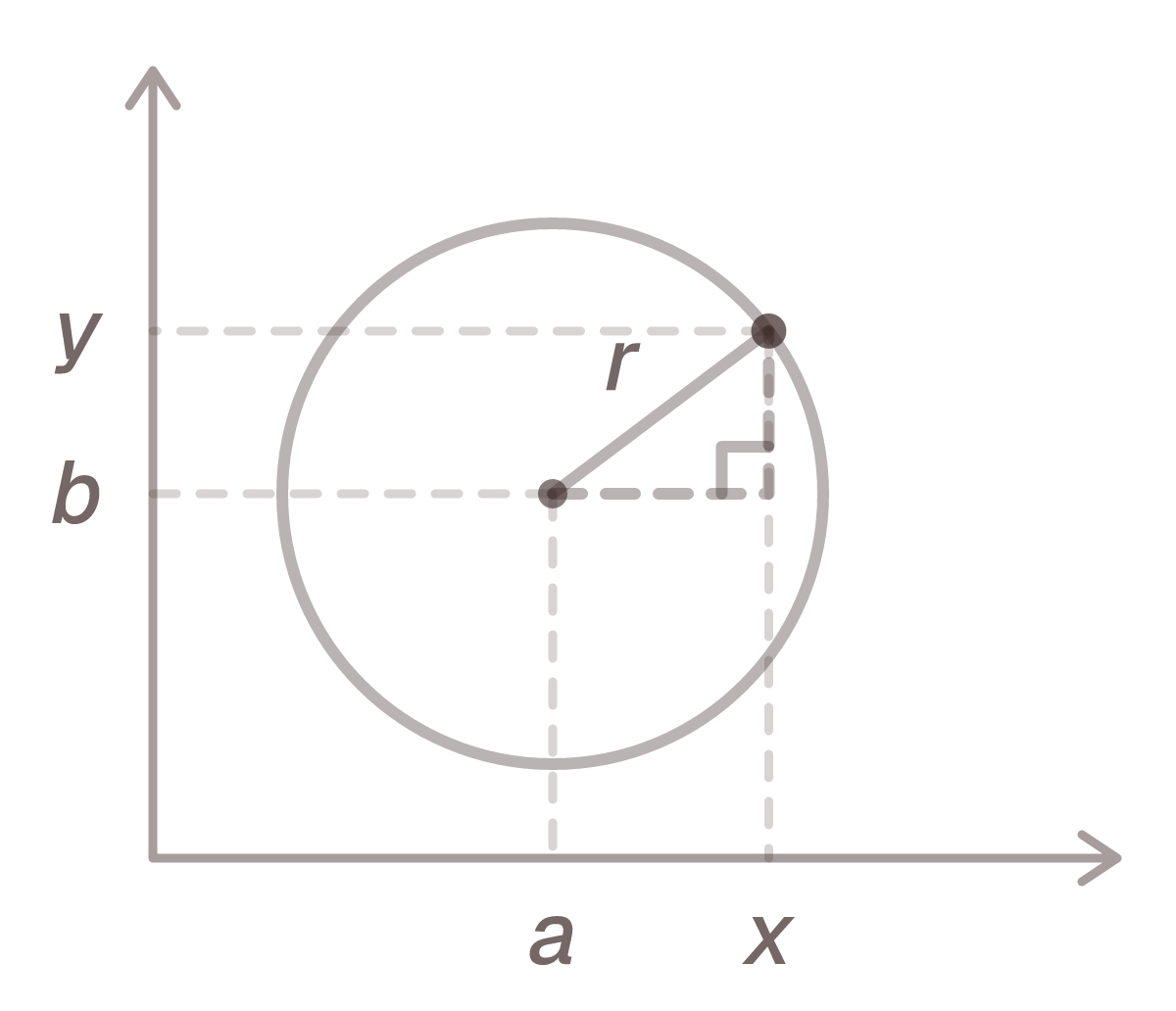
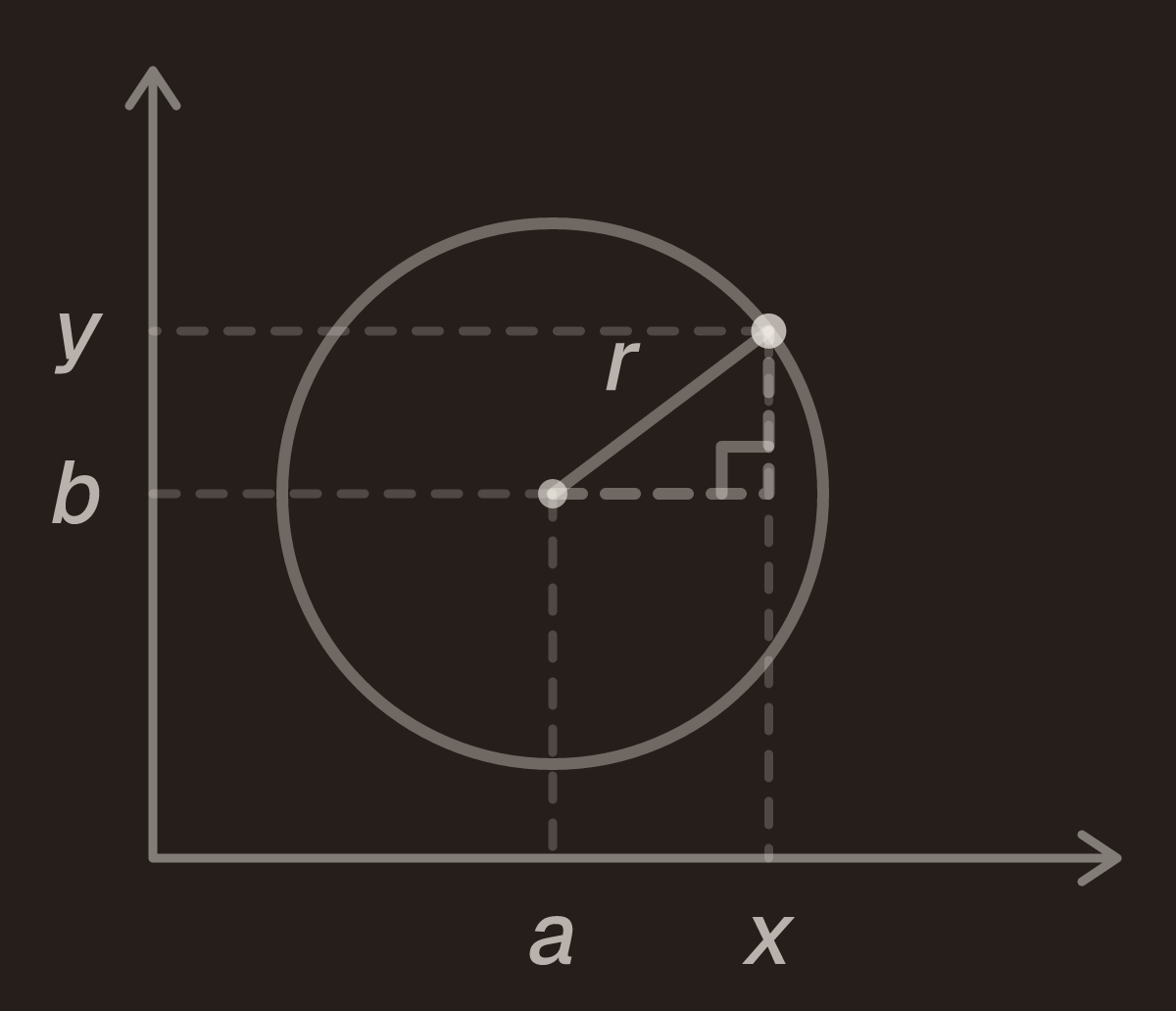
A circle is every point at distance r from the centre (a, b). The distance is measured with the Pythagorean theorem: the difference in x is one leg, the difference in y is the other, and the distance is the hypotenuse.
The circle with centre (2, 3) and radius 5 therefore has the equation (x − 2)² + (y − 3)² = 25. The point (6, 6) lies on it, since 4² + 3² = 25.
Reading off the centre and the radius
Watch the signs. The equation has a minus in it, so a minus in the bracket means a positive coordinate:
| Equation | Centre | Radius |
|---|---|---|
| (x − 2)² + (y − 3)² = 25 | (2, 3) | 5 |
| (x + 4)² + (y − 1)² = 9 | (−4, 1) | 3 |
| x² + y² = 16 | (0, 0) | 4 |
The right-hand side is the radius squared. A circle with r² = 25 has radius 5, not 25.
Completing the square
The equation often turns up expanded: x² + y² − 4x − 6y − 12 = 0. To see the circle you have to complete the square:
- Group the x terms and the y terms. x² − 4x + y² − 6y = 12.
- Halve each coefficient and square it. Half of −4 is −2, squared is 4. Half of −6 is −3, squared is 9.
- Add to both sides. x² − 4x + 4 + y² − 6y + 9 = 12 + 4 + 9.
- Rewrite as squares. (x − 2)² + (y − 3)² = 25.
The centre is (2, 3) and the radius 5. If the right-hand side comes out negative there is no circle at all; if it comes out zero the “circle” is a single point.
Worked examples
Is the point on the circle? (x − 1)² + (y + 2)² = 100 and the point (7, 6): 36 + 64 = 100. Yes.
Inside or outside? The same circle and the point (9, 0): 64 + 4 = 68 < 100, so inside. A sum larger than r² puts the point outside.
The equation from two facts. Centre (−3, 5), radius 2: (x + 3)² + (y − 5)² = 4.
The equation from a centre and a point. Centre (0, 0) through (3, 4): r² = 9 + 16 = 25, so x² + y² = 25.
Common mistakes
- Forgetting to square the radius. The right-hand side is r², not r.
- Flipping the sign of the centre. (x + 4)² belongs to a = −4.
- Adding to only one side when completing the square. The equation has to stay true.
- Assuming every quadratic in x and y is a circle. Different coefficients of the same sign on x² and y² make an ellipse, and opposite signs usually make a hyperbola.
Common questions
What if r² comes out negative?
Then there is no curve. The equation describes the empty set, which completing the square reveals.
Why is there no card solving for x?
Because a vertical line can meet a circle in two points. One answer would have to choose one of them and
stay silent about the other, and this collection does not do that.
How do I get the area from the equation?
Read r² off the right-hand side and multiply by π — the
area of a circle is πr², so you never need the
root.