Pick the unit your lengths are in. Areas are then labelled in square units and volumes in cubic units; nothing is converted.
The definition
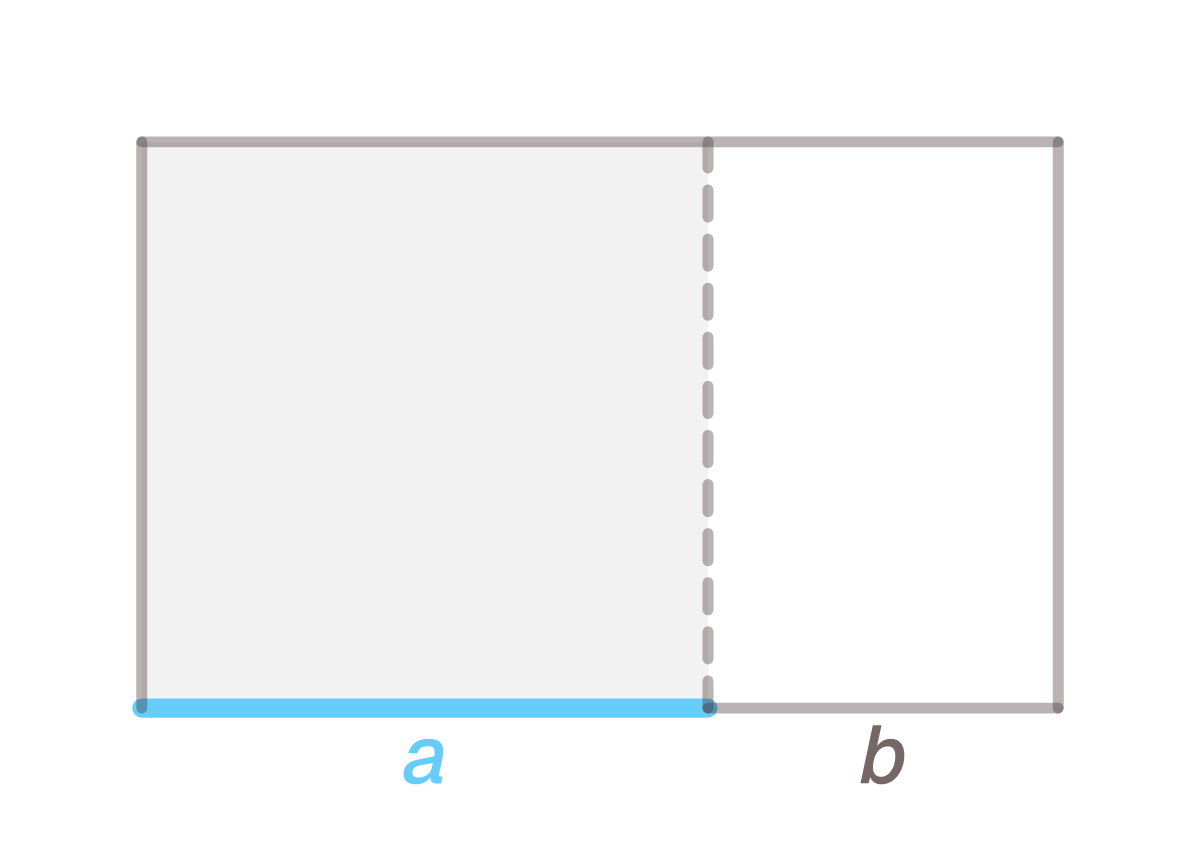
The length a + b is cut into a longer piece a and a shorter piece b. The cut is in the golden ratio
when the two ratios are equal. The ratio is called φ (phi):
φ = a / b = (1 + √5) / 2 ≈ 1.618
The shorter piece is 10 cm. The longer one is then a = 10 · 1.618 ≈ 16.2 cm, and the whole length
26.2 cm. Check: 26.2 / 16.2 ≈ 1.618 and 16.2 / 10 = 1.62.
Where the number comes from
Set φ = a / b. The left side is (a + b) / a = 1 + b/a = 1 + 1/φ, so the definition becomes
1 + 1/φ = φ
Multiply by φ: φ + 1 = φ², so φ² − φ − 1 = 0. The
quadratic formula gives
φ = (1 ± √(1 + 4))/2 = (1 ± √5)/2. A ratio of two lengths is positive, so φ = (1 + √5)/2 ≈ 1.618. The
other root, ≈ −0.618, is not a ratio of lengths.
Which piece is which
The thing that is easy to mix up is whether the number you have is the shorter piece, the longer piece or
the whole length. With the number 10:
| 10 is |
Longer piece a |
Shorter piece b |
| the shorter piece |
10 · 1.618 ≈ 16.2 |
10 |
| the longer piece |
10 |
10 / 1.618 ≈ 6.2 |
| the whole length |
10 / 1.618 ≈ 6.2 |
10 − 6.2 ≈ 3.8 |
The card above works with the two pieces. Given the whole length, divide it by φ to get the longer piece,
and the rest is the shorter one.
Cutting a whole length
A picture is 30 cm wide and is to be divided by a vertical line in the golden ratio. The longer piece is
30 / 1.618 ≈ 18.5 cm and the shorter 30 − 18.5 = 11.5 cm, so the line goes 11.5 cm from one edge.
Check: 18.5 / 11.5 ≈ 1.61.
The golden rectangle
A rectangle whose sides are in the ratio φ is called golden. Cut a square off its long side and the
rectangle that is left is golden too, with the same ratio between its sides. That is the figure above: the
square has side a, and the rectangle left over has sides b and a.
Two rules make φ easy to calculate with:
- φ² = φ + 1 ≈ 2.618
- 1/φ = φ − 1 ≈ 0.618
Common mistakes
- Multiplying the whole length by 1.618. The whole is divided by φ to get the longer piece.
- Mixing up 1.618 and 0.618. One is φ, the other 1/φ. The longer piece times 0.618 gives the shorter.
- Keeping the negative root. A ratio of lengths is positive.
Common questions
What does the golden ratio have to do with the Fibonacci numbers?
The ratio of two consecutive Fibonacci numbers, 8/5, 13/8, 21/13 and so on, closes in on φ. 21/13 is
already 1.615.
Where is the golden ratio in a pentagon?
In a regular pentagon the diagonal is φ times the side. The diagonals also cut each other in the golden
ratio.