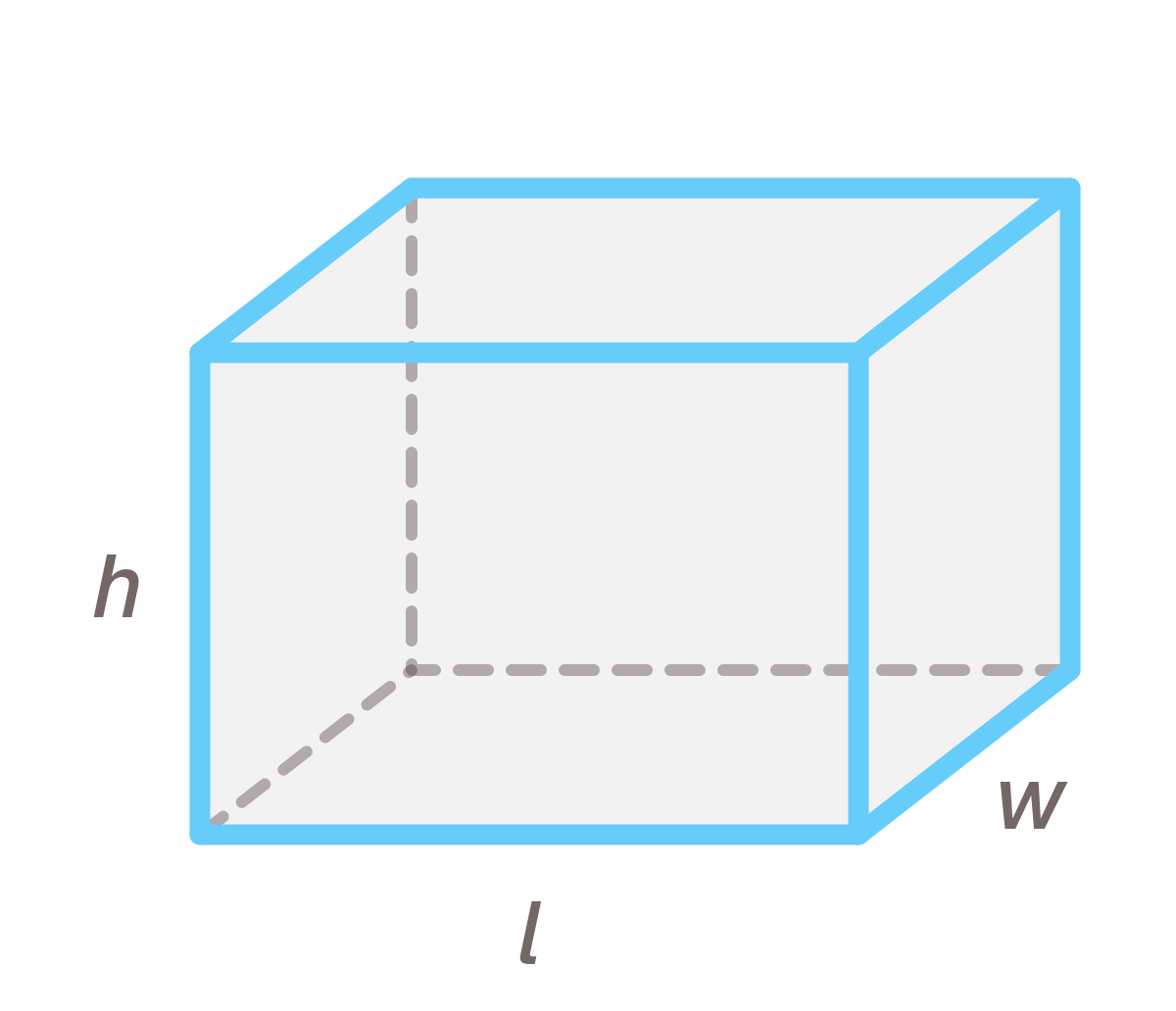
Pick the unit your lengths are in. Areas are then labelled in square units and volumes in cubic units; nothing is converted.
A cuboid has six faces, and they come in pairs: the front matches the back, the left the right, the top
the bottom. So three areas are worked out and the sum is doubled.
Every face is a rectangle, so its area is the
product of two of the three measurements:
| Pair |
Measurements |
Area per face |
| Front and back |
length and height |
l · h |
| Left and right |
width and height |
w · h |
| Top and bottom |
length and width |
l · w |
The sum of the three, times two, is the surface area. Each term is one pair of faces on the box.
The difference from the volume
The volume is l · w · h: all three measurements
multiplied, answered in cubic units. The surface area adds pairs of products and is answered in square
units. An answer in cubic units means the set-up has gone wrong.
Worked examples
A moving box 50 × 40 × 30 cm. The pairs come to 50 · 30 = 1,500, 40 · 30 = 1,200 and 50 · 40 = 2,000.
The sum is 4,700, so the surface area is 2 · 4,700 = 9,400 cm² — just under a square metre of card.
Backwards. A cuboid has a surface area of 94 cm², a width of 4 cm and a height of 3 cm. Half the area
is 47, and the pair that does not involve the length is 4 · 3 = 12. The length is
(47 − 12) / (4 + 3) = 5 cm.
Common mistakes
- Forgetting the two. Three areas are half the box. Without the doubling, the back, the right side
and the bottom are missing.
- Mixing units. Centimetres times metres give nothing meaningful. Convert all three measurements to
the same unit first.
- Using this formula on a cube and slipping on the way. It works perfectly well — but when all three
measurements are equal, the cube’s formula
is shorter and has fewer places to go wrong.
Common questions
Why only three products when the box has six faces?
The faces come in equal pairs. Three products cover all six as long as the sum is doubled.
Can I find one measurement from the area and the other two?
Yes. Take half the area, subtract the product of the two known measurements, and divide by their sum.
Does the lid count if the box is open?
Not then. Surface area assumes a closed solid — subtract the area of each face that is missing (l · w for a lid).