The equation
- x² = 4py
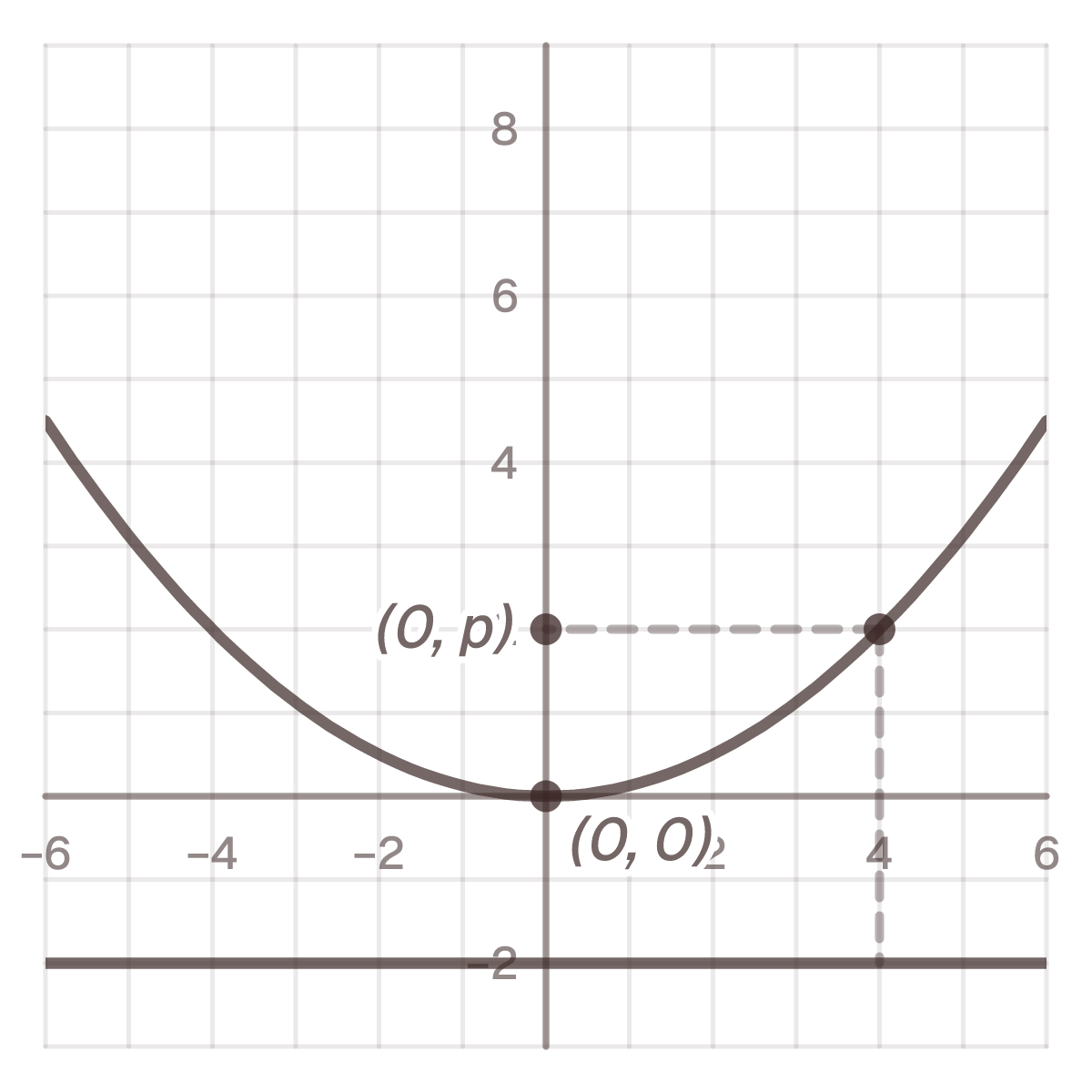
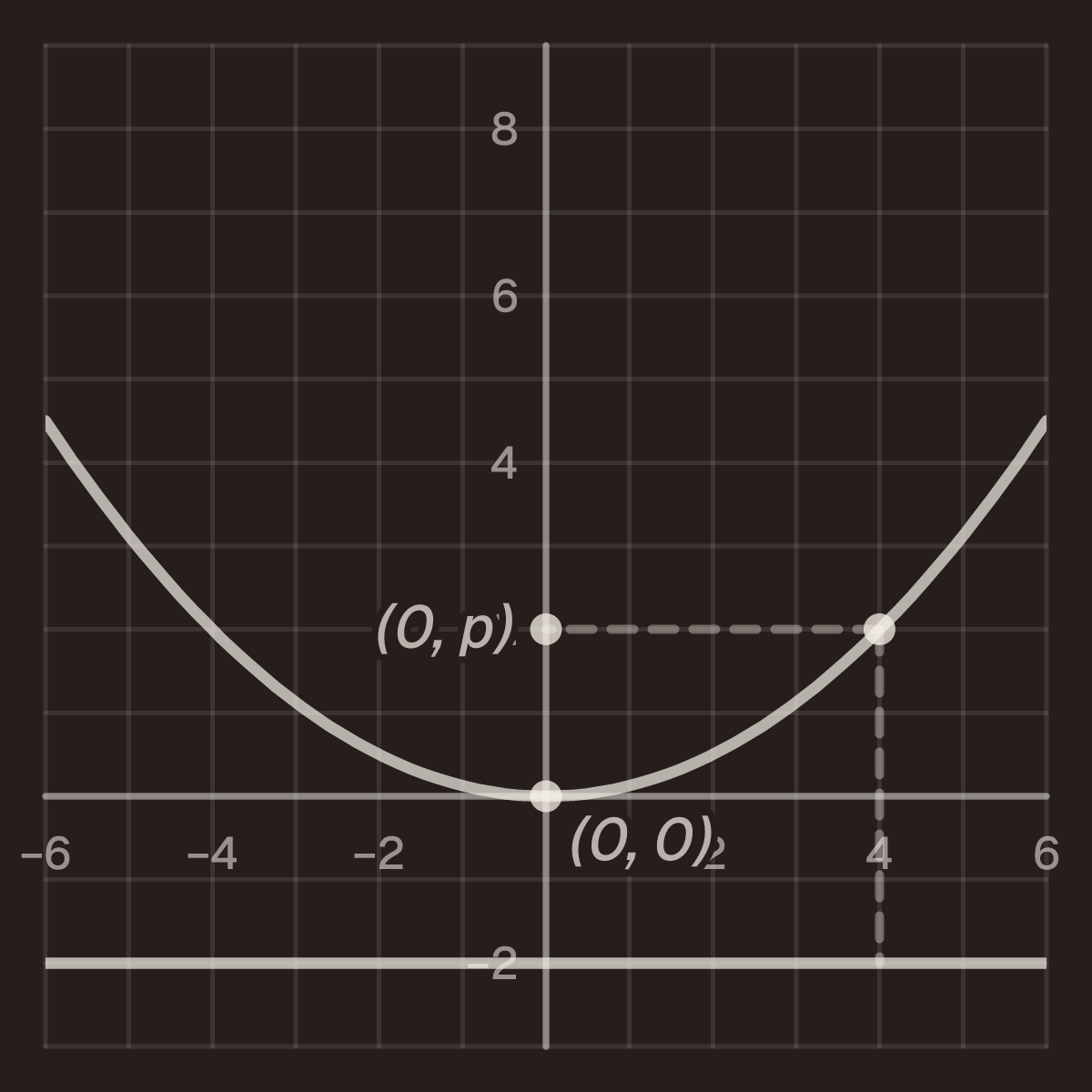
A parabola is every point as far from one point, the focus (0, p), as from one line, the directrix y = −p. The vertex lies halfway between, at the origin.
Holds when the vertex is at the origin, the parabola is symmetric about the y-axis and p ≠ 0. With p > 0 it opens upwards, with p < 0 downwards.
With p = 2 the equation is x² = 8y. The focus is at (0, 2) and the directrix is y = −2. The point (4, 2) lies on the parabola, because 4² = 16 = 8 · 2. Its distance to the focus is 4, and to the directrix it is 2 − (−2) = 4.
The focus of y = ax²
The parabola from school is written y = ax². It is the same curve: solve x² = 4py for y and you get y = x²/(4p), so
a = 1/(4p), that is p = 1/(4a)
The easy mistake is to take p = a, or p = 4a:
| Parabola | p = 1/(4a) | Focus | Directrix |
|---|---|---|---|
| y = x² | 1/4 | (0, 0.25) | y = −0.25 |
| y = x²/8 | 2 | (0, 2) | y = −2 |
| y = 2x² | 1/8 | (0, 0.125) | y = −0.125 |
| y = −x²/12 | −3 | (0, −3) | y = 3 |
The focus of y = x² is therefore at (0, 0.25), not at (0, 1). A steeper parabola has its focus closer to the vertex.
A parabola that opens downwards
x² = −12y has 4p = −12, so p = −3. The focus is at (0, −3), below the vertex, and the directrix is y = 3. The point (6, −3) lies on the parabola: 36 = −12 · (−3). It is 6 from the focus and 3 − (−3) = 6 from the directrix.
Why the equation holds
Take a point (x, y). Its distance to the focus (0, p) is √(x² + (y − p)²), and its distance to the directrix y = −p is |y + p|. Set them equal and square both sides:
x² + (y − p)² = (y + p)²
x² + y² − 2py + p² = y² + 2py + p²
x² = 4py
Some books write the sideways parabola y² = 4ax instead, with the focus at (a, 0). It is the same curve turned a quarter turn, with a in the role p has here.
Common mistakes
- p = a. For y = ax², p = 1/(4a).
- The wrong side of the vertex. The directrix lies on the opposite side from the focus, the same distance away.
- Forgetting the 4. x² = py has its focus at (0, p/4), not at (0, p).
- Putting the focus on the curve. It lies inside it, on the axis of symmetry.
Common questions
Why is it called the focus?
A parabolic mirror gathers light that arrives parallel to its axis at the focus. Sunlight gathered there
can get hot enough to start a fire, which is where the word, Latin for hearth, comes from. Satellite
dishes work on the same property.
What if the parabola lies on its side?
Swap x and y: y² = 4px opens to the right, with the focus at (p, 0) and the directrix x = −p.
What if the vertex is not at the origin?
Shift everything by as much as the vertex. With the vertex at (h, k) the equation becomes
(x − h)² = 4p(y − k), and the focus is at (h, k + p). The vertex form y = a(x − h)² + k is on the
vertex form of a parabola.