Pick the unit your lengths are in. Areas are then labelled in square units and volumes in cubic units; nothing is converted.
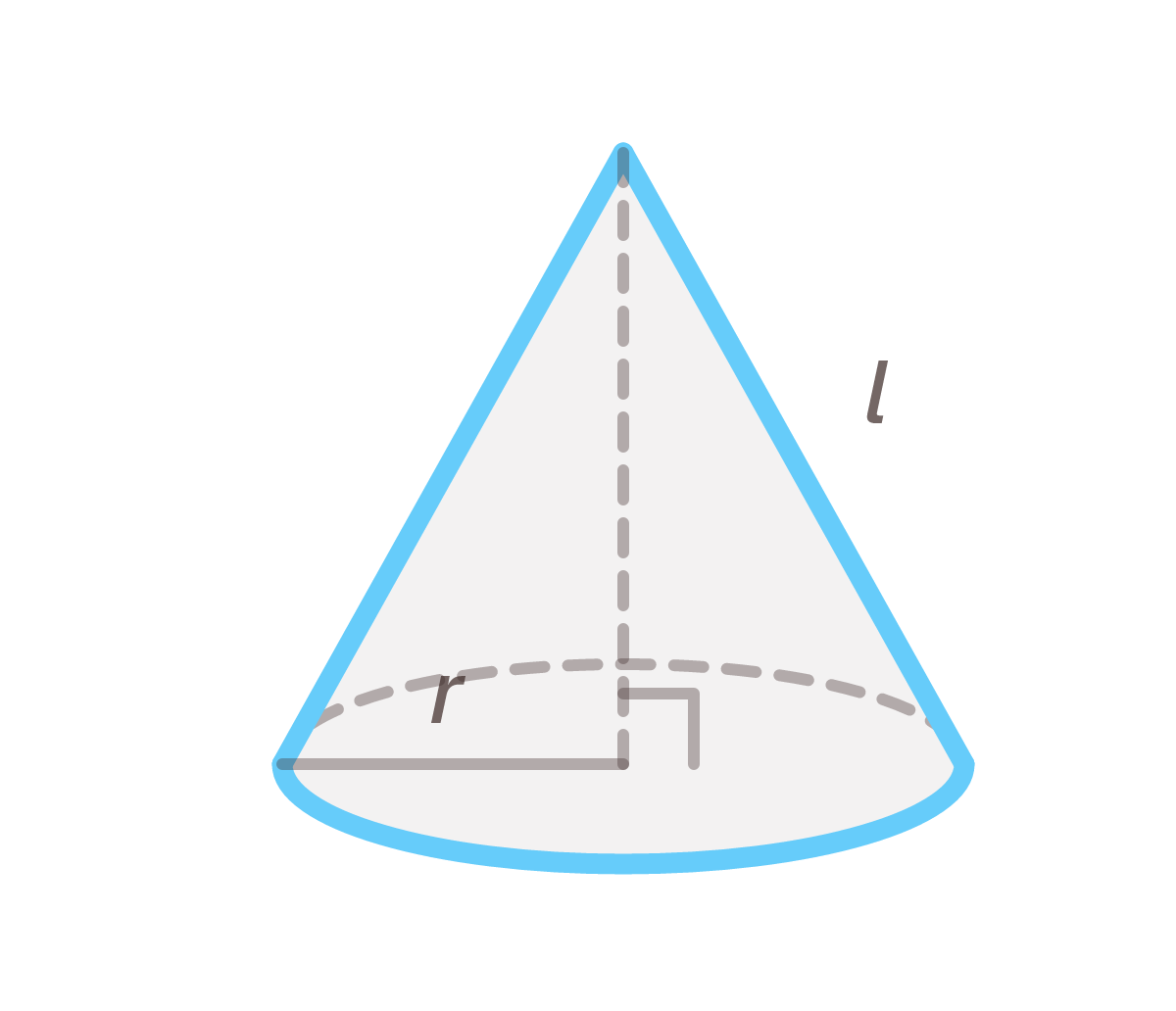
A cone has two surfaces: the base circle and the sloping side. Each has a formula you already recognise:
- The base, a circle of area πr².
- The wall, the sloping side, of area πrl.
Added, that is πr² + πrl. Both terms contain πr, so it is taken outside:
A = πr(r + l)
The bracket is the radius plus the slant height, added before anything is multiplied. That is the form
formula books print, and it is quicker to compute.
The slant height first
The l in the formula is the slant height — the distance along the sloping side from the rim of the
base to the apex — and not the cone’s height h straight up through the middle. The radius, the height and
the slant height form a right-angled triangle inside the cone, so
Pythagoras’ theorem gives:
l² = r² + h²
If the question gives the height instead of the slant height, that is always the first step.
Worked examples
A cone with a radius of 3 cm and a height of 4 cm. The slant height is √(9 + 16) = 5 cm. The surface
area is π · 3 · (3 + 5) = 24π ≈ 75.4 cm². Checking with the two parts separately: the base is 9π and
the wall is 15π, together 24π.
Working backwards for the slant height. A cone has a surface area of 24π cm² and a radius of 3 cm. The
wall is 24π − 9π = 15π cm², so the slant height is 15π / (π · 3) = 5 cm.
Working backwards for the radius. The radius takes a quadratic equation, because the area is quadratic
in r. From r² + lr − A/π = 0 it follows that r = (−l + √(l² + 4A/π)) / 2, and only
the positive root will do. With A = 24π and l = 5: r = (−5 + √(25 + 96)) / 2 = (−5 + 11) / 2 = 3 cm.
Common mistakes
- Putting the height into the bracket. r + h is not r + l. Convert with Pythagoras first.
- Multiplying out wrongly. πr(r + l) is πr² + πrl, not πr² + l or πr · r + l. The bracket covers the
whole sum.
- Counting the base twice. A cone has one base. It is the cylinder that has two circles.
- Leaving out the base when it does belong. An ice cream cone has no base; a conical heap of gravel has
no base to cover either. A closed conical container does.
Common questions
Are πr(r + l) and πr² + πrl the same formula?
Yes, exactly the same. One is the other with πr factored out. Use whichever you compute more reliably.
Why can’t the radius be found with a division?
Because r appears in two places, once squared. That makes the equation quadratic, just as it is for the
surface area of a cylinder.
How much of the answer is the base?
The ratio is r to l. If the slant height is much longer than the radius — a tall, narrow cone — the base
is a small part. A low, wide cone gives the base more weight.