The formula
- D = |ax₀ + by₀ + cz₀ + d| / √(a² + b² + c²)
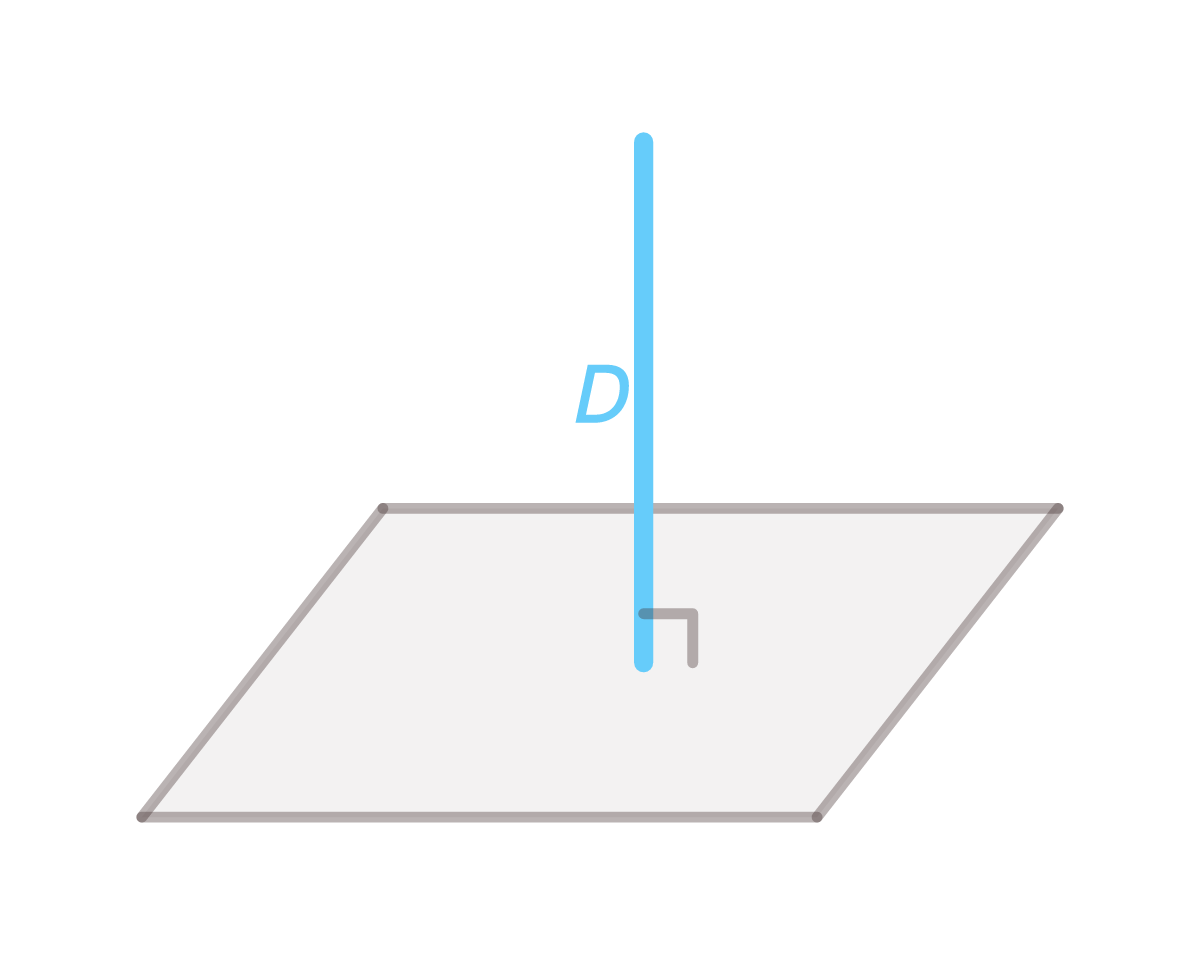
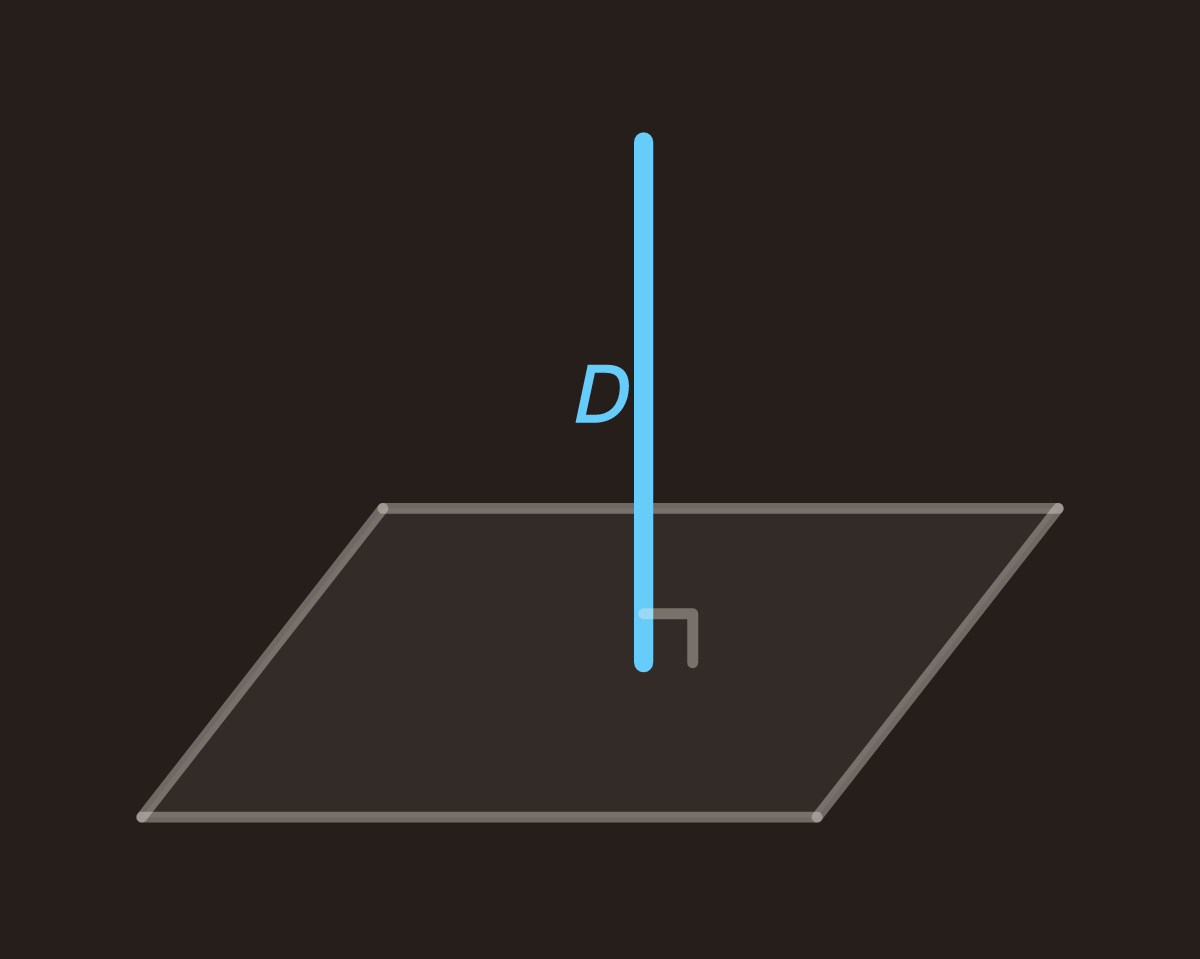
The plane is ax + by + cz + d = 0 and the point is (x₀, y₀, z₀). The distance D is the shortest one, along the normal from the point straight to the plane. The letter d is already the plane’s constant, so the distance is D here.
Holds when a, b and c are not all 0. Otherwise the equation describes no plane, and the denominator is 0.
The plane 2x + 3y + 6z − 5 = 0 and the point (1, 2, 3):
- Numerator: 2 · 1 + 3 · 2 + 6 · 3 − 5 = 2 + 6 + 18 − 5 = 21
- Denominator: √(4 + 9 + 36) = √49 = 7
- Distance: D = 21 / 7 = 3
The absolute value
The left side ax₀ + by₀ + cz₀ + d is positive for points on one side of the plane and negative for points on the other. A distance is not negative, so the sign is removed.
The plane 2x − 3y + 6z + 5 = 0 and the point (−2, 3, −1):
| Working | D |
|---|---|
| |−4 − 9 − 6 + 5| / 7 = |−14| / 7 | 2 |
| (−4 − 9 − 6 + 5) / 7, no absolute value | −2 |
| |−4 − 9 − 6| / 7, d forgotten | 19/7 ≈ 2.71 |
The sign still tells you something: two points with the same sign lie on the same side of the plane.
Points where the formula gets simple
A point in the plane. The point (1, 4, 1) and the plane 2x + 3y + 6z − 20 = 0 give the numerator 2 + 12 + 6 − 20 = 0, and the distance is 0. The point lies in the plane.
A plane perpendicular to an axis. The plane z = 4 is 0x + 0y + 1z − 4 = 0, with normal vector (0, 0, 1) and denominator 1. The distance from (3, 7, 9) is |9 − 4| = 5, just the difference in z.
Why the formula holds
Call the foot of the perpendicular from the point Q. The vector from Q to the point is parallel to the normal vector n = (a, b, c), so the distance is the length of that vector’s projection onto n. The projection’s length is the dot product with n, divided by the length of n. Take any point in the plane instead of Q: the difference lies in the plane and is perpendicular to n, so the dot product does not change. The working lands on the numerator ax₀ + by₀ + cz₀ + d.
The same formula with one dimension fewer gives the distance from a point to a line in the plane, |ax₀ + by₀ + c| / √(a² + b²).
Common mistakes
- Forgetting the absolute value. A negative distance only means the point is on the other side.
- Leaving d out of the numerator. The whole left side goes in, constant included.
- Forgetting the root in the denominator. The denominator is the normal vector’s length, not a² + b² + c².
- Not moving the constant across first. If the plane is written ax + by + cz = e, then d = −e.
Common questions
How do I find the distance between two parallel planes?
Pick a point in one plane and find its distance to the other. Every point of the first plane gives the
same distance.
Does the normal vector need to have length 1?
No, that is what the denominator takes care of. Multiply the plane’s equation by a number and the
numerator and denominator change by the same factor, so the distance stays the same.
Where do I find the equation of the plane?
How to set it up and read it is on the page on the
equation of a plane.