Skip to content
LoveToCalc

Theorem — what does that mean?

Area of a sector

A sector is a slice of the circle, and it takes exactly the share of the area that its angle takes of the full turn.

In Swedish: Cirkelsektorns area

Area of a sector

The relation

A=θ360°πr²

The whole circle, taken in the proportion the angle is of a full turn.
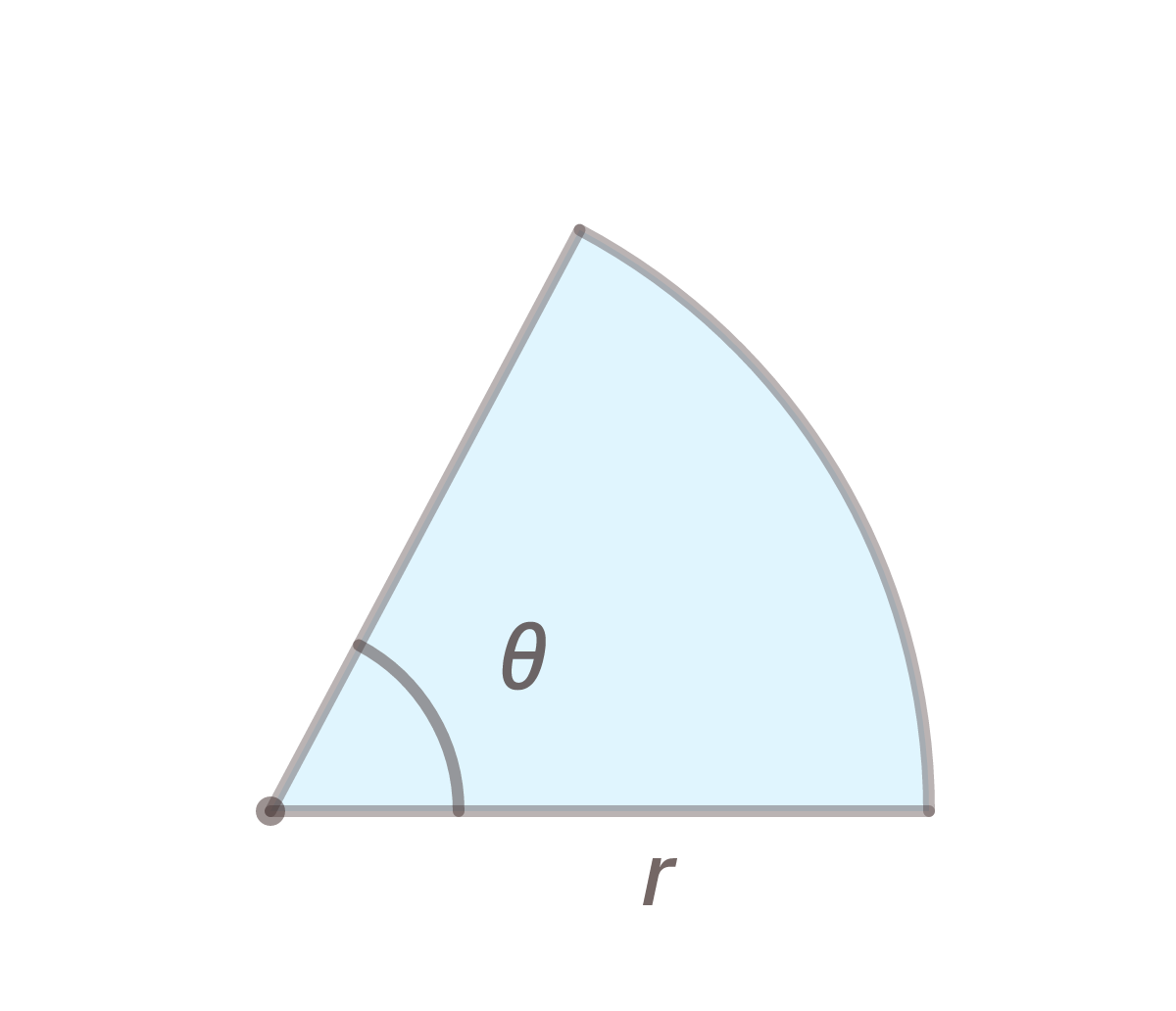
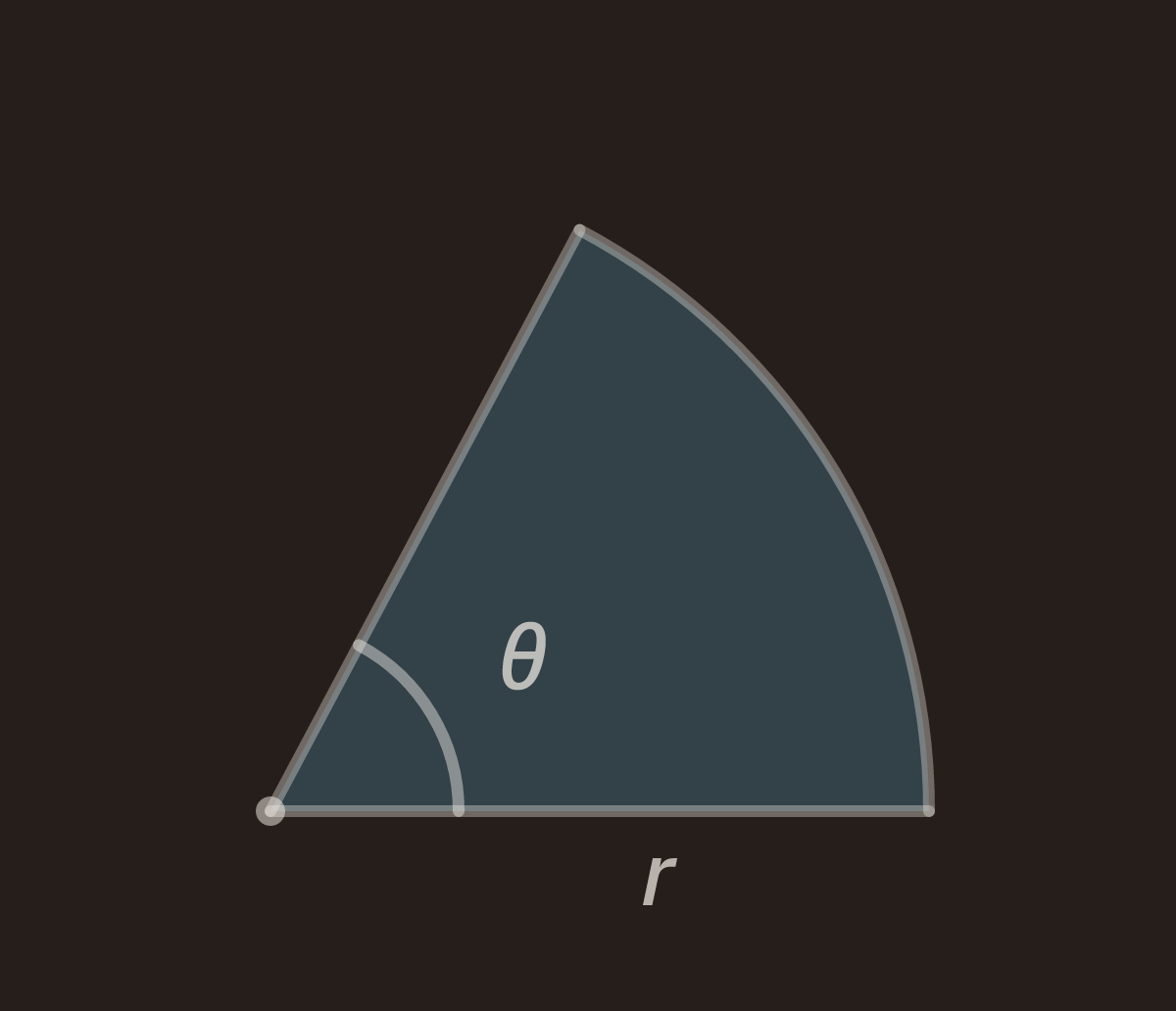
A slice of a circle: two radii r from the centre and the arc between them. The central angle θ is marked with a small arc at the centre. The shaded surface between the two radii is the area A. The angle can be anything up to a full turn.
Solve for

A≈28.2743cm²

A equals (90 degrees divided by 360 degrees) times (π times 6 squared), equals 0.25 times (π times 36), is approximately 0.25 times 113.0973, is approximately 28.2743 cm²

Working4 steps

Practice questions

You are given

  • θ=270°
  • r=5cm

Round to 1 decimal.

Pick the unit your lengths are in. Areas are then labelled in square units and volumes in cubic units; nothing is converted.

A fraction of the full turn

A full turn is 360°. A sector with a central angle of θ takes θ / 360 of the circle — a quarter turn is a quarter of the area, a sixth of a turn a sixth of it.

So the sector’s area is (θ / 360) · π r². You do not need a separate formula for the slice; you need the circle’s area and a fraction.

Worked examples

A third. The radius is 6 cm and the angle 120°: the fraction is 120 / 360 = 1/3, and the circle’s area is π · 6² = 36π. The sector is 36π / 3 = 12π ≈ 37.7 cm².

A quarter. Radius 4 m, angle 90°: (90 / 360) · π · 4² = 4π ≈ 12.6 m².

A flower bed. A corner of the garden is a quarter circle with a radius of 2.5 m. Its area is (90 / 360) · π · 2.5² ≈ 4.9 m² — that is how much soil has to cover it.

Common mistakes

Common questions

What is the difference between a sector and a segment? The sector is the slice: two radii and the arc between them. The segment is what is left when you cut the sector off with a straight chord — for angles below 180°, the sector minus the triangle.

What happens at 360°? The fraction is 360 / 360 = 1 and the formula gives π r², the area of the whole circle. At 180° you get a semicircle.

How does the sector relate to the arc? The same fraction governs both. The angle takes θ / 360 of the circle’s area in the sector and θ / 360 of the circumference in the arc length.

Looking for another letter? The formula solved for each one
Solved for each letter
Solve forRearrangedWith the numbersComes to
r360°Aθπ360°·28.2790°π6 cm
θ360°Aπr²360°·28.27π·6²90°
Aθ360°πr²90°360°π·6²28.27 cm²

The Greek alphabet

Table

The Greek alphabet
CapitalLowercaseNameUsed for
ΑαalphaAngles
ΒβbetaAngles
ΓγgammaAngles
ΔδdeltaChange (Δ), as in ΔT and Δx
ΕεepsilonA small positive number
Ζζzeta—
ΗηetaEfficiency
ΘθthetaAngles, such as the central angle
Ιιiota—
Κκkappa—
ΛλlambdaWavelength
ΜμmuCoefficient of friction and the mean; the prefix micro
Ννnu—
Ξξxi—
Οοomicron—
ΠπpiA circle's circumference divided by its diameter, about 3.14
ΡρrhoDensity
ΣσsigmaStandard deviation (σ) and sum (Σ)
Ττtau—
Υυupsilon—
ΦφphiAngles
ΧχchiThe chi-squared test (χ²)
Ψψpsi—
ΩωomegaThe ohm, the unit of resistance (Ω); angular velocity (ω)

Last reviewed October 6, 2026 ·How pages are reviewed

More about the circular sector

The same drawing, measured in the other ways it can be measured.

GeometryAll formulas

Put this formula on your site

Copy the code into your page where the formula card should appear. It loads from lovetocalc.com, so it stays current on its own — all we ask is that the credit line comes with it.