- ka = (ka₁, ka₂)
- (c₁, c₂) = k(a₁, a₂)
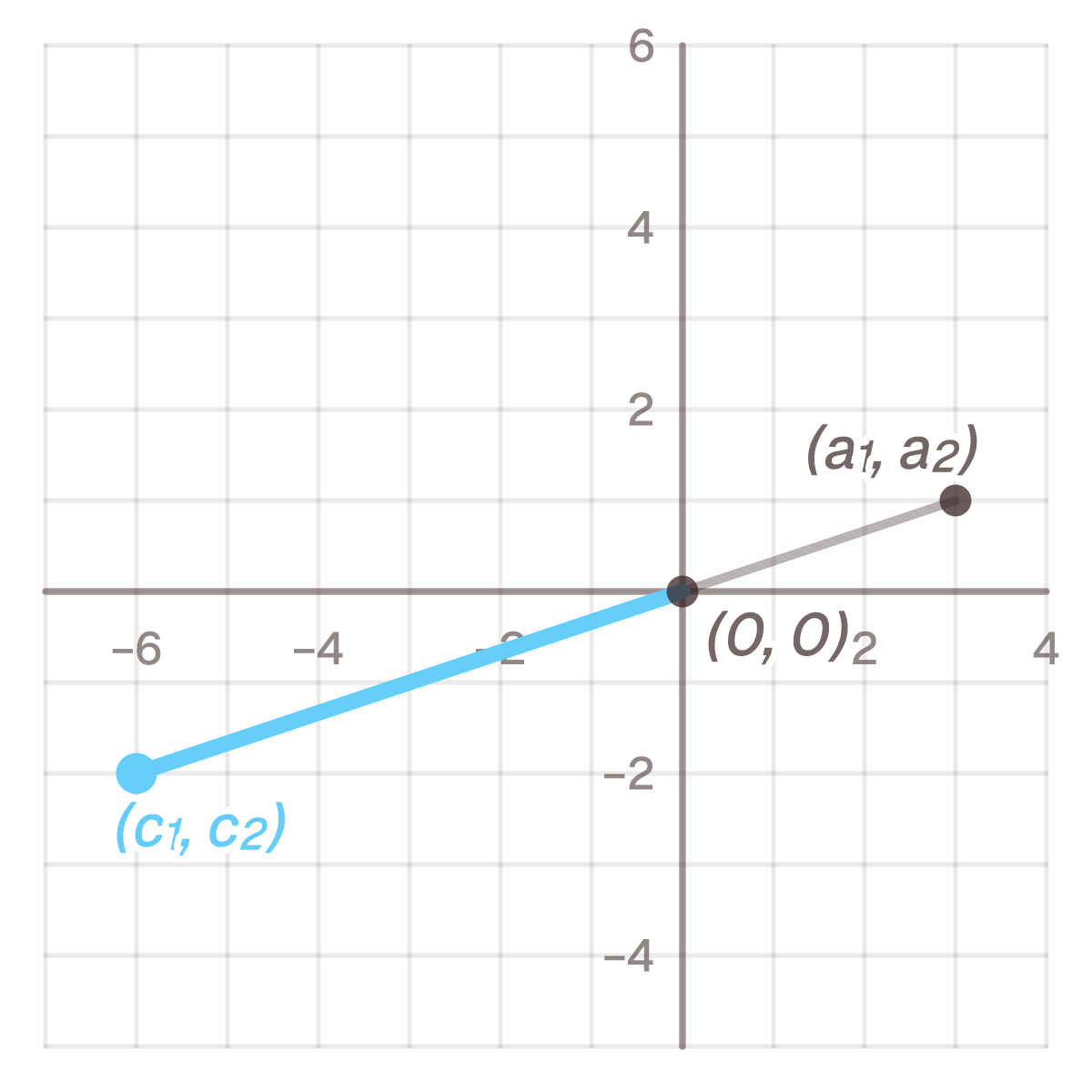
For the vector a = (a₁, a₂) and the number k. On the card above, the product’s coordinates are called
c₁ and c₂.
With k = −2 and a = (3, 1):
−2a = (−2 · 3, −2 · 1) = (−6, −2)
What the number does to the vector
| k |
ka compared with a |
| greater than 1 |
same direction, longer |
| between 0 and 1 |
same direction, shorter |
| 0 |
the zero vector |
| negative |
opposite direction |
The length is multiplied by the absolute value of k: |ka| = |k| · |a|. The vector −2a above is twice
as long as a and points the opposite way.
Are two vectors parallel?
Two vectors are parallel when one is a number times the other. Is (−6, 9) parallel to (2, −3)? The
first coordinates give k = −6/2 = −3. Try the same k on the second: −3 · (−3) = 9. It matches, so
(−6, 9) = −3 · (2, −3).
A test without division is to cross-multiply: c₁ · a₂ = c₂ · a₁. Here −6 · (−3) = 18 and 9 · 2 = 18.
The card finds k from both vectors as k = (c₁a₁ + c₂a₂)/(a₁² + a₂²), here (−12 − 27)/(4 + 9) = −3.
When a₁ is not 0 that is the same number as c₁/a₁, but the form also works for a vertical vector, where
a₁ = 0. If the vectors are not parallel there is no k, and the card says so.
Unit vectors
Divide a vector by its length and you get a vector of length 1 in the same direction. The vector (3, 4)
has length 5, so its unit vector is (3/5, 4/5) = (0.6, 0.8). The length comes from the
magnitude of a vector.
Common mistakes
- Multiplying only one coordinate. The number multiplies every coordinate.
- Losing the sign. A negative k reverses the vector, and every coordinate changes sign.
- Reading k off a single coordinate. Both coordinates have to give the same k, or the vectors are
not parallel.
Common questions
Can a vector be divided by a number?
Yes. a/k is the same as (1/k) · a, as long as k is not 0.
How is this different from the dot product?
A number times a vector gives a vector. The dot product
of two vectors gives a number.
How does it relate to vector addition?
2a is a + a and 3a is a + a + a. Multiplying by a whole number is repeated
vector addition, as it is for numbers.