Pick the unit your lengths are in. Areas are then labelled in square units and volumes in cubic units; nothing is converted.
What the theorem says
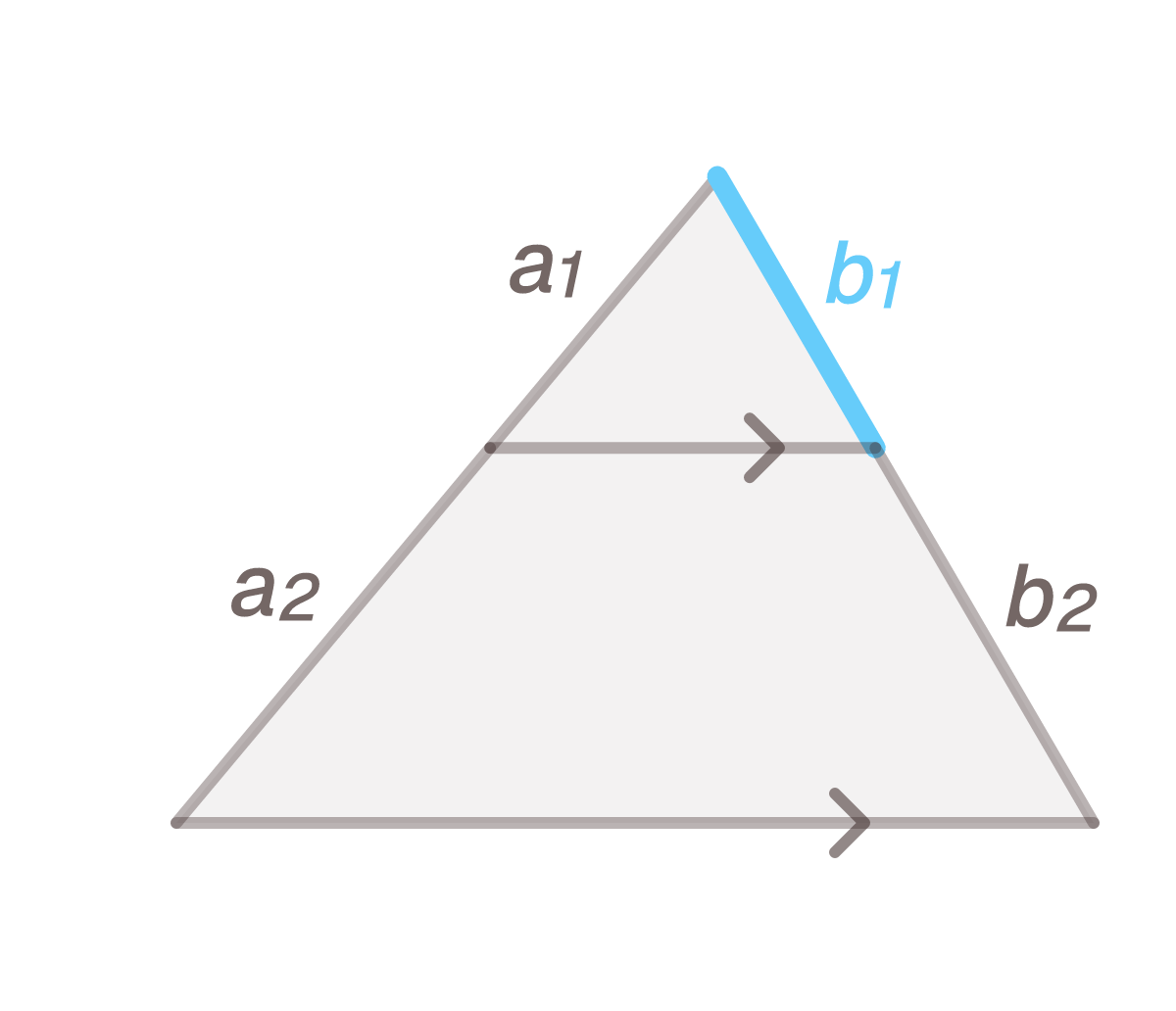
Draw a line parallel to one side of a triangle and the other two sides are each divided into two parts,
and those parts stand in the same ratio on both sides.
The result is also called the basic proportionality theorem, the intercept theorem or the side splitter theorem.
If the left side is divided 4 and 6, and the lower part of the right side is 9, then its upper
part is 4 · 9 / 6 = 6. The ratio 4 : 6 is the same as 6 : 9, which is 2 : 3 either way.
How it differs from the parallel-cut theorem
The two theorems concern the same figure but compare different things:
| Theorem |
Compares |
| Parallel cut |
the part with the whole side |
| Transversal theorem |
the part with the other part |
Both are true at once, and which one you reach for depends only on what you have measured. If you know
the whole side, use the parallel cut. If you have the two pieces, use this one.
Note that the transversal theorem does not apply to the length of the parallel line itself — that one
is in proportion to the base, not to the pieces of the sides.
Why it holds
The small triangle is similar to the whole one,
so a₁/a = b₁/b, where a and b are the whole sides. Write a = a₁ + a₂ and b = b₁ + b₂, cross-multiply and
simplify, and a₁/a₂ = b₁/b₂ falls out.
Worked examples
The upper part. a₁ = 3, a₂ = 5, b₂ = 10 gives b₁ = 3 · 10 / 5 = 6.
The lower part. a₁ = 12, a₂ = 9, b₁ = 8 gives b₂ = 9 · 8 / 12 = 6.
Check. 8/12 = 0.667 and 6/9 = 0.667 — the same ratio.
The whole side. Parts 6 and 15 on the left, 8 as the upper part on the right gives a lower part of
15 · 8 / 6 = 20, so the whole right side is 8 + 20 = 28.
Common mistakes
- Putting the whole side in the denominator. That is the parallel-cut theorem written in the
transversal theorem’s layout, and the answer comes out wrong.
- Applying it to the parallel line. The cut is compared with the base, not with the pieces of the
sides.
- Crossing the parts. The upper part goes over the lower part on both sides, not upper over lower
on one and the reverse on the other.
- Forgetting the parallel. Without it, none of this holds.
Common questions
Does it have another name?
Triangle proportionality theorem, sometimes Thales’ intercept theorem. The three names describe the
same result.
Does it work for several parallel lines?
Yes. Several parallel lines crossing two straight lines divide them in the same ratios all the way
along, which is what makes the theorem useful for dividing a segment into equal parts.
Can I use it in reverse?
Yes: if a line divides the two sides in the same ratio, it is parallel to the third side. That converse
is true as well.