Surface area of a pyramid
The relation
A
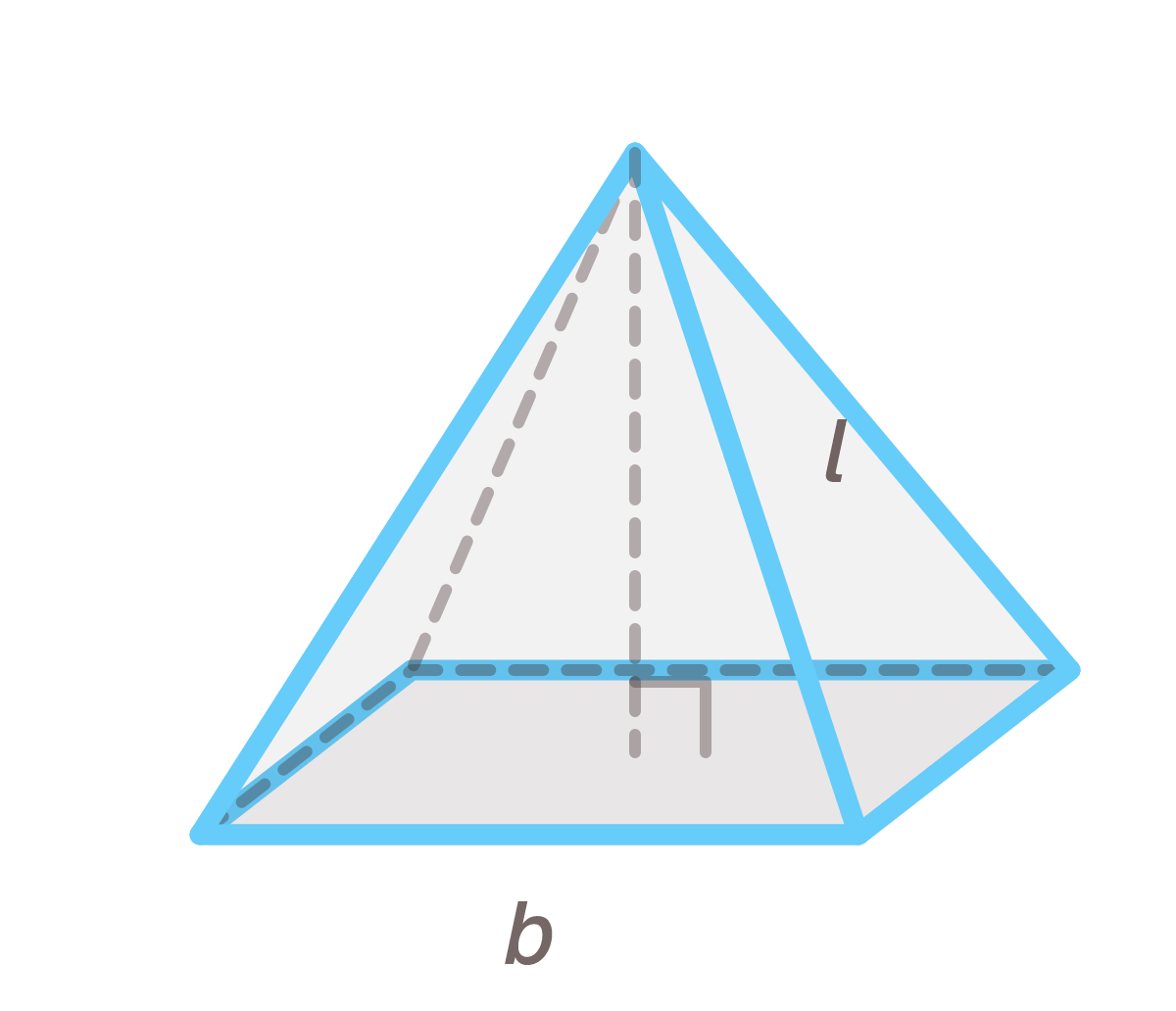
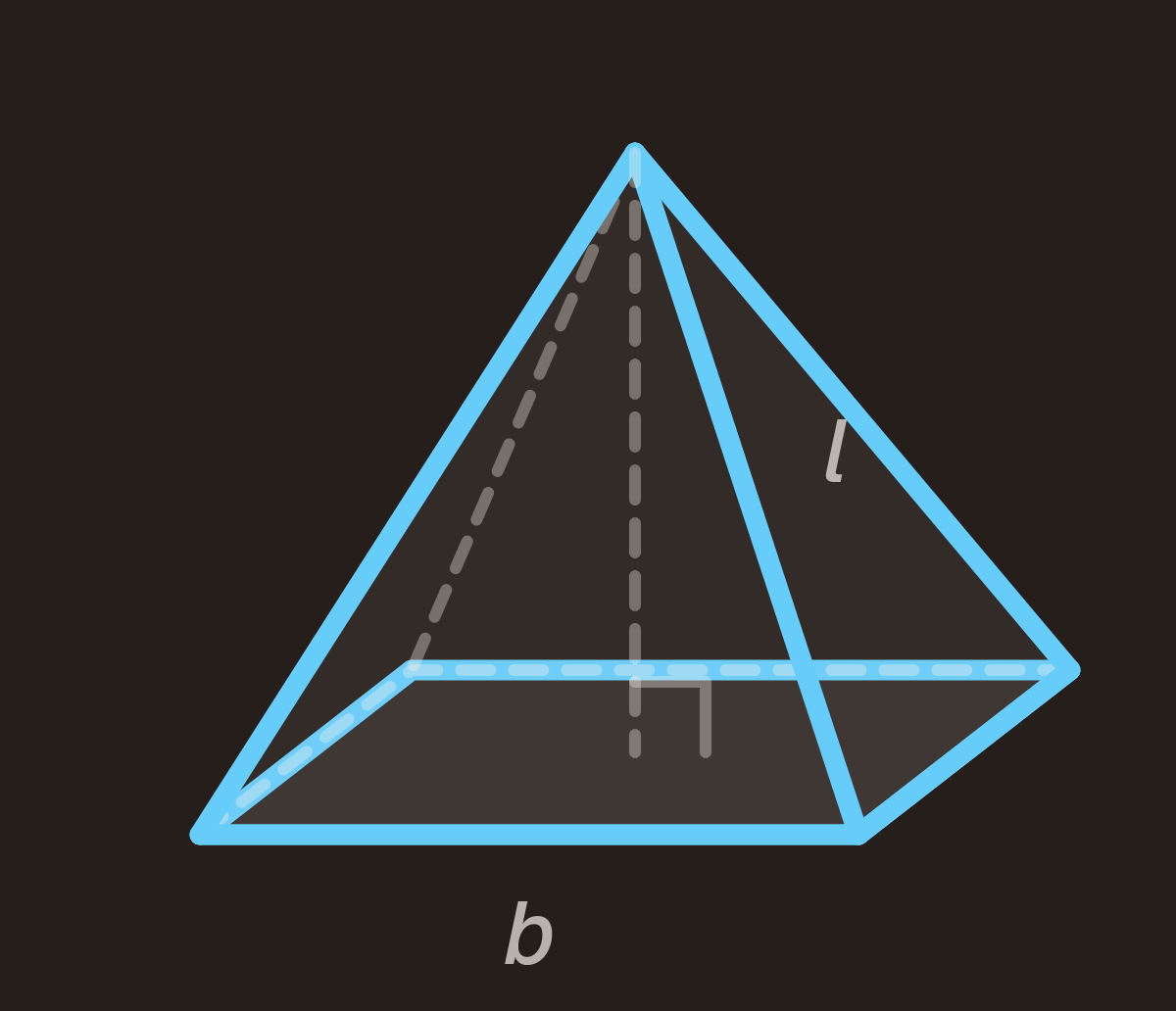
The four leaning triangles plus the square underneath them.
Solve for
A=96cm²
A equals 6 squared plus (2 times (6 times 5)), equals 36 plus (2 times 30), equals 36 plus 60, equals 96 cm²
Den här sidan finns på svenska. Byt till svenska
Definition — what does that mean?
The four leaning triangles plus the square they stand on.
In Swedish: Pyramidens begränsningsarea
A
The four leaning triangles plus the square underneath them.
A=96cm²
A equals 6 squared plus (2 times (6 times 5)), equals 36 plus (2 times 30), equals 36 plus 60, equals 96 cm²
You are given
A = 3584 cm²
Pick the unit your lengths are in. Areas are then labelled in square units and volumes in cubic units; nothing is converted.
A right pyramid on a square base has five faces: the base and four identical sides. The formula is those two parts added:
A = b² + 2 · b · l
It can also be written b(b + 2l), but b² + 2bl is the form that shows which faces are which, and that is the form that is easiest to check against the drawing.
The l in the formula is the slant height — the distance up the middle of a side face — and not the pyramid’s height straight up through the centre. The two differ, and they are connected by Pythagoras’ theorem:
l² = h² + (b / 2)²
If the question gives you the height, the first step is always to turn it into the slant height. It is the same step as on the lateral area, and it is a step that often gets skipped.
A pyramid with a base edge of 6 cm and a slant height of 5 cm. The base is 6² = 36 cm² and the wall is 2 · 6 · 5 = 60 cm². The surface area is 36 + 60 = 96 cm².
Working backwards for the slant height. A pyramid has a surface area of 96 cm² and a base edge of 6 cm. The wall is 96 − 36 = 60 cm², so the slant height is 60 / (2 · 6) = 5 cm.
Working backwards for the base edge. This rearrangement takes more than a line of algebra, because the area is quadratic in b. From b² + 2lb − A = 0 it follows that b = −l + √(l² + A), and only the positive root will do — a pyramid has no negative edge. With A = 96 and l = 5: b = −5 + √(25 + 96) = −5 + 11 = 6 cm.
How does it differ from the lateral area?
By exactly b² — the base’s area. The
lateral area is the four triangles alone.
Why can’t I find the base edge with a simple division?
Because b appears in two places, once squared. That makes the equation quadratic, and it is solved by
completing the square or with the quadratic formula.
How does this relate to the volume?
It does not, beyond being the same solid. The
volume is B · h / 3, measured in cubic units,
and it uses the height — not the slant height.
| Solve for | Rearranged | With the numbers | Comes to |
|---|---|---|---|
| b | 6 cm | ||
| l | A | 96 | 5 cm |
| A | b² | 6² | 96 cm² |
Last reviewed October 6, 2026 ·How pages are reviewed
The same drawing, measured in the other ways it can be measured.
Copy the code into your page where the formula card should appear. It loads from lovetocalc.com, so it stays current on its own — all we ask is that the credit line comes with it.