Volume of a cylinder
The relation
V
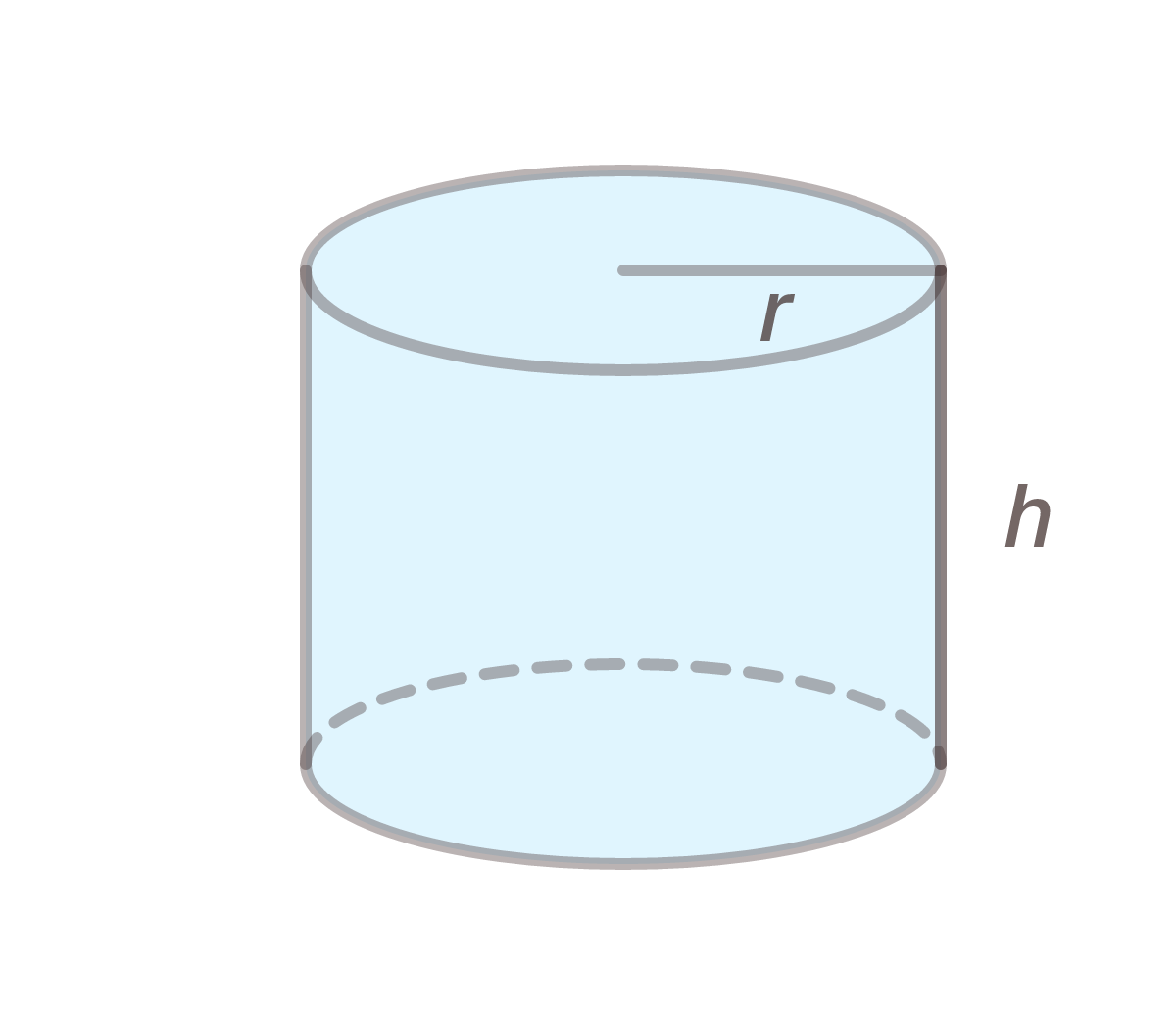
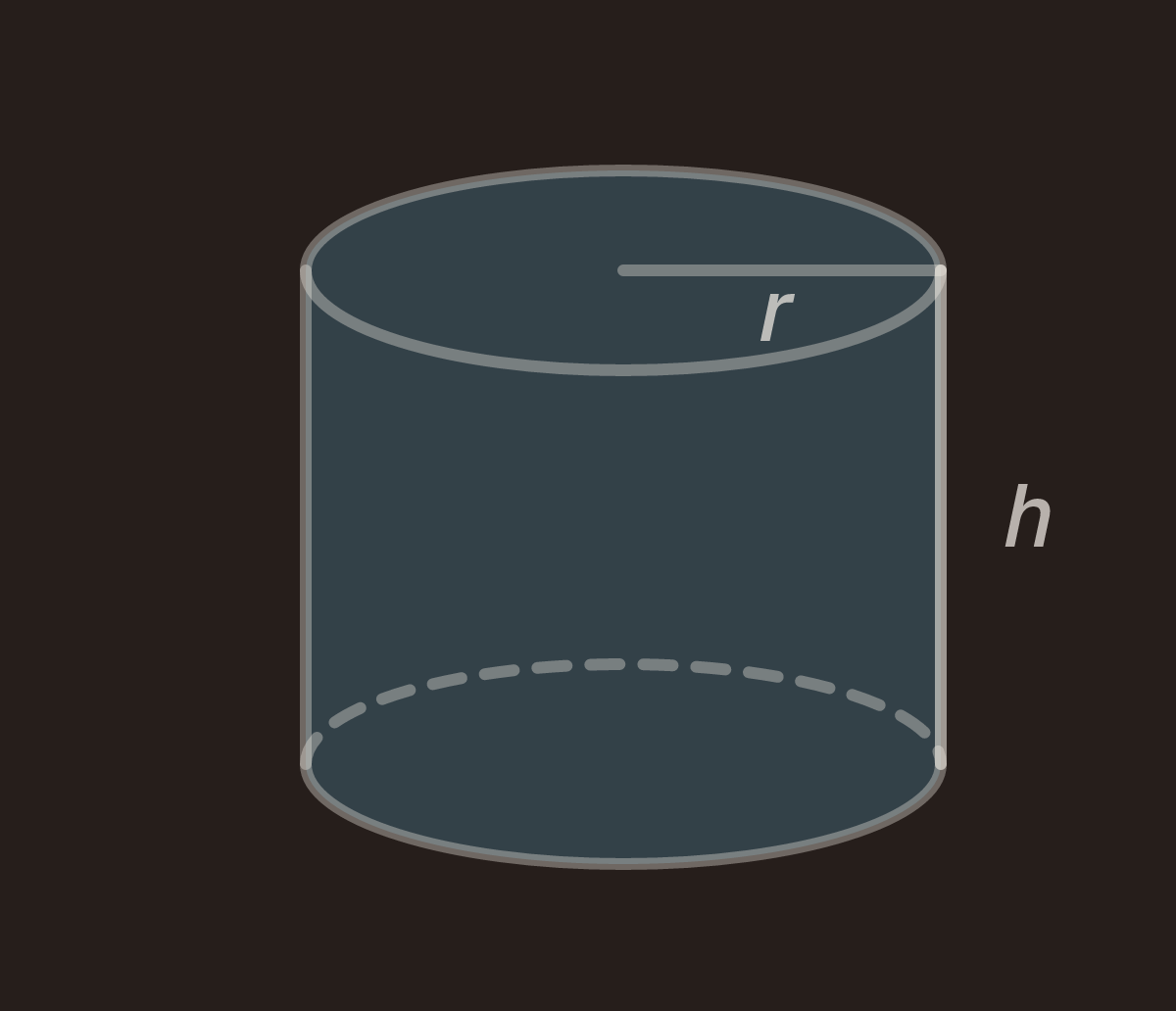
The circular base times the height.
Solve for
V≈125.6637cm³
V equals (π times 2 squared) times 10, equals (π times 4) times 10, is approximately 12.5664 times 10, is approximately 125.6637 cm³
Den här sidan finns på svenska. Byt till svenska
Theorem — what does that mean?
The circular base times the height — the same idea as the cuboid, with a round bottom instead of a rectangular one.
In Swedish: Cylinderns volym
V
The circular base times the height.
V≈125.6637cm³
V equals (π times 2 squared) times 10, equals (π times 4) times 10, is approximately 12.5664 times 10, is approximately 125.6637 cm³
You are given
V = ?
Round to 1 decimal.
Pick the unit your lengths are in. Areas are then labelled in square units and volumes in cubic units; nothing is converted.
Picture the cylinder as a stack of coins. Each coin is a circle of area πr², and stacking them to a height
of h makes the volume that area times the height:
It is the reasoning behind the volume of a cuboid — base area times height — with only the shape of the base swapped out. That a leaning stack of coins holds as much as an upright one (as long as the height is the same) is Cavalieri’s principle, so the formula also covers an oblique cylinder.
The formula therefore rests on the area of a circle, and that is why it is filed as a theorem rather than a definition.
A can. The radius is 2 cm and the height 10 cm: π · 2² · 10 = 40π ≈ 125.7 cm³, a little over an eighth of a litre.
A water tank. The diameter is 1.2 m, so the radius is 0.6 m, and the height is 1.5 m: π · 0.6² · 1.5 = 0.54π ≈ 1.70 m³, which is about 1,700 litres.
Backwards. You know the vessel should hold 1 m³ and that the radius is 0.6 m. The height is 1 / (π · 0.36) ≈ 0.88 m. The card above solves for whichever of the three quantities you need.
How much of a surrounding box does a cylinder fill?
About 79%, since π/4 ≈ 0.785. So round cans pack less efficiently than square ones.
How do I work out the volume of a pipe?
Take the outer cylinder and subtract the inner one: π(R² − r²) · h.
| Solve for | Rearranged | With the numbers | Comes to |
|---|---|---|---|
| r | 2 cm | ||
| h | Vπr² | 125.66π·2² | 10 cm |
| V | πr²h | π·2²·10 | 125.66 cm³ |
Table
| Unit | In cubic metres |
|---|---|
| mm³ | 1 × 10⁻⁹ |
| ml | 0.000001 |
| cm³ | 0.000001 |
| cl | 0.00001 |
| in³ | 0.000016387064 |
| dl | 0.0001 |
| l | 0.001 |
| dm³ | 0.001 |
| gal | 0.003785411784 |
| ft³ | 0.028316846592 |
| m³ | 1 |
Last reviewed October 6, 2026 ·How pages are reviewed
Sheets that ask this formula, with their answer keys. Open one to see the questions or print it.
Twenty questions on four solids. The volume is asked for in most; in some the volume is given and an edge or the height is asked for instead.
The same drawing, measured in the other ways it can be measured.
Copy the code into your page where the formula card should appear. It loads from lovetocalc.com, so it stays current on its own — all we ask is that the credit line comes with it.