The equation
- x²/a² + y²/b² = 1
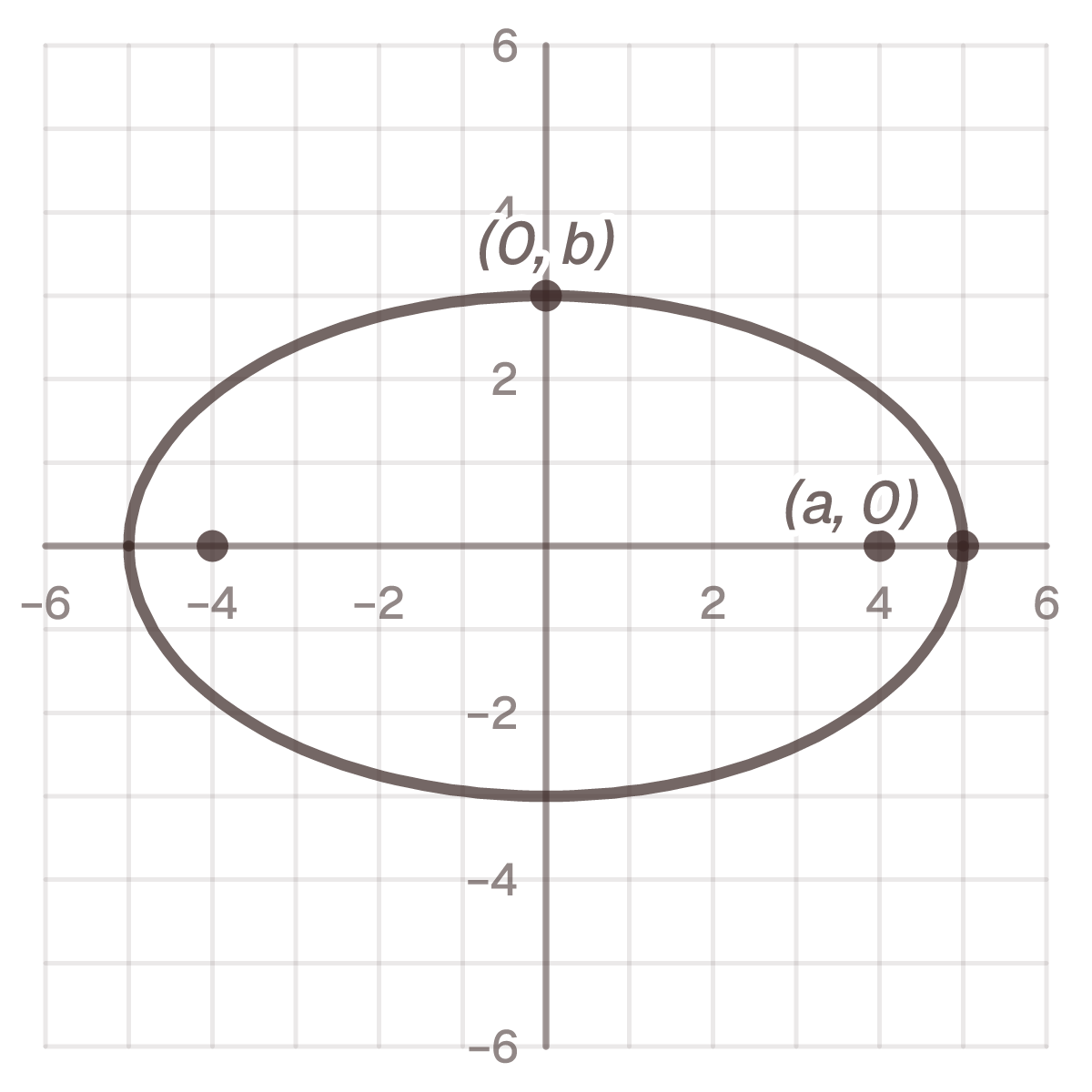
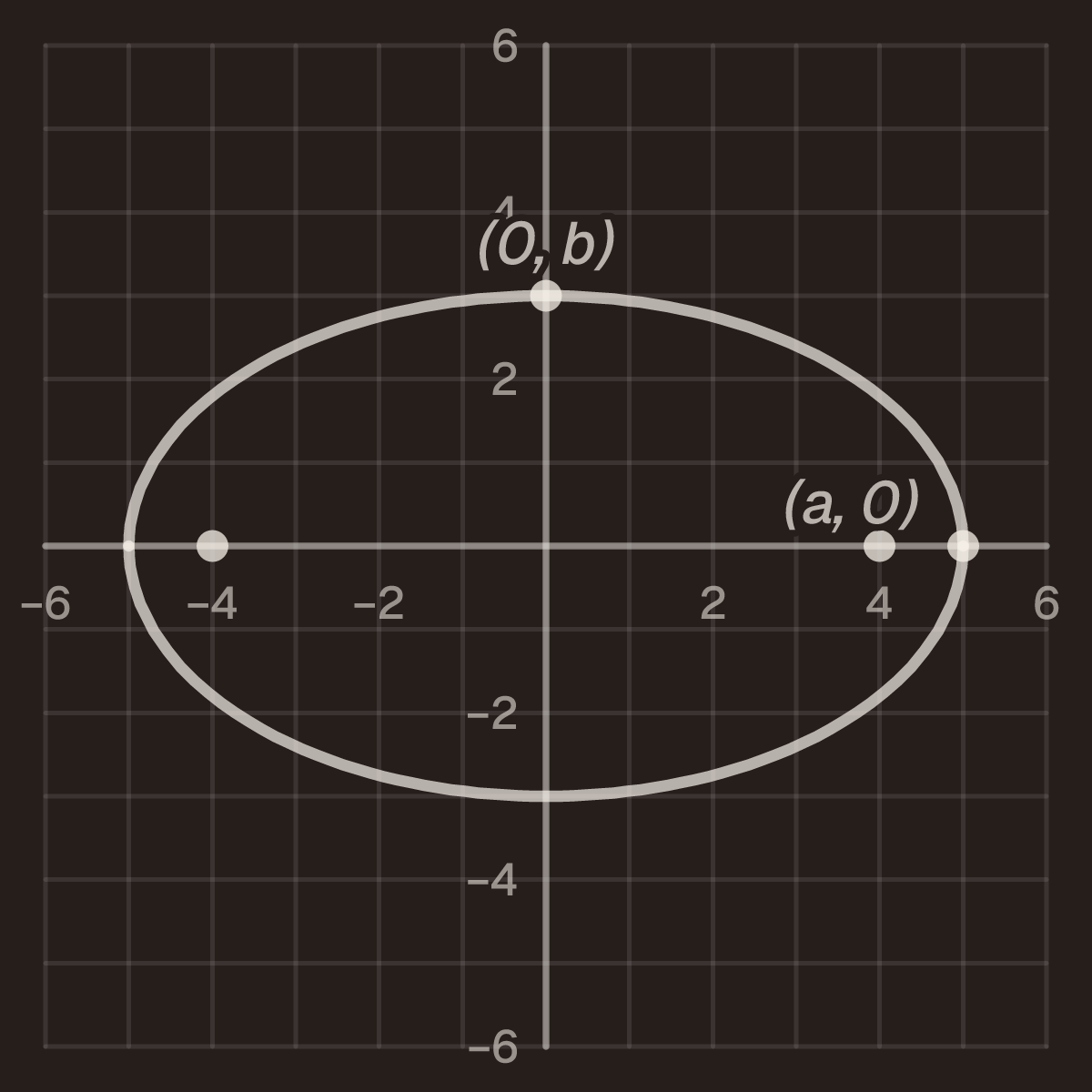
The ellipse is centred at the origin and crosses the x-axis at (±a, 0) and the y-axis at (0, ±b). The numbers a and b are the semi-axes, half the ellipse’s width and half its height. With a = b it is a circle of radius a.
The ellipse x²/25 + y²/9 = 1 has a = 5 and b = 3: it is 10 wide and 6 tall. The point (4, 1.8) lies on it, because 16/25 + 3.24/9 = 0.64 + 0.36 = 1.
The denominators are squares
Under x² stands a², not a. Read 25 as the semi-axis and you draw an ellipse 50 wide instead of 10:
| Equation | a | b | Width × height |
|---|---|---|---|
| x²/25 + y²/9 = 1 | 5 | 3 | 10 × 6 |
| x²/9 + y²/25 = 1 | 3 | 5 | 6 × 10 |
| x²/16 + y²/16 = 1 | 4 | 4 | a circle of radius 4 |
The second row is the same ellipse turned a quarter turn: the larger number now stands under y², and the ellipse is taller than it is wide.
The foci
An ellipse is also every point whose distances to two fixed points, the foci, add up to 2a. When a > b the foci lie on the x-axis at (±c, 0), where
c² = a² − b²
For x²/25 + y²/9 = 1, c² = 25 − 9 = 16, so the foci are at (±4, 0). Check with the point (4, 1.8): its distance to (4, 0) is 1.8 and to (−4, 0) it is √(64 + 3.24) = 8.2, together 10 = 2a.
When b > a the axes swap roles, and the foci lie on the y-axis with c² = b² − a².
An equation not in standard form
4x² + 9y² = 36 is an ellipse, but the denominators are hidden. Divide both sides by the right side so that it becomes 1:
4x²/36 + 9y²/36 = 1, so x²/9 + y²/4 = 1
Now it reads off: a = 3 and b = 2, and c² = 9 − 4 = 5, so the foci are at (±√5, 0).
Common mistakes
- Reading the denominator as the semi-axis. Under x² stands a²; the semi-axis is its root.
- The wrong sign in c². For an ellipse c² = a² − b², larger minus smaller. For a hyperbola it is a plus.
- Putting the foci on the wrong axis. They lie on the axis with the larger denominator.
- Forgetting to make the right side 1. Only then do the semi-axes stand in the denominators.
Common questions
How do I find the area of an ellipse?
From the semi-axes: A = πab. See the area of an ellipse.
The ellipse above has area 15π ≈ 47.1.
What does the equation look like when the centre is not the origin?
With the centre at (h, k), replace x by x − h and y by y − k: (x − h)²/a² + (y − k)²/b² = 1, just as in
the equation of a circle.
How is it different from a hyperbola?
One sign. x²/a² − y²/b² = 1 is a hyperbola: two branches opening away from each other instead of one
closed curve. See the equation of a hyperbola.