Area of a rhombus
The relation
A
Half the product of the two diagonals, which meet at a right angle.
Solve for
A=24cm²
A equals (6 times 8) divided by 2, equals 48 divided by 2, equals 24 cm²
Den här sidan finns på svenska. Byt till svenska
Theorem — what does that mean?
Multiply the diagonals and halve the result. It works because the diagonals cross at a right angle.
In Swedish: Rombens area
A
Half the product of the two diagonals, which meet at a right angle.
A=24cm²
A equals (6 times 8) divided by 2, equals 48 divided by 2, equals 24 cm²
You are given
A = 24 cm²
Pick the unit your lengths are in. Areas are then labelled in square units and volumes in cubic units; nothing is converted.
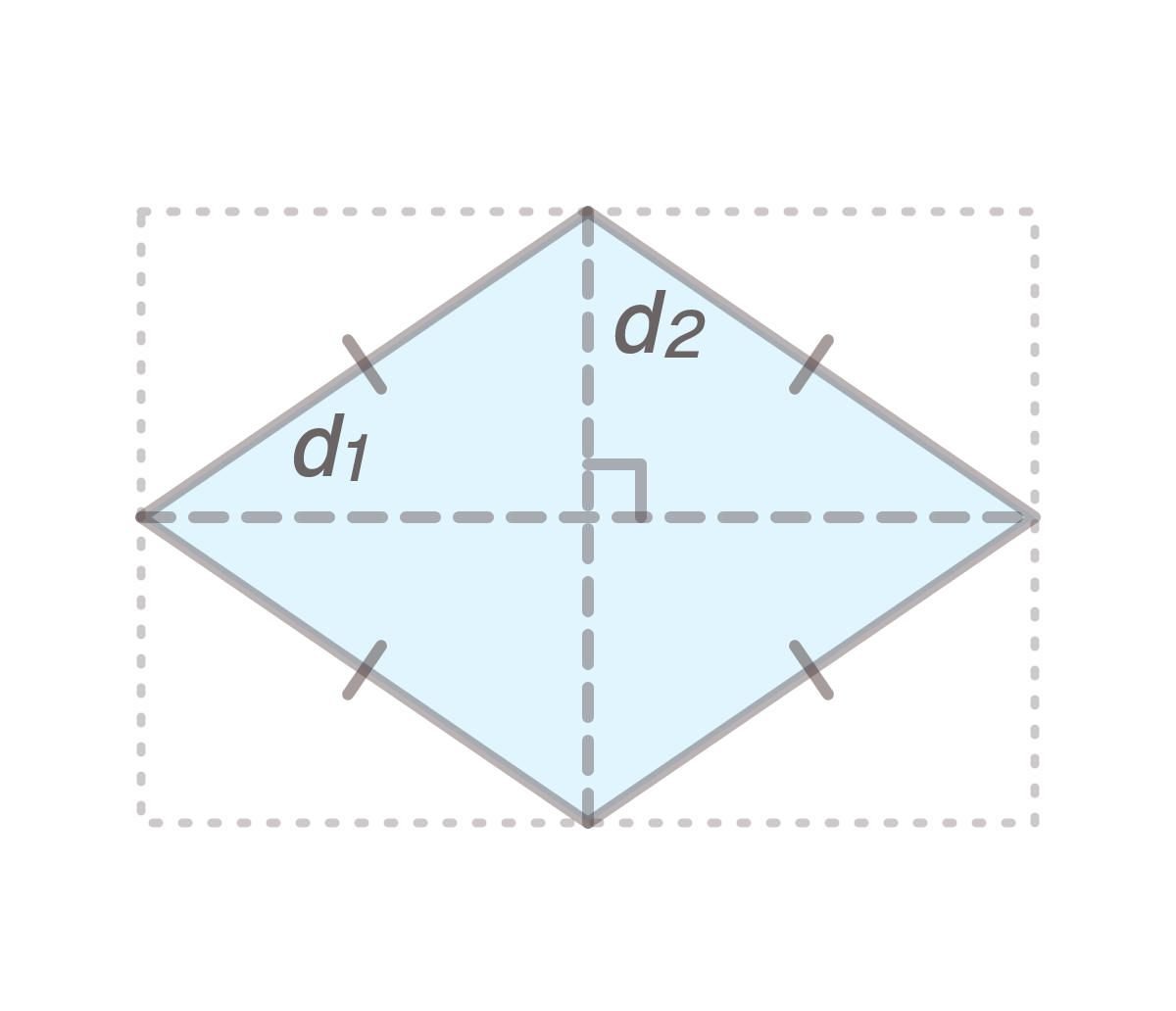
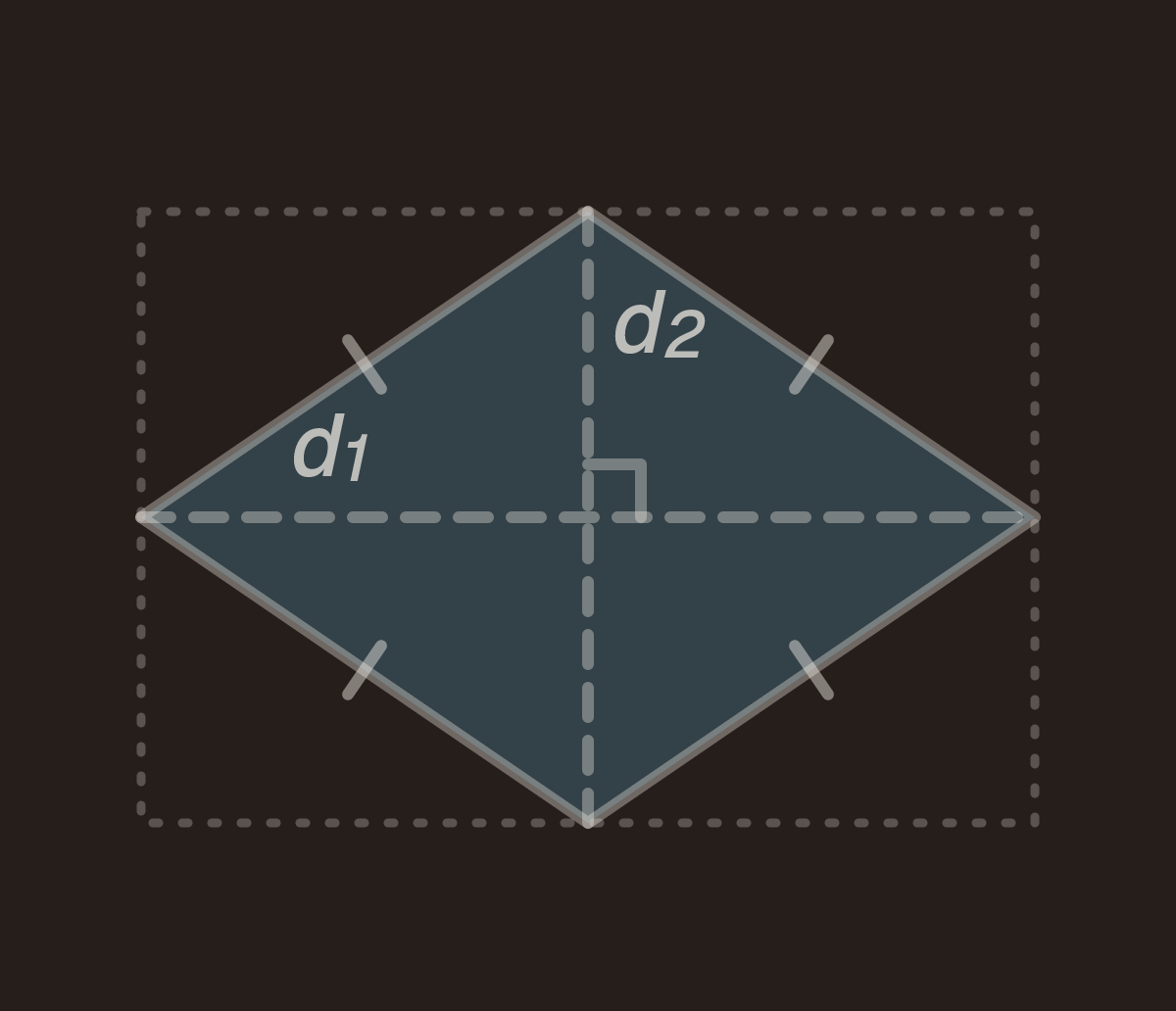
A rhombus is a quadrilateral with four equal sides — a square that has been pushed over. Its two diagonals cross at a right angle, and each cuts the other in half. That is what makes the area so easy to write down.
A rhombus with diagonals of 6 cm and 8 cm has an area of 6 · 8 / 2 = 24 cm².
Draw the rectangle that just encloses the rhombus: it is d₁ wide and d₂ tall, so its area is d₁ · d₂. The diagonals cut the rhombus into four right triangles, and each of those has a twin outside the rhombus but inside the rectangle. The rhombus is exactly half the rectangle.
Put another way: the four triangles together have area 4 · (d₁/2 · d₂/2) / 2, which is d₁ · d₂ / 2.
A rhombus is also a parallelogram, so
works just as well, where b is one side and h is the distance to the opposite side. Which one you use depends on what you have measured. Diagonals are easier to measure on a figure drawn on paper; base and height are easier on a floor tile that is lying still.
Forwards. Diagonals of 10 cm and 14 cm give 10 · 14 / 2 = 70 cm².
Backwards. The area is 48 cm² and one diagonal is 12 cm. The other is 2 · 48 / 12 = 8 cm. Pick the diagonal as the unknown in the card above and every step is written out.
With the side instead. A rhombus with a side of 5 cm and a height of 4 cm has an area of 5 · 4 = 20 cm² — the diagonal formula is no help here, because the diagonals were never measured.
Is a square a rhombus?
Yes. A square is the rhombus whose angles happen to be right angles. The formula holds: a square with a
side of 5 has diagonals of 5√2 ≈ 7.07, and 7.07 · 7.07 / 2 ≈ 25 — the same answer as 5².
What is the difference from a kite?
A kite has two pairs of equal sides next to each
other, but the pairs need not match. The area uses the same formula, because a kite’s diagonals also meet
at a right angle.
How long are the diagonals if I only know the side?
The side alone is not enough — a rhombus can be squashed without its sides changing. If you know the side
and one diagonal, the Pythagorean
theorem gives the other, applied to one of the
four right triangles.
| Solve for | Rearranged | With the numbers | Comes to |
|---|---|---|---|
| d₁ | 2Ad₂ | 2·248 | 6 cm |
| d₂ | 2Ad₁ | 2·246 | 8 cm |
| A | d₁d₂2 | 6·82 | 24 cm² |
Last reviewed October 6, 2026 ·How pages are reviewed
Copy the code into your page where the formula card should appear. It loads from lovetocalc.com, so it stays current on its own — all we ask is that the credit line comes with it.