Pick the unit your lengths are in. Areas are then labelled in square units and volumes in cubic units; nothing is converted.
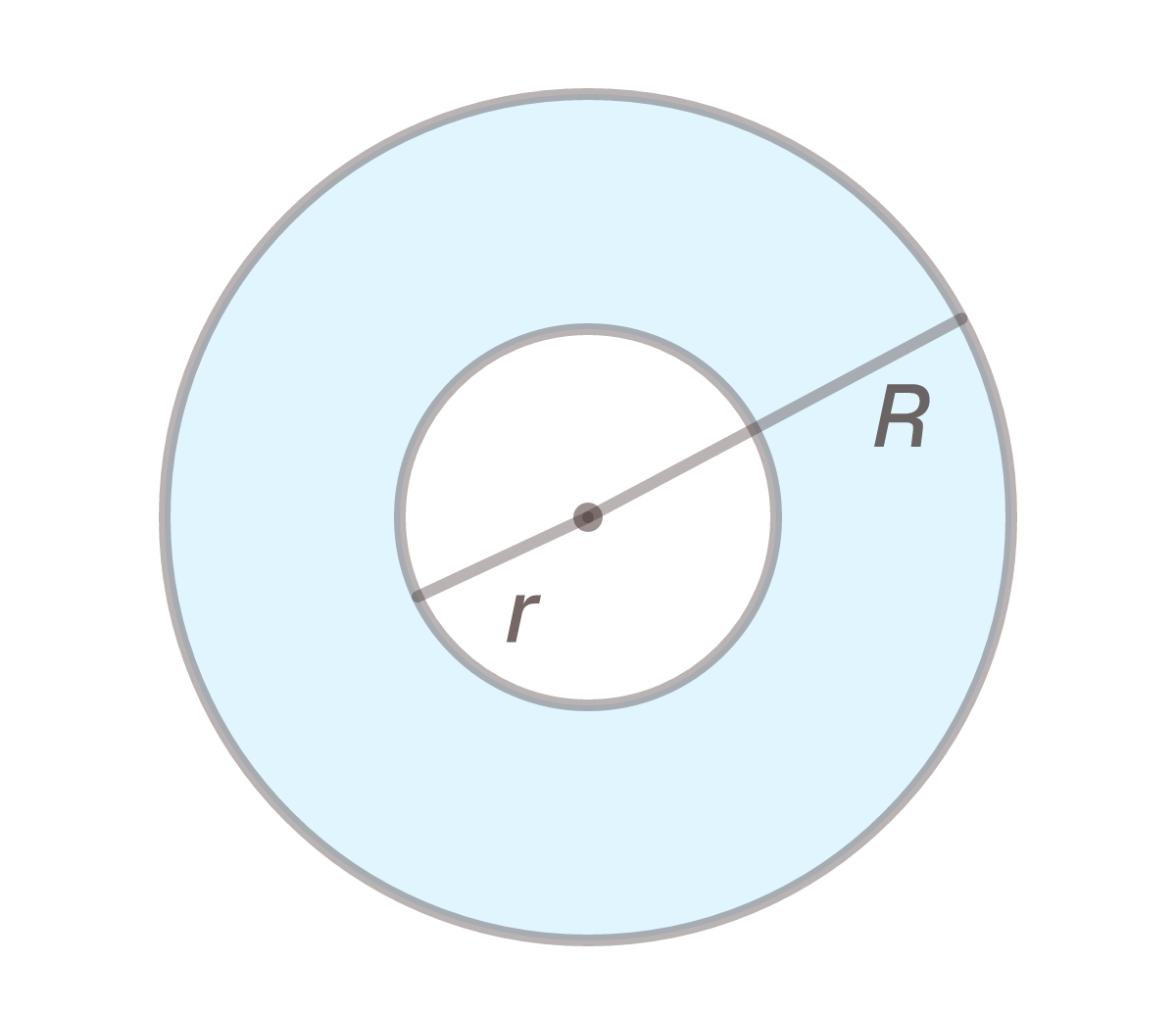
R is the outer radius and r the inner one. An annulus is what is left of a disc once a smaller circle has
been punched out of the middle: a washer, the cross-section of a pipe, a flower bed around a fountain.
A ring with R = 5 cm and r = 3 cm has an area of π(25 − 9) = 16π ≈ 50.3 cm².
Why you cannot subtract the radii
The tempting mistake is π(R − r)². With the numbers above that gives π · 2² = 4π ≈ 12.6 cm², a quarter of
the right answer.
The difference is that R² − r² and (R − r)² are not the same thing. The first is a difference of
squares and can be written (R + r)(R − r); the
second is R² − 2Rr + r², with a middle term the first does not have. The width R − r is not enough on its
own — a narrow ring far out has a much bigger area than an equally narrow ring near the centre.
That factored form is in fact the practical one: A = π(R + r)(R − r) is the width of the ring times the
circumference at the middle radius. A width of 2 cm at a middle radius of 4 cm gives
2π · 4 · 2 = 16π, the same answer.
Worked examples
A washer. The outer diameter is 20 mm and the hole 8 mm. The radii are 10 mm and 4 mm, so the area is
π(100 − 16) = 84π ≈ 264 mm².
A pipe. A steel pipe has an outer diameter of 60 mm and a wall thickness of 5 mm. So R = 30 mm and
r = 25 mm, and the cross-section is π(900 − 625) = 275π ≈ 864 mm².
A flower bed. Around a fountain of radius 1.5 m runs a bed 0.5 m wide. R = 2 m, r = 1.5 m, and the
area is π(4 − 2.25) = 1.75π ≈ 5.50 m².
Common mistakes
- Working out π(R − r)². See above. Square first, subtract second.
- Putting diameters in. The formula takes radii. With diameters the answer is four times too large.
- Confusing wall thickness with the inner radius. A pipe is usually given by outer diameter and wall
thickness; the inner radius is R minus the thickness, not the thickness itself.
Common questions
What is the figure called?
An annulus, from the Latin for a little ring. Plural annuli. In everyday English it is just a ring, and
the word is used in mathematics even when the ring is wide.
How long is the perimeter?
It has two — an outer and an inner. Together they are 2πR + 2πr, or 2π(R + r), which is what you want if
you are painting the edges.
Can I get the volume of a pipe this way?
Yes. The cross-section times the length gives the volume of the material, as for a plain
cylinder: V = π(R² − r²) · h.