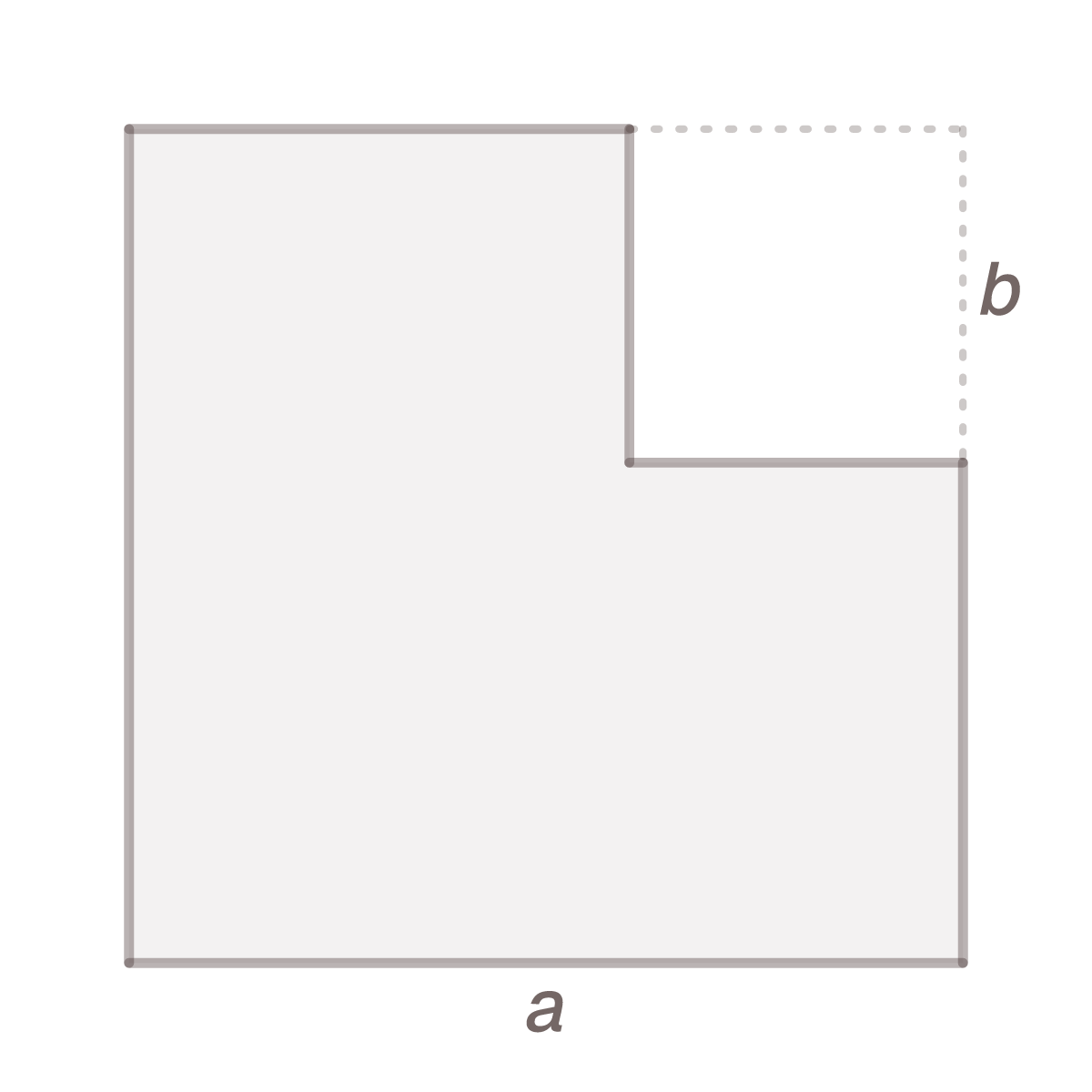
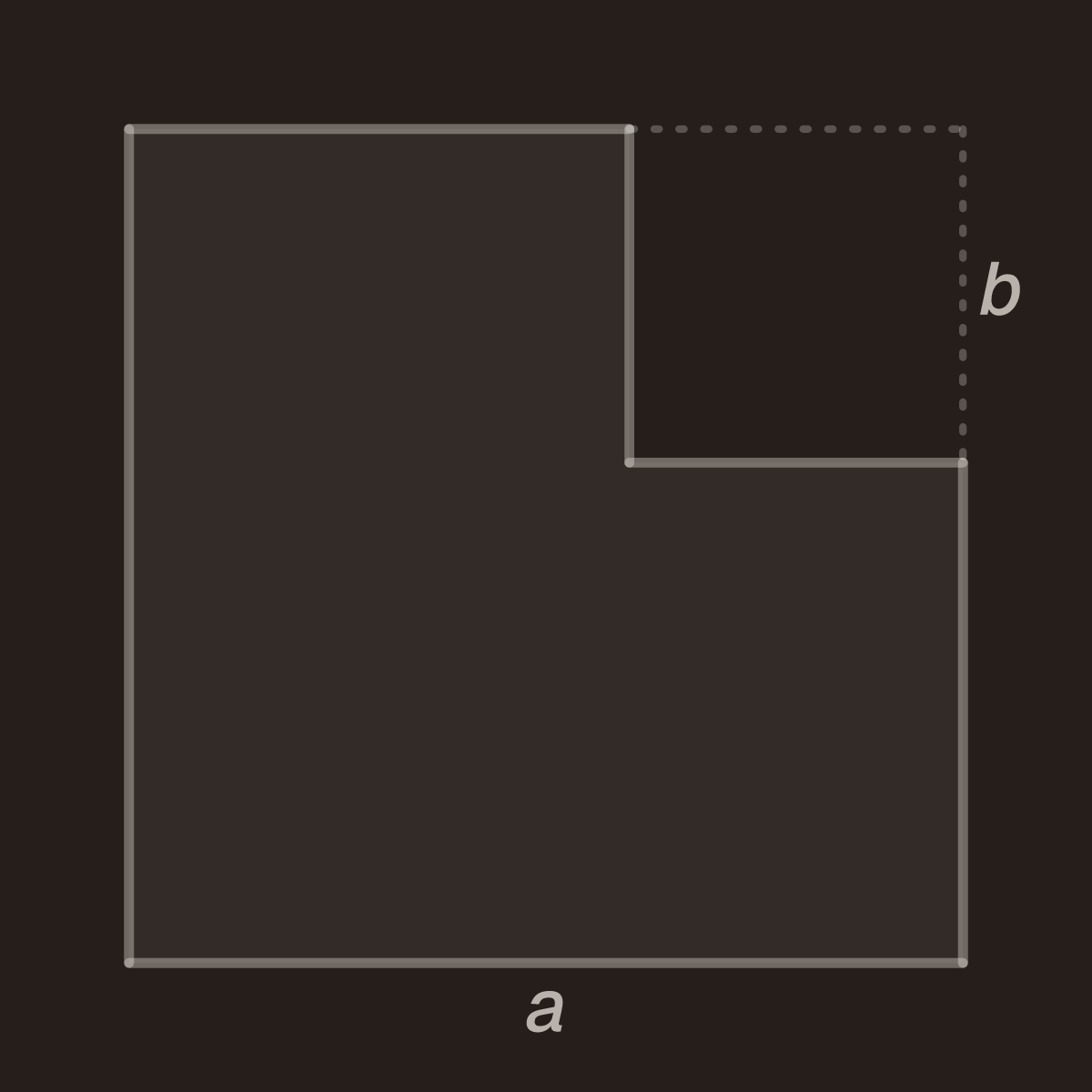
The rule
- (a + b)(a − b) = a² − b²
Two brackets holding the same two numbers, a plus in one and a minus in the other. Brackets like that are called conjugates, which is where the rule gets its other name.
The result has only two terms. The other two squaring rules give three.
Why the middle terms disappear
Multiply it out:
(a + b)(a − b) = a² − ab + ba − b²
The middle terms are −ab and +ba. Same number, opposite signs, so they cancel to nothing:
(a + b)(a − b) = a² − b²
Compare that with the other two rules, where the middle terms reinforce each other instead:
| Expression | Middle terms | Result |
|---|---|---|
| (a + b)² | +ab and +ba | a² + 2ab + b² |
| (a − b)² | −ab and −ba | a² − 2ab + b² |
| (a + b)(a − b) | −ab and +ba | a² − b² |
Factorising with it
Backwards, the rule is a tool: every difference of two squares splits into two factors.
- x² − 9 = (x + 3)(x − 3)
- 4y² − 25 = (2y + 5)(2y − 5)
- x² − 1 = (x + 1)(x − 1)
It is often the first move when a fraction is to be cancelled down or a quadratic solved without a formula.
Mental arithmetic
The rule makes certain multiplications easy to do in your head. Look for two numbers the same distance from a round one:
98 · 102 = (100 − 2)(100 + 2) = 10,000 − 4 = 9,996
47 · 53 = (50 − 3)(50 + 3) = 2,500 − 9 = 2,491
19 · 21 = (20 − 1)(20 + 1) = 400 − 1 = 399
Common mistakes
- Thinking a² + b² factorises too. It does not, not with real numbers. Only the difference of two squares splits.
- Forgetting to square the coefficient. 4y² − 25 is (2y)² − 5², so (2y + 5)(2y − 5) — not (4y + 5)(4y − 5).
- Confusing it with the squaring rules. Here two different brackets stand side by side. When the same bracket appears twice it is the square of a sum or of a difference that applies.
Common questions
Does the order of the brackets matter?
No. (a − b)(a + b) gives the same thing — multiplication is commutative. The result is still written
a² − b², with the square of the term carrying the plus sign in both brackets first.
Why “conjugate”?
Conjugate here means paired: a + b and a − b belong together and differ only by one sign. The same
word is used for complex numbers for the same reason.