Why there are three terms
Squaring a sum means multiplying the bracket by itself. When every term in the first bracket meets every term in the second, you get four products:
- (a + b)(a + b) = a · a + a · b + b · a + b · b
The two in the middle are the same product, so together they make 2ab, leaving a² + 2ab + b². The proof above this text walks through those steps, which is why the rule is an identity rather than a theorem: it follows from a chain of equalities, with no new assumption anywhere.
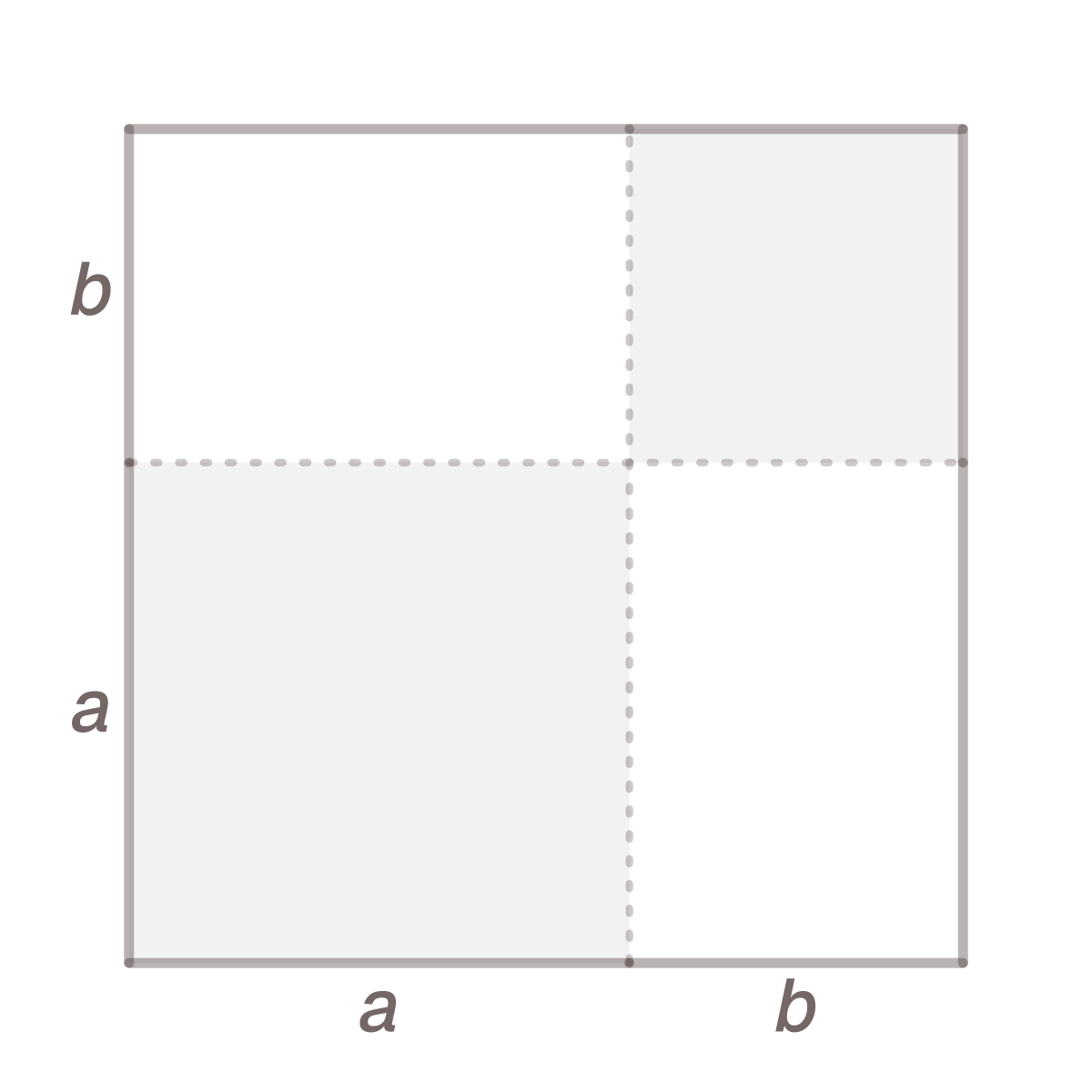
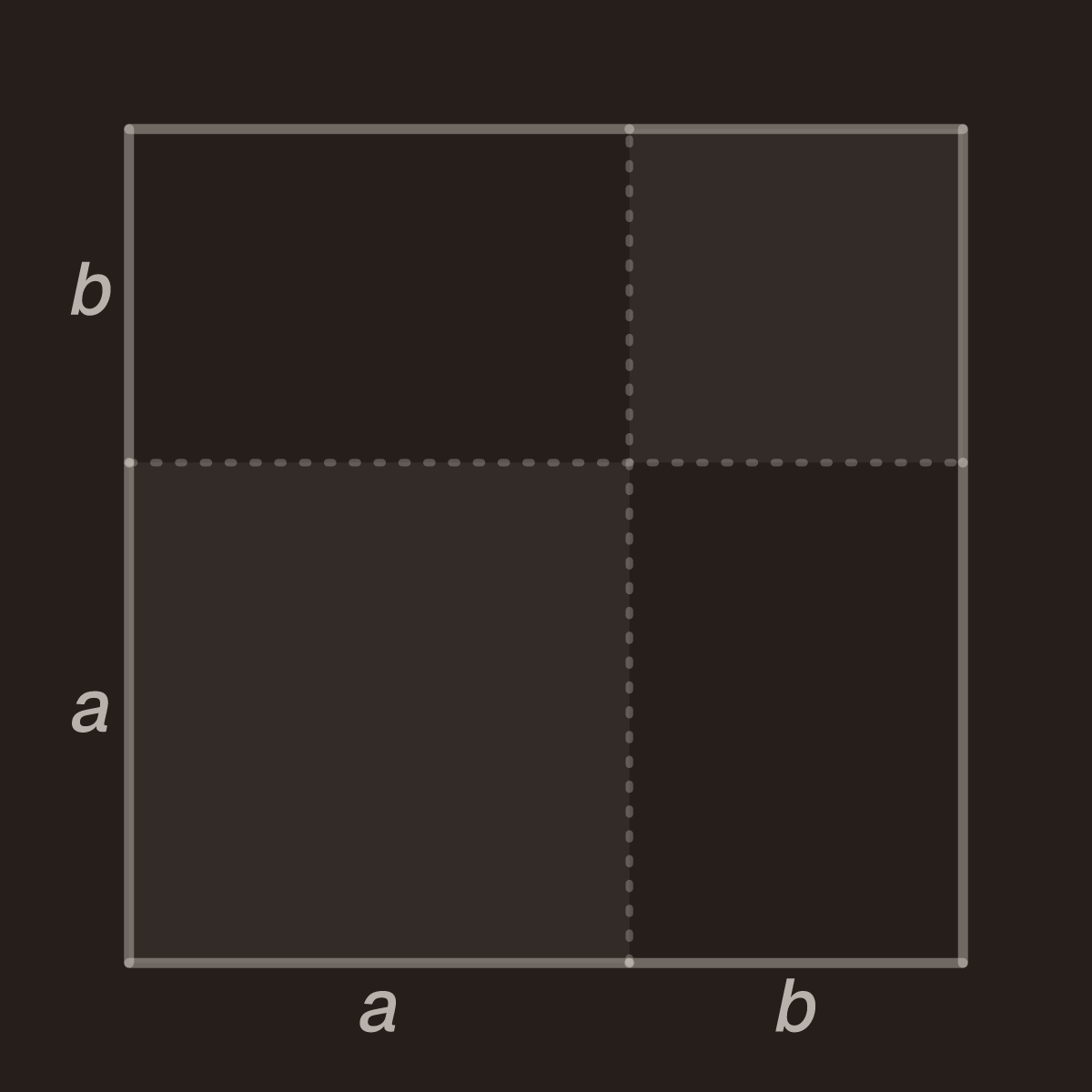
Geometrically it is a square of side a + b, which splits into four pieces: two squares, a² and b², and two equal rectangles of area ab each. The doubled product is those two rectangles.
Worked examples
Expanding. (x + 4)² = x² + 8x + 16.
Mental arithmetic. 103² = (100 + 3)² = 10,000 + 2 · 100 · 3 + 9 = 10,000 + 600 + 9 = 10,609.
The other way round. x² + 10x + 25 is a square, because 25 = 5² and 10x = 2 · x · 5, so the expression is (x + 5)². Recognising that pattern backwards is what completing the square rests on — and with it the quadratic formula.
The sister rules
| Rule | Written out |
|---|---|
| Square of a sum | (a + b)² = a² + 2ab + b² |
| Square of a difference | (a − b)² = a² − 2ab + b² |
| Difference of two squares | (a + b)(a − b) = a² − b² |
The second is the first with b replaced by −b: the squares are unaffected, but the middle term changes sign. The third is the only one of the three where the middle terms cancel instead of adding up.
Common mistakes
- Writing (a + b)² = a² + b². A common mistake. Test it with numbers: (2 + 3)² is 25, not 4 + 9 = 13.
- Forgetting the two. a² + ab + b² is missing half of the middle term.
- Losing the sign in the second rule. The middle term goes negative, but b² stays positive — a square of a real number is never negative.
Questions people ask
Does the rule hold for every number?
Yes. It follows from the ordinary laws of arithmetic and holds for positive numbers, negative numbers,
fractions and expressions containing variables.
What about (a + b + c)²?
Same principle: every term meets every term. You get a² + b² + c² + 2ab + 2ac + 2bc — the squares plus
twice the product of each pair.