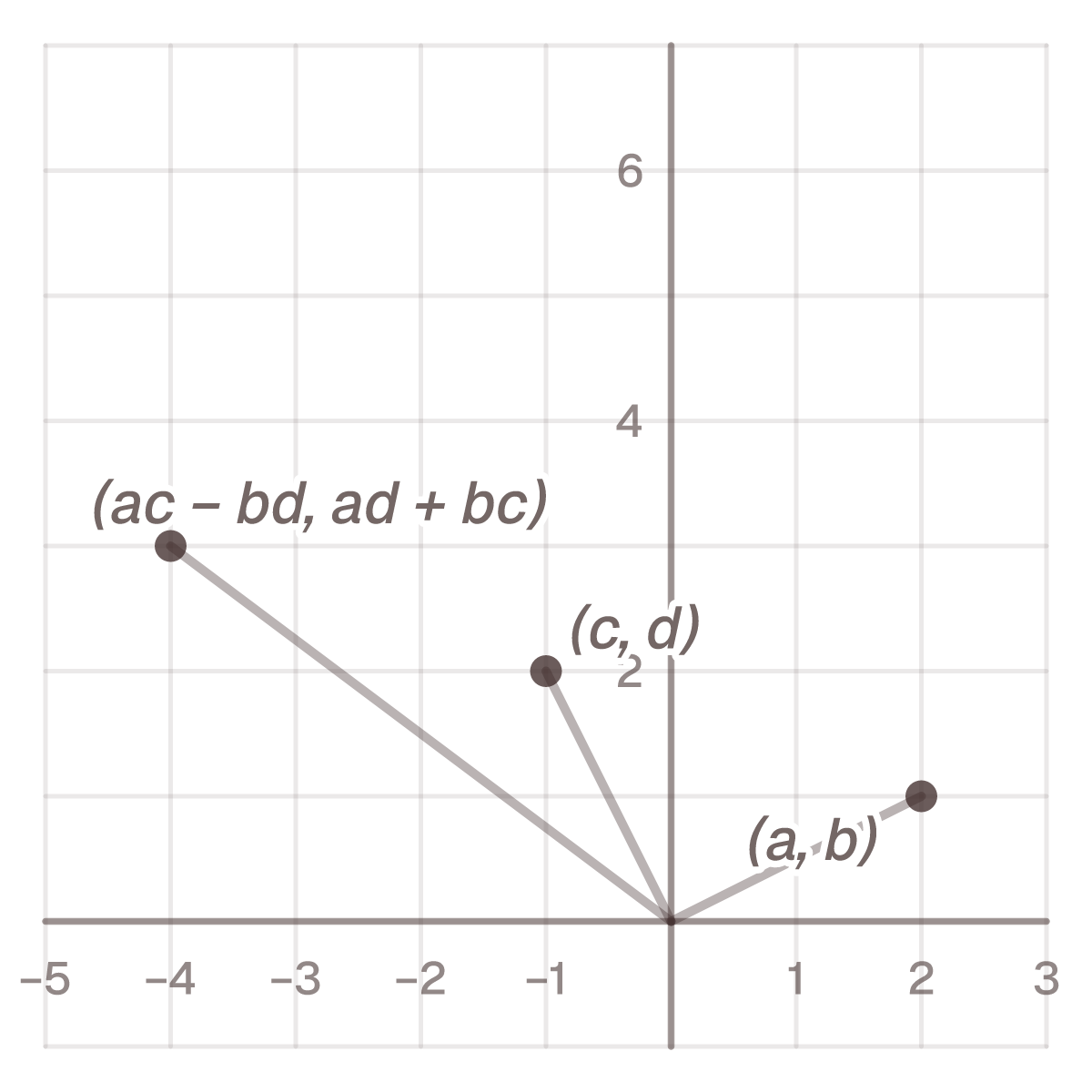
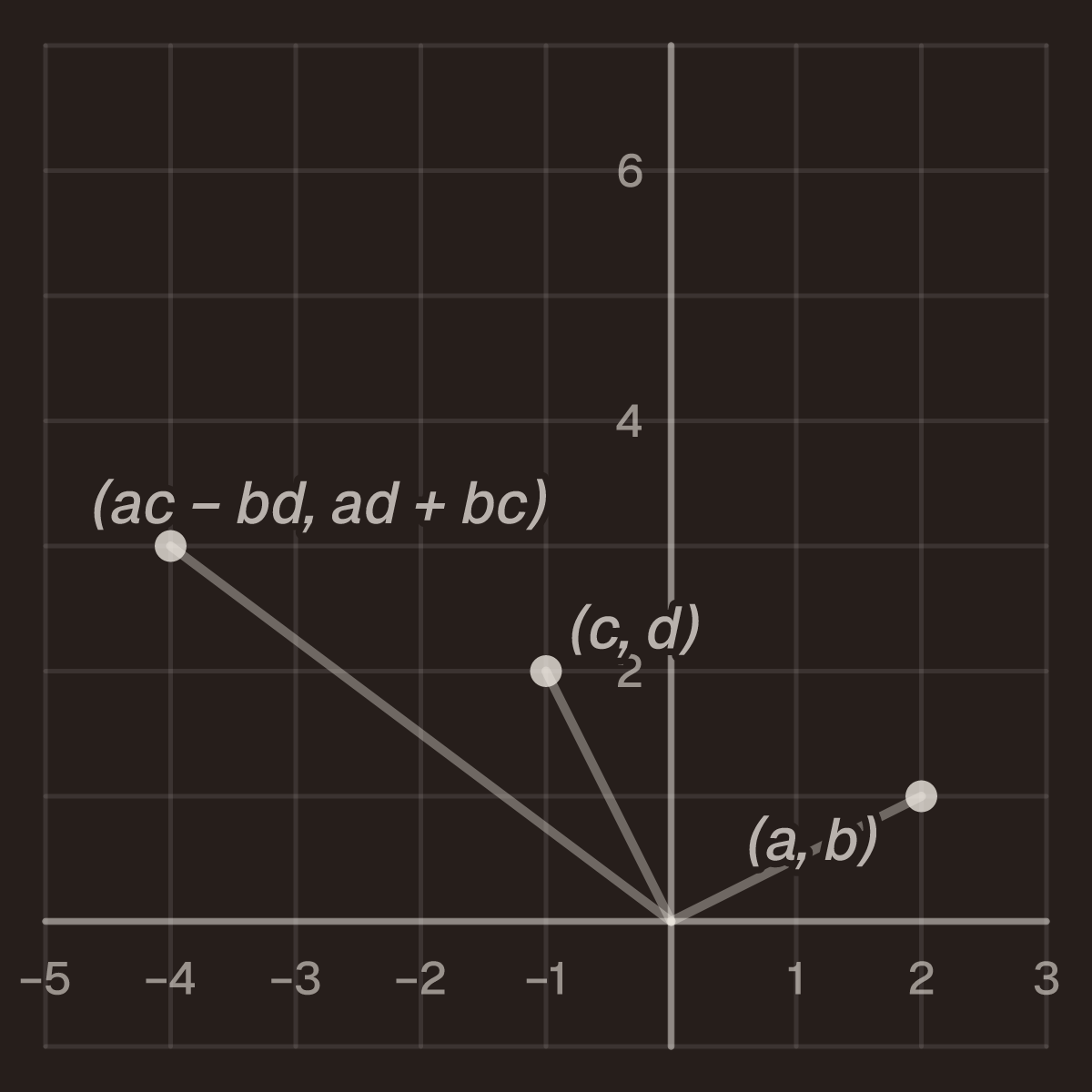
The formula
- (a + bi)(c + di) = (ac − bd) + (ad + bc)i
Holds for all real a, b, c and d. It follows from multiplying out and the definition of the imaginary unit, i² = −1:
(a + bi)(c + di) = ac + adi + bci + bd·i² = ac + adi + bci − bd.
Collect the terms without i, ac − bd, and the terms with i, (ad + bc)i.
Example
(3 + 4i)(2 − 5i):
- 3 · 2 = 6
- 3 · (−5i) = −15i
- 4i · 2 = 8i
- 4i · (−5i) = −20i² = +20
Real part 6 + 20 = 26, imaginary part −15 + 8 = −7, so the product is 26 − 7i. The formula gives the same: ac − bd = 6 − (−20) = 26 and ad + bc = −15 + 8 = −7.
A useful special case
Multiplying by a real number scales both parts: 3(2 + i) = 6 + 3i. Multiplying by i turns the number a quarter turn: i(a + bi) = −b + ai.
Common mistakes
- Forgetting that i² = −1. The product bd·i² is −bd, not +bd, so the real part is ac − bd.
- Multiplying the parts separately. (3 + 4i)(2 − 5i) is not 6 − 20i. Every term meets every term.
- Mixing up the two cross terms. Both ad and bc go in the imaginary part.
Where next
- In polar form the same product is simpler: product and quotient in polar form.
- Division uses a product with the conjugate: dividing complex numbers.
- A complex number times its conjugate is always real.