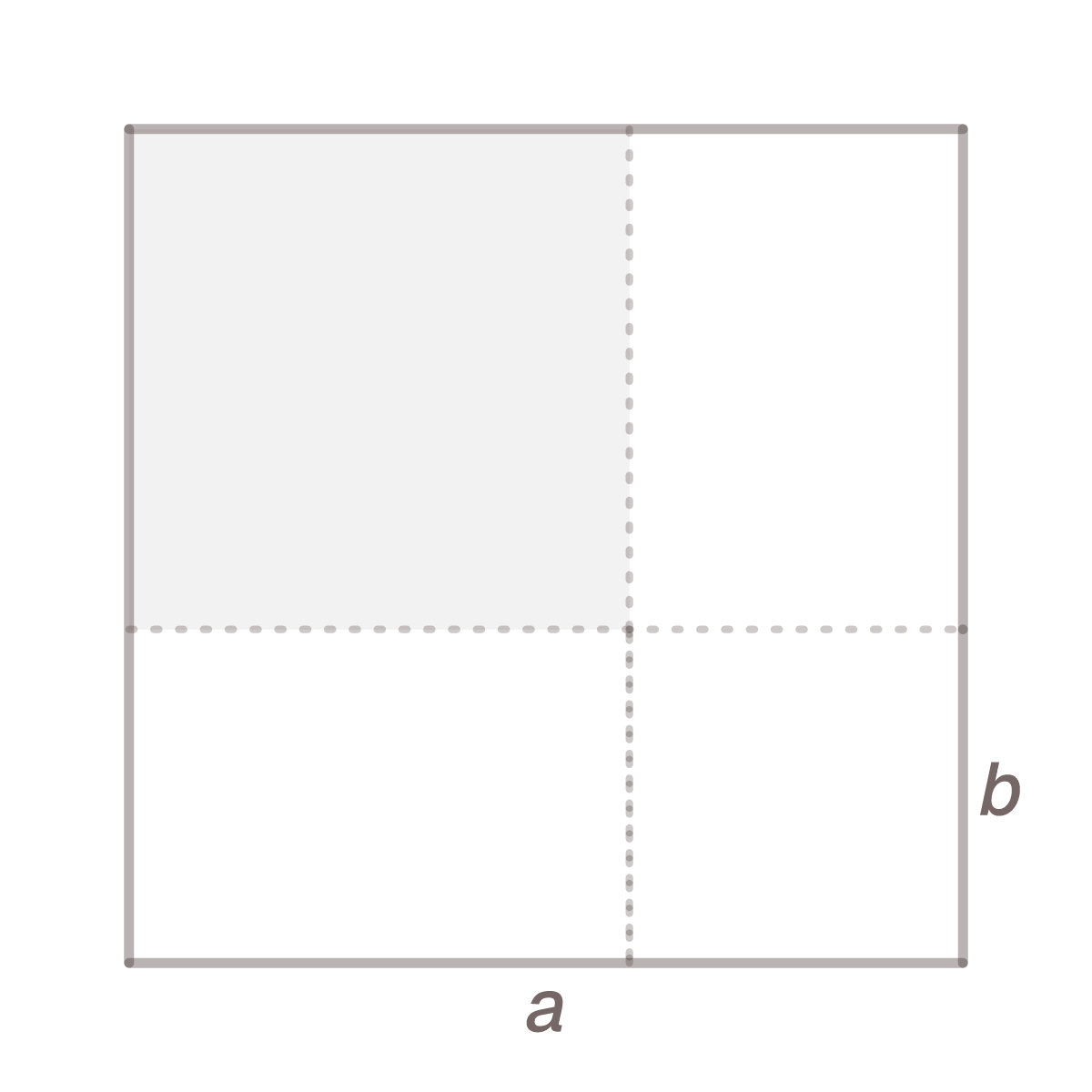
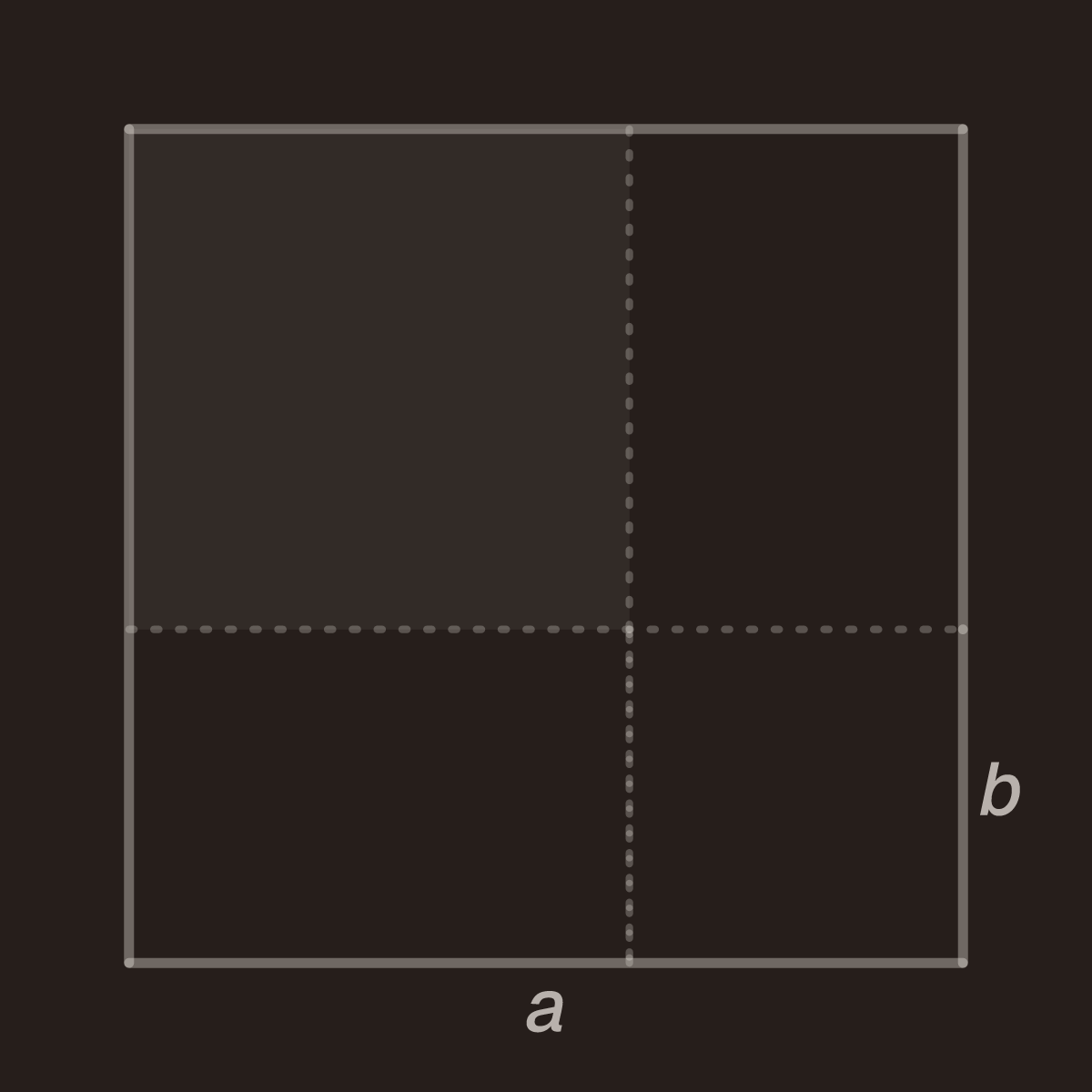
The rule
- (a − b)² = a² − 2ab + b²
Three terms, as for the square of a sum. The only thing that changes is the sign in front of the middle term:
| Expression | Expanded |
|---|---|
| (a + b)² | a² + 2ab + b² |
| (a − b)² | a² − 2ab + b² |
The last term is positive in both: b² comes from (−b) · (−b), and a negative times a negative is positive.
Why it looks like that
Write the square as a multiplication and multiply it out:
(a − b)² = (a − b)(a − b) = a² − ab − ba + b²
The two middle terms are the same number, −ab and −ba, so together they make −2ab:
(a − b)² = a² − 2ab + b²
The proof above is shown on the page as a chain of equalities: square, multiply out, collect. Each step is a rule of algebra. No equation is being solved, so nothing is subtracted from both sides.
Worked examples
(x − 5)² is x² − 2 · x · 5 + 5² = x² − 10x + 25.
(3y − 4)² is (3y)² − 2 · 3y · 4 + 4² = 9y² − 24y + 16. Note that the whole of 3y is squared, not just y.
97² without a calculator: write it as (100 − 3)² = 10,000 − 600 + 9 = 9,409.
Common mistakes
- Writing (a − b)² = a² − b². A common mistake. Put a = 5 and b = 3: (5 − 3)² = 4, while 25 − 9 = 16. Squaring does not distribute over a difference.
- Making the last term negative. −b times −b is +b². The minus survives only in the middle.
- Dropping the coefficient when squaring. (3y − 4)² gives 9y², not 3y².
Common questions
How is this different from the difference of squares?
That rule is about a sum times its own difference, (a + b)(a − b), where the middle terms cancel
completely and the result has no middle term at all. Here the same bracket is multiplied by itself,
so the middle terms reinforce each other instead. See difference of squares.
Does it hold for every number?
Yes. It is an identity, not an equation to solve: true for every pair of numbers, negatives and
decimals included, so this page shows a proof rather than a calculator card.
Can I use it backwards?
Yes, and that is where it earns its keep. Seeing x² − 10x + 25 you can recognise (x − 5)². The check
is that the middle term should be twice the product of x and 5: 2 · x · 5 = 10x.