Skip to content
LoveToCalc

Definition — what does that mean?

Modulus and argument

The modulus is how far the number is from the origin, the argument in which direction. The modulus is Pythagoras; the argument needs the quadrant.

In Swedish: Absolutbelopp och argument

Modulus and argument

The relation

|z|=a²+b²

The modulus of a + bi is its distance from the origin, √(a² + b²). The argument is the angle to the positive real axis, from tan θ = b/a and the quadrant.
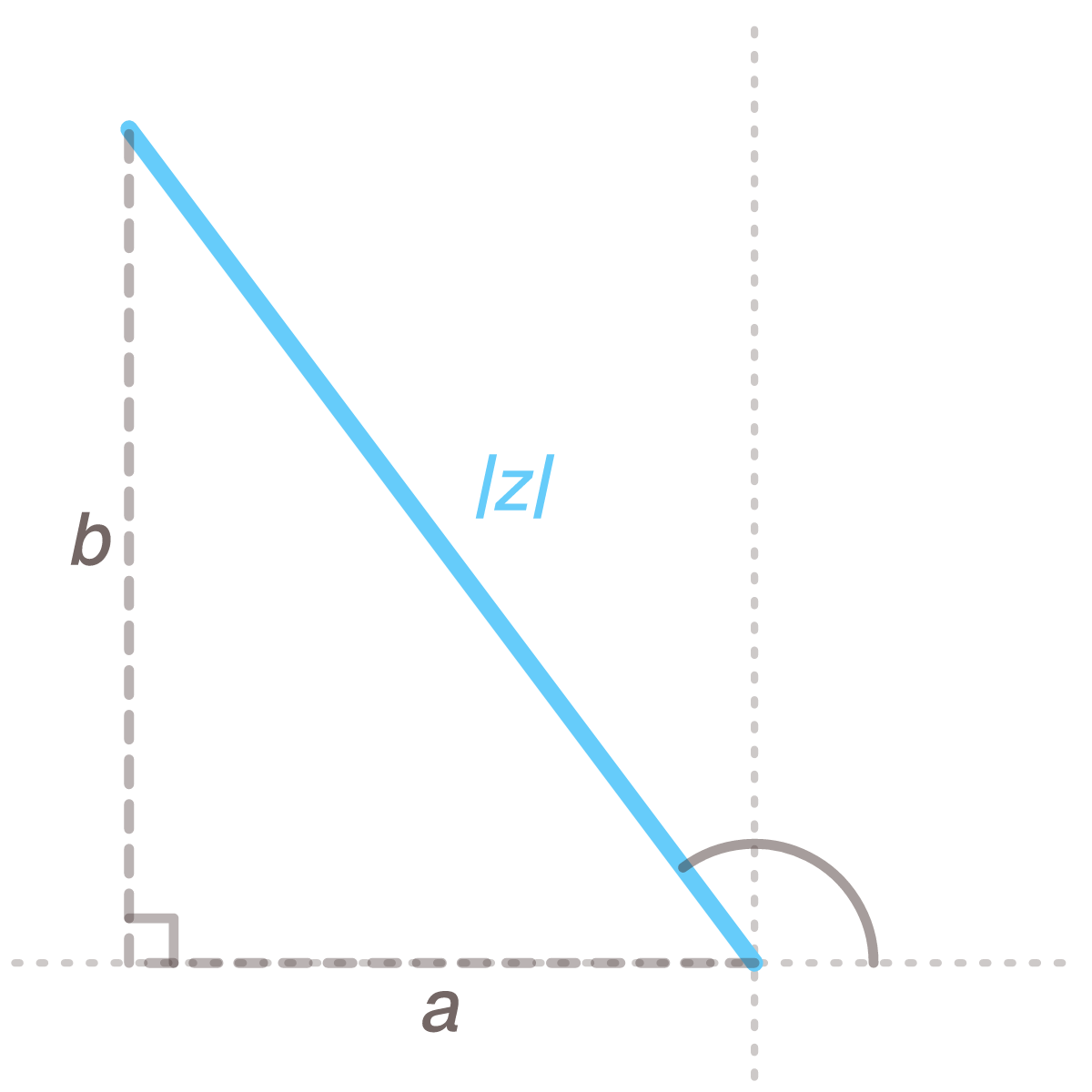
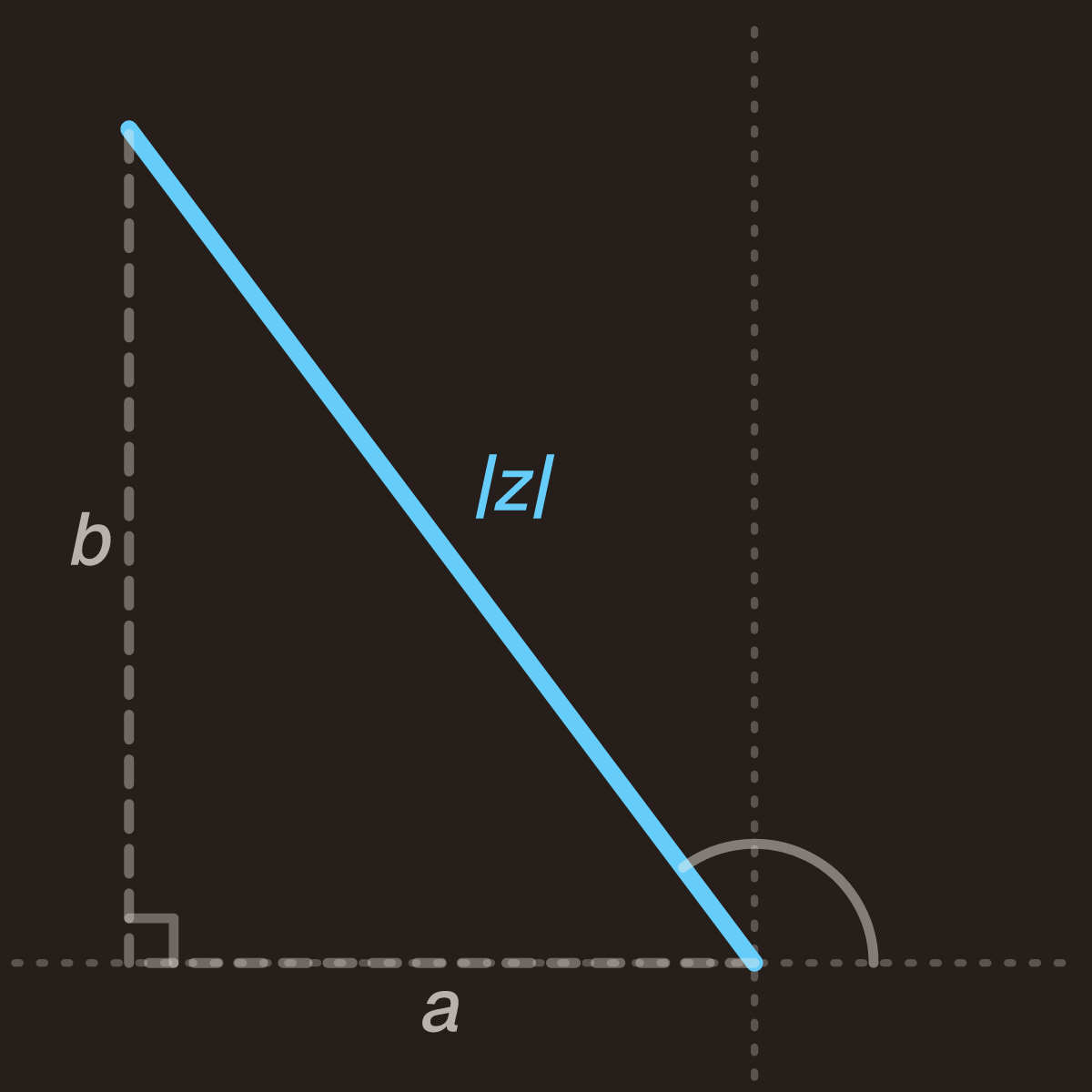
The complex plane with the number −3 + 4i: 3 to the left of the imaginary axis and 4 up. The distance |z| from the origin is the hypotenuse of the right triangle with legs a and b. The argument is the angle from the positive real axis, which here is more than a right angle, because the number lies in the second quadrant.
Solve for

|z|=5

|z| equals the square root of ((−3) squared plus 4 squared), equals the square root of (9 plus 16), equals the square root of (25), equals 5

Working4 steps

Practice questions

You are given

  • a=-5
  • b=-12

The formula

Example

z = −3 + 4i:

|z| = √((−3)² + 4²) = √(9 + 16) = √25 = 5

tan θ = 4/(−3). A calculator gives arctan(−4/3) ≈ −0.927, but the point is in the second quadrant, so θ ≈ −0.927 + π ≈ 2.214 (≈ 126.9°).

Two things to watch

The modulus is the length of the vector (a, b), with the same bracket trap: −3² + 4² is 7, not 25. Bracket a negative part before squaring it.

The argument is fixed by tan θ = b/a only up to half a turn. If the point is left of the imaginary axis (a < 0), add π (180°) to the calculator’s answer, in the second quadrant and the third alike (in the third, subtracting π instead gives the principal value). If the point is on the imaginary axis (a = 0) the quotient cannot be formed; then θ = 90° when b > 0 and θ = −90° when b < 0.

A second example: backwards

A number has modulus 10 and argument 5π/6. Then a = 10 cos(5π/6) = −5√3 ≈ −8.66 and b = 10 sin(5π/6) = 5: z = −5√3 + 5i. The card above goes that way too, one part at a time.

Where next

Common mistakes

Common questions

What is the modulus of a real number? Its ordinary absolute value: |−3| = √((−3)² + 0²) = 3. The formula is the same, with b = 0.

Which range should the argument be in? Usually −π < θ ≤ π, the principal argument. θ + 2π points the same way and is just as correct, but books and calculators answer with the principal value.

Looking for another letter? The formula solved for each one
Solved for each letter
Solve forRearrangedWith the numbersComes to
a|z|²−b²5²−4²3
b|z|²−a²5²−(−3)²4
|z|a²+b²(−3)²+4²5

Last reviewed October 6, 2026 ·How pages are reviewed

AlgebraAll formulas

Put this formula on your site

Copy the code into your page where the formula card should appear. It loads from lovetocalc.com, so it stays current on its own — all we ask is that the credit line comes with it.