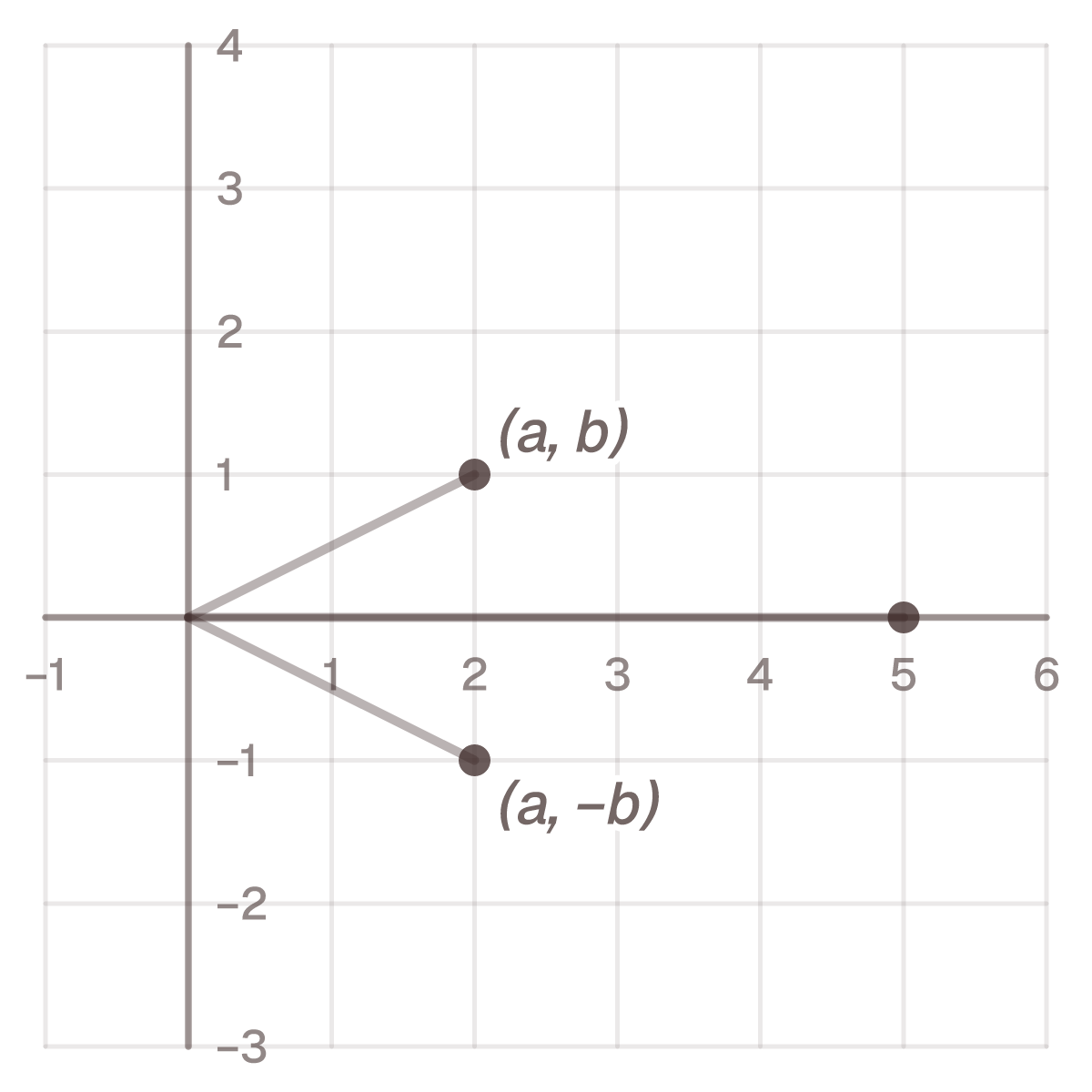
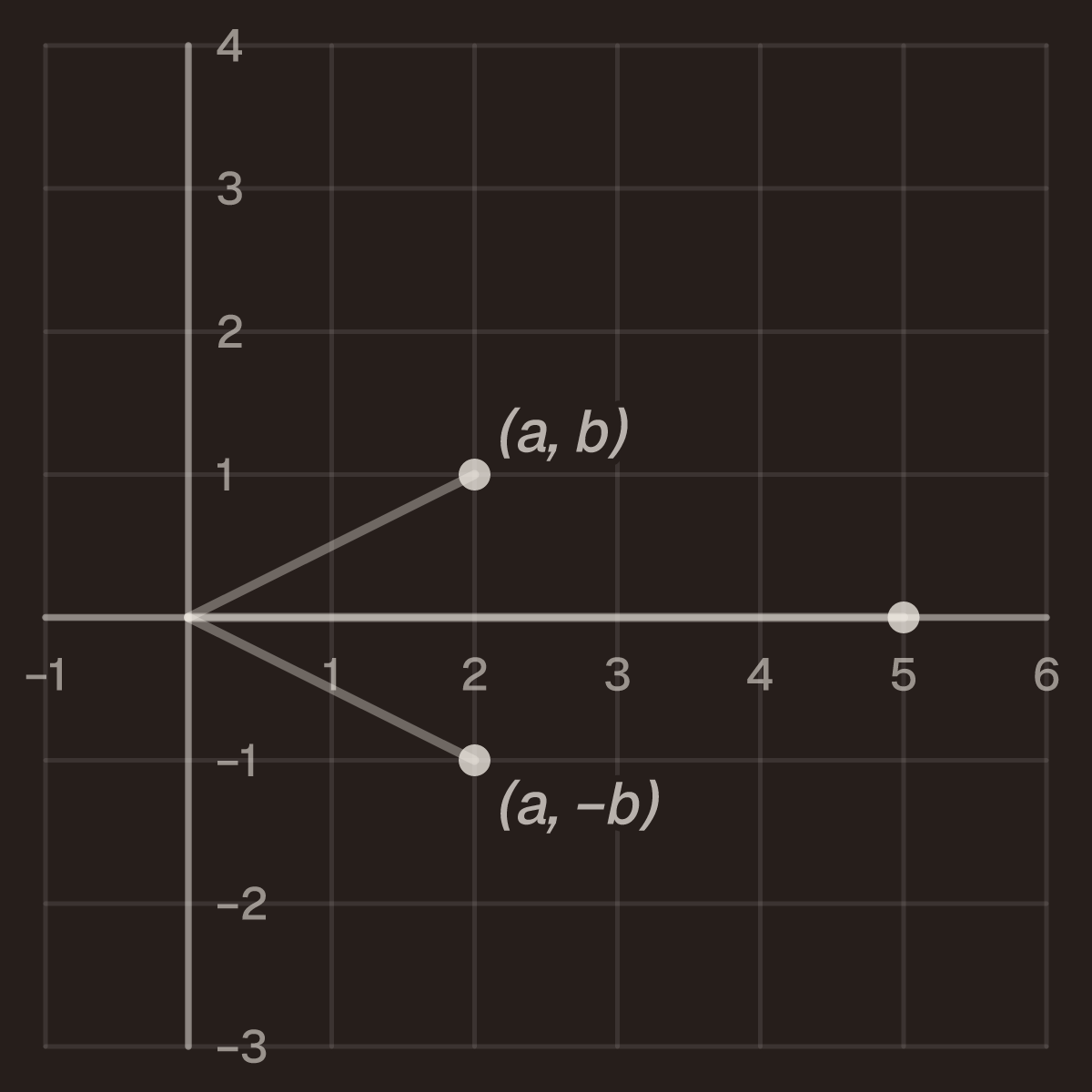
The formula
- z · z̄ = (a + bi)(a − bi) = a² + b² = |z|²
Holds for every complex number z = a + bi.
Why the i terms cancel
Multiply out: (a + bi)(a − bi) = a² − abi + abi − b²i². The two middle terms are opposites and cancel. Since i² = −1, the last term −b²i² is +b². What remains is a² + b².
It is the difference of squares in disguise: (a + bi)(a − bi) = a² − (bi)² = a² + b².
Example
(3 + 4i)(3 − 4i) = 9 + 16 = 25, and |3 + 4i| = 5, so |z|² = 25. ✓
For z = −2 + i: z · z̄ = 4 + 1 = 5, and |z| = √5.
What it is used for
- Removing i from a denominator. To compute 1/(c + di), multiply top and bottom by c − di. The bottom becomes c² + d². See dividing complex numbers.
- Finding the modulus. |z| = √(z · z̄), which is the same as √(a² + b²) from modulus and argument.
Common mistakes
- Squaring instead of multiplying by the conjugate. (a + bi)² = a² − b² + 2abi is not real.
- Getting a² − b². That would need i² = +1. With i² = −1 the sign is plus.
- Using the opposite number. Multiplying by −a − bi gives −(a² − b² + 2abi), not a real number.