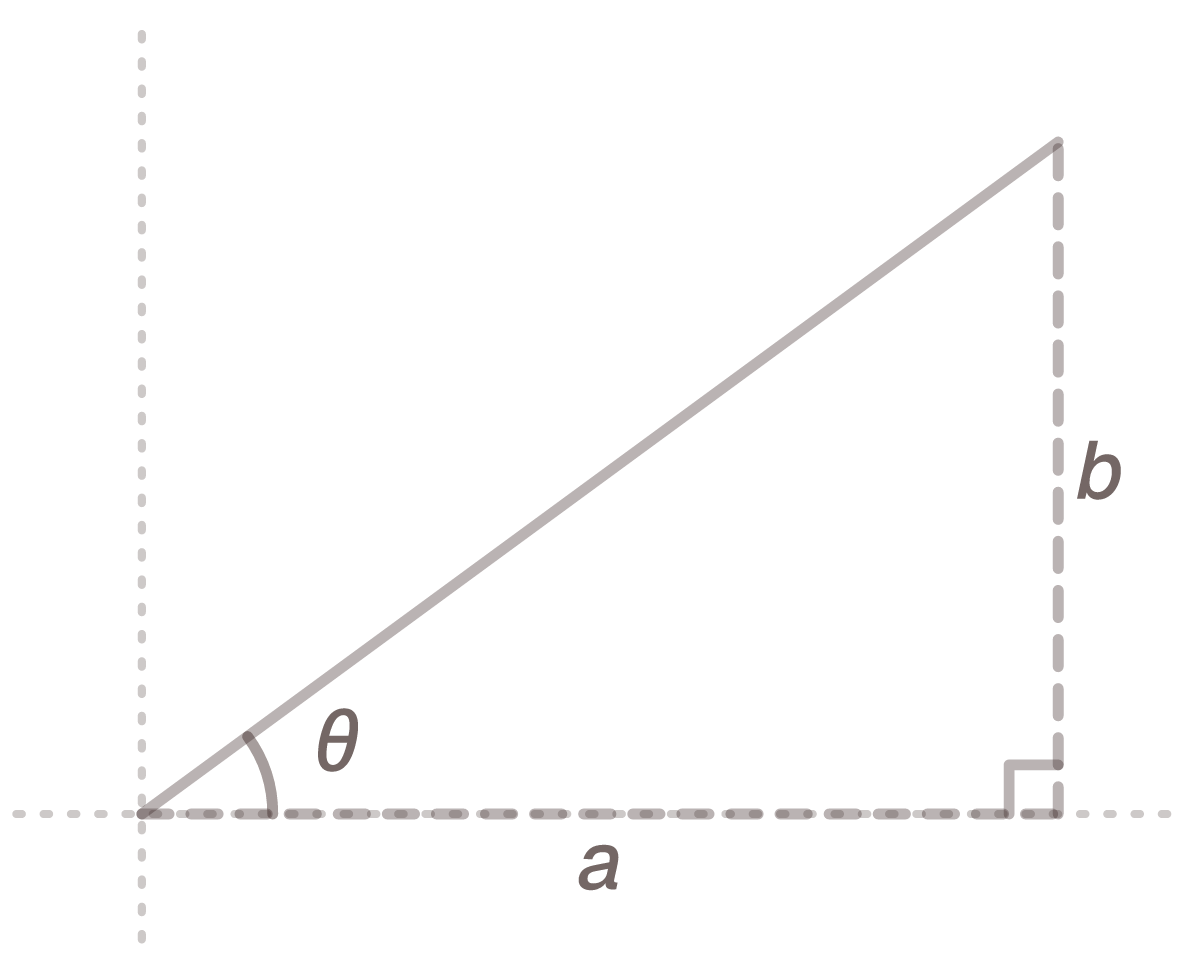
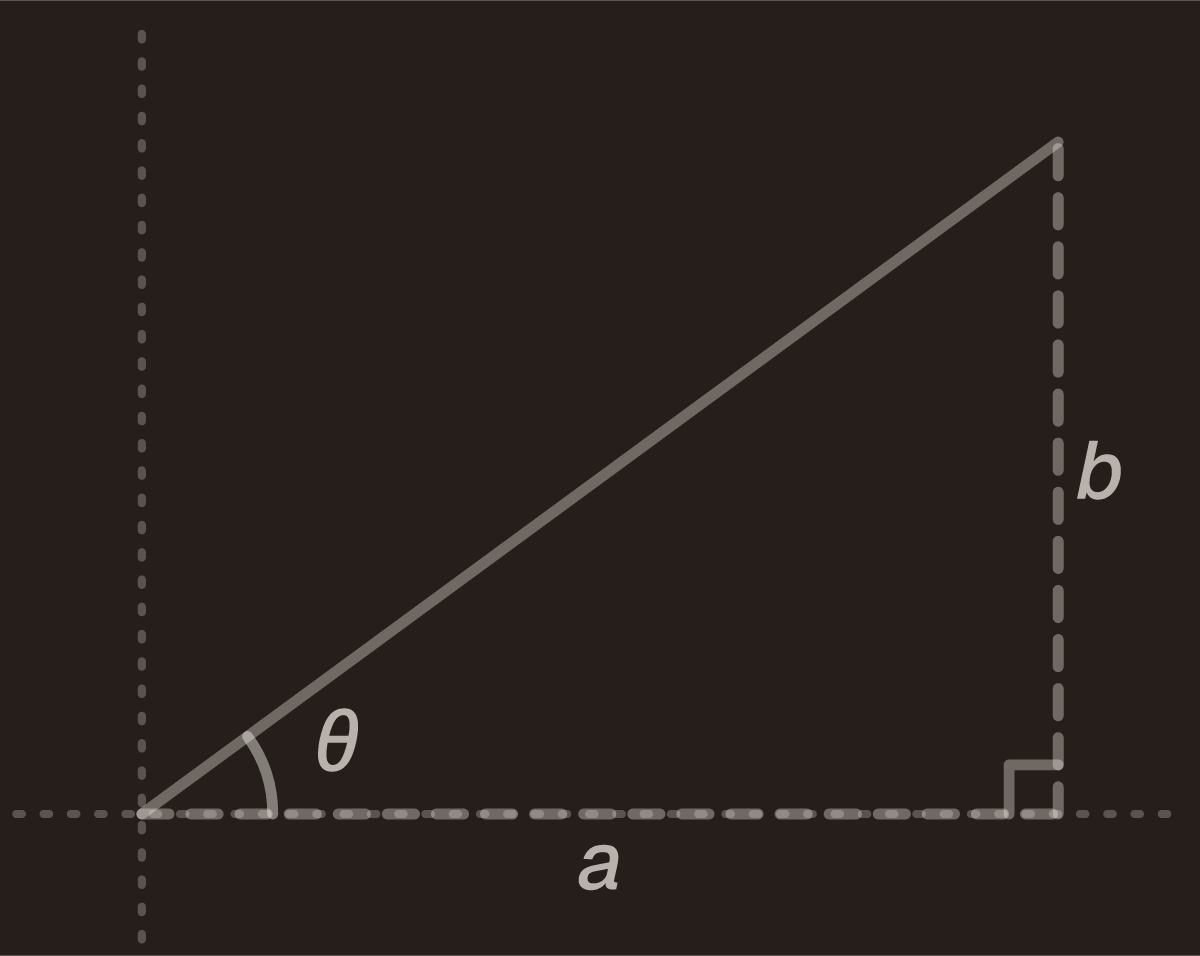
The relation
- tan θ = b/a, where θ = arg z is the angle from the positive real axis to the point (a, b)
Holds when a ≠ 0. For a = 0 the number lies on the imaginary axis, and θ = π/2 if b > 0 or −π/2 if b < 0. The angle is in radians here, as in the polar form.
Choosing the angle
Two angles half a turn apart have the same tangent, so a calculator’s arctan(b/a) is right only when the point is to the right of the imaginary axis. If a < 0, add π (180°).
| Number | Quadrant | arctan(b/a) | Argument |
|---|---|---|---|
| 3 + 4i | first | 0.927 | 0.927 |
| −3 + 4i | second | −0.927 | −0.927 + π ≈ 2.214 |
| −3 − 4i | third | 0.927 | 0.927 − π ≈ −2.214 |
| 3 − 4i | fourth | −0.927 | −0.927 |
The last column is the principal argument, in the interval −π < θ ≤ π. Adding 2π gives an equally correct angle.
Why not θ = arctan(b/a)?
Because it is wrong for half of all numbers. The numbers 3 + 4i and −3 − 4i have the same quotient b/a = 4/3 and point in opposite directions.
Common mistakes
- Skipping the quadrant. Sketch the point first; one look settles which half of the plane it is in.
- Mixing degrees and radians. 0.927 rad is 53.1°. Keep the unit of the calculator in step with the unit of the answer.
Where next
- The length that goes with the angle: modulus and argument.
- Both together: rectangular and polar form.
- The same relation for a line: angle of inclination.