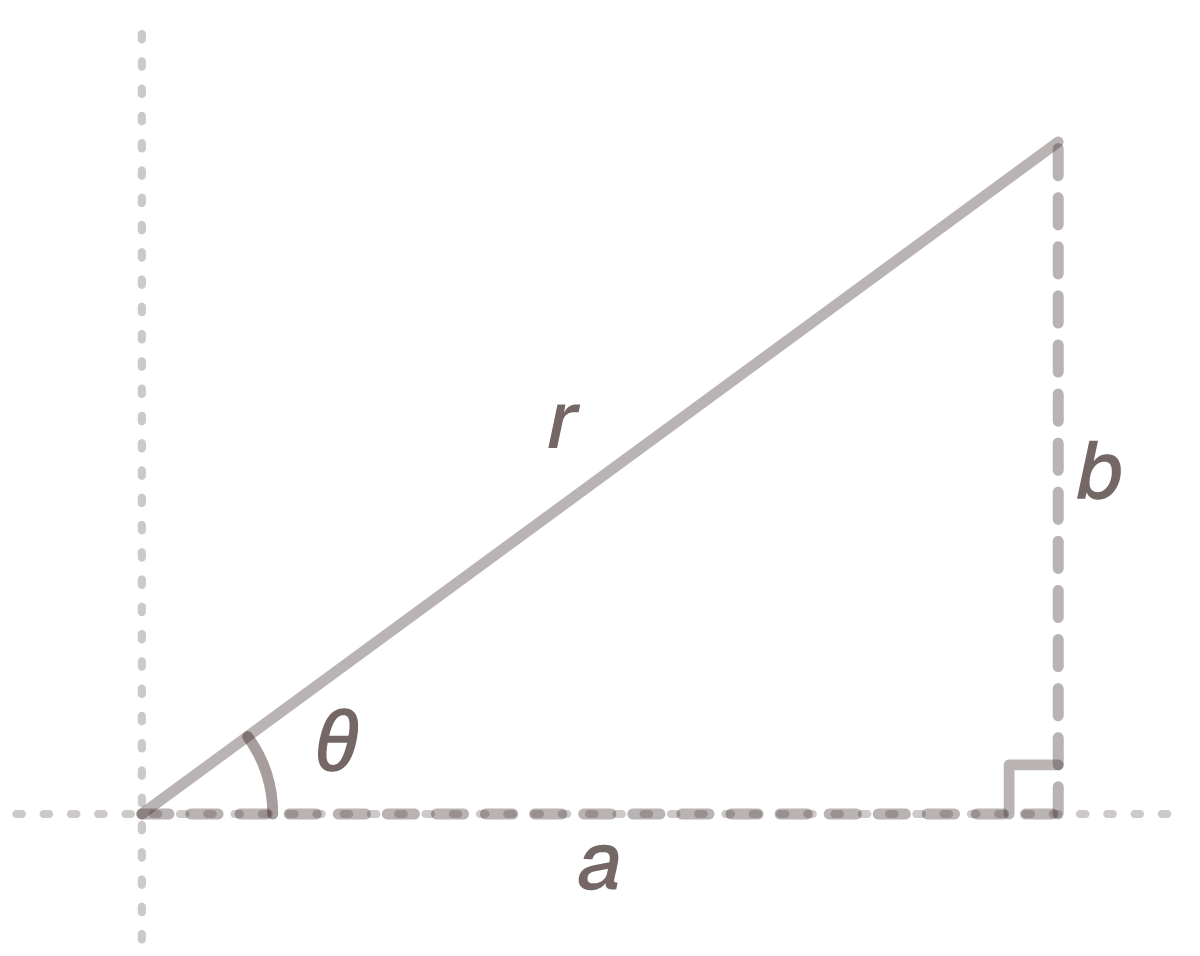
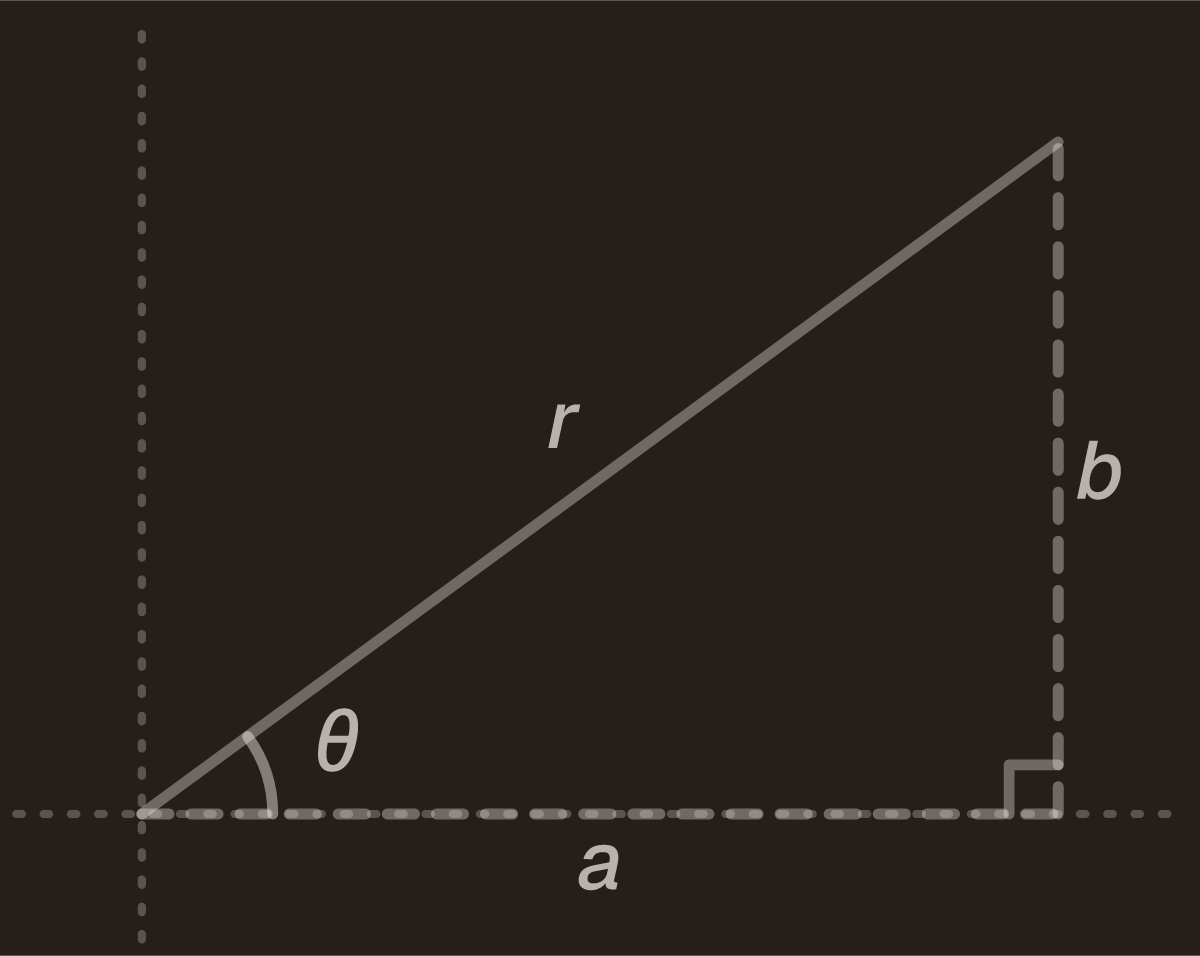
The formula
- z = a + bi = r(cos θ + i sin θ) = re^(iθ)
a is the real part and b the imaginary part. r = √(a² + b²) is the modulus and θ the argument, the angle from the positive real axis. The forms are linked by a = r cos θ and b = r sin θ.
The exponential form needs θ in radians.
Example
z = 3 + 4i has r = √(9 + 16) = 5 and tan θ = 4/3, so θ ≈ 0.927 (≈ 53.1°):
z = 5(cos 0.927 + i sin 0.927) = 5e^(0.927i)
The other way: 2(cos π/3 + i sin π/3) = 2 · 1/2 + 2 · (√3/2) i = 1 + √3 i.
The quadrant
tan θ = b/a only gives the angle up to half a turn. For z = −1 + i a calculator gives arctan(−1) = −π/4, but the point is in the second quadrant and the argument is 3π/4. Sketch the point first.
A second example: on the negative real axis
z = −4 has a = −4 and b = 0. The modulus is 4 and the point lies straight to the left, so the argument is π, not 0: z = 4(cos π + i sin π) = 4e^(iπ). That is Euler’s famous line, e^(iπ) = −1, written as a complex number in polar form.
Where next
- The modulus and argument as a card of their own: modulus and argument.
- What the polar form is for: product and quotient in polar form and De Moivre’s formula.
- The angle in radians: degrees to radians.
Common mistakes
- Trusting arctan(b/a) when a is negative. Add π (180°). When a = 0 the argument is π/2 if b > 0 and −π/2 if b < 0.
- Mixing degrees and radians in e^(iθ). The exponential form holds in radians only.
- Dropping r when rewriting: r(cos θ + i sin θ), not cos θ + i sin θ.
Common questions
What is i?
The imaginary unit, the number with i² = −1. No real number has that property, which is why the complex
numbers exist: they are the real numbers with i added.