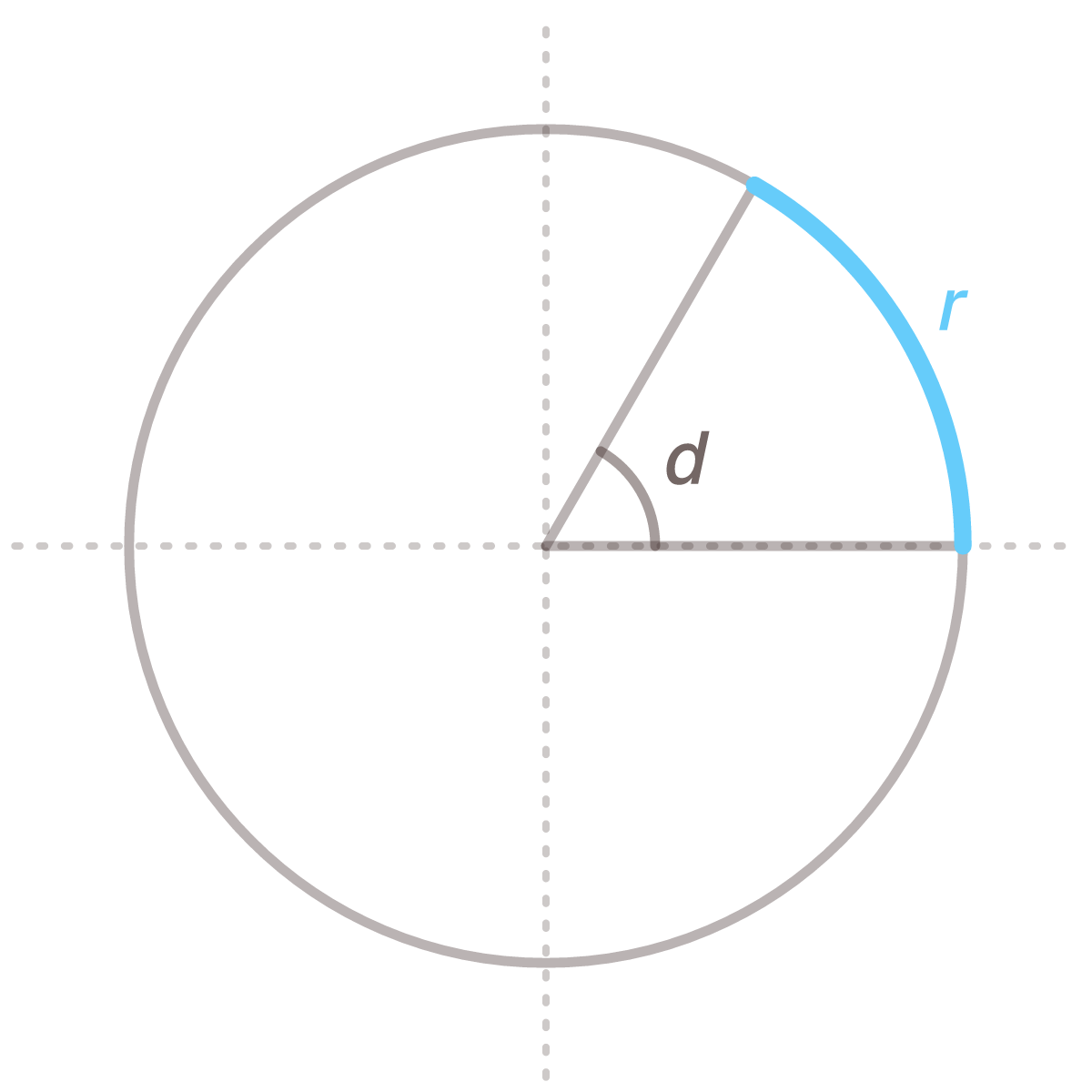
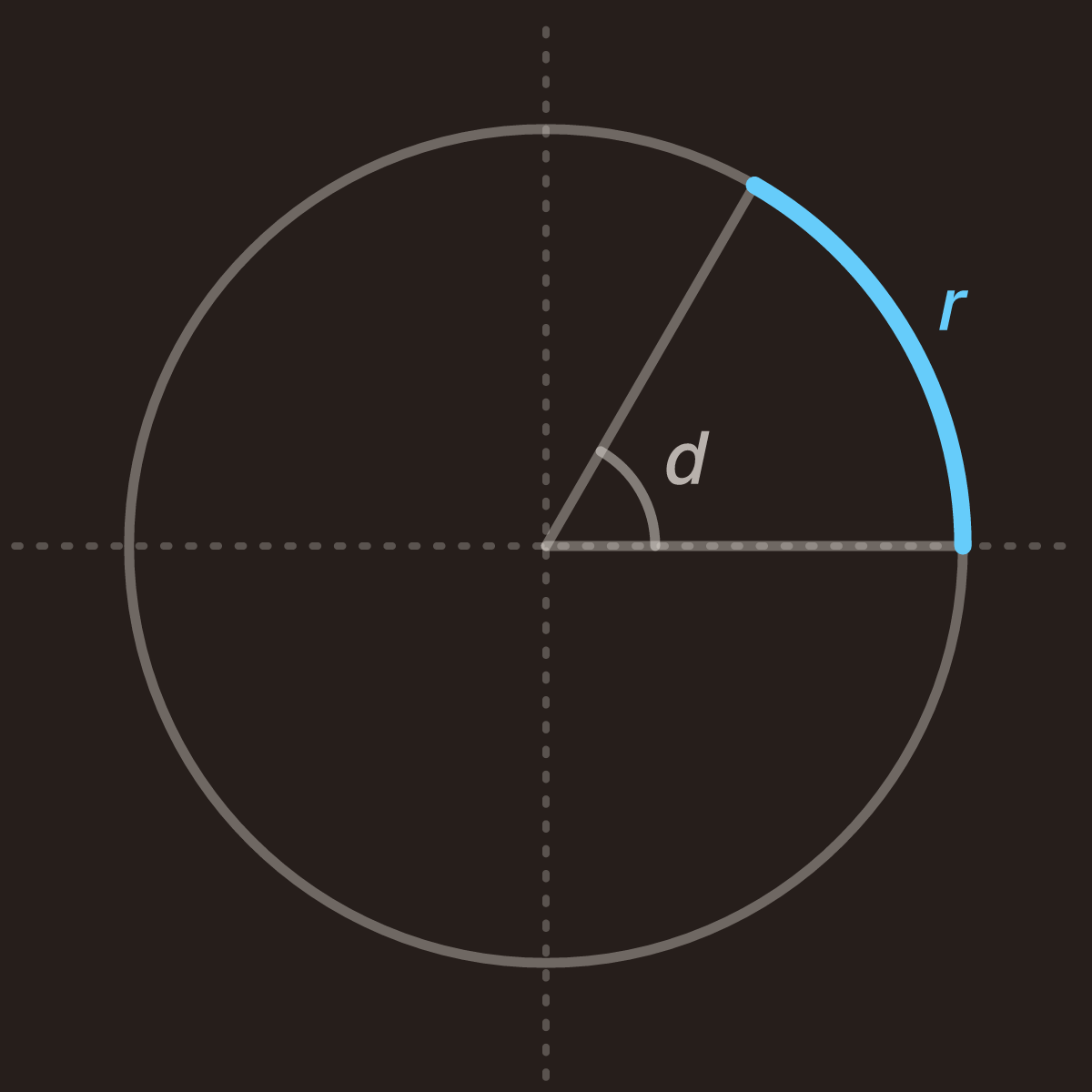
d is the angle in degrees and r is the same angle in radians. The factor π/180 is about 0.01745, but
it is rarely written as a decimal — the answer is left with π in it instead, as π/2 or 2π/3.
Why 180? Because half a turn can be measured two ways and both measurements are the same angle. In
degrees it is 180. In radians it is π, since a radian is defined as the angle whose arc is as long as
the radius, and half a turn has an arc of πr. Dividing one measurement by the other gives the factor.
The table that gets you a long way
| Degrees |
Radians |
Approximately |
| 30° |
π/6 |
0.524 |
| 45° |
π/4 |
0.785 |
| 60° |
π/3 |
1.047 |
| 90° |
π/2 |
1.571 |
| 120° |
2π/3 |
2.094 |
| 180° |
π |
3.142 |
| 270° |
3π/2 |
4.712 |
| 360° |
2π |
6.283 |
The quickest way to do it in your head is to see what fraction of 180 the angle is. 60° is a third of
180, so π/3. 135° is three quarters of 180, so 3π/4. No multiplication needed.
Worked examples
A common angle. 150° gives r = 150 · π/180 = 150π/180 = 5π/6, about 2.618.
One that is not. 37° gives r = 37π/180 ≈ 0.6458. There is no tidy form to write here, so the
decimal is the answer.
More than a full turn. 450° gives 450π/180 = 5π/2. Angles past 360° convert the same way as
any other.
Common mistakes
- Dividing by π instead of multiplying. Going this way π is on top. For positive angles radians are
smaller numbers than degrees, which settles the direction: 90 has to become 1.57.
- Leaving the calculator in the wrong mode. sin(90) is 1 if the calculator is in degrees and 0.894
if it is in radians. Nothing in the working shows the error — only the answer does.
- Cancelling the π away. 150π/180 cancels to 5π/6, not to 5/6. π is a factor on top and it comes
along.
- Rounding too early. Write π/3, not 1.05, if the answer is going to be used further on. The
rounding comes last.
Common questions
What is a radian, really?
The angle whose arc is exactly as long as the radius. That is why a radian has no unit: it is a length
divided by a length. It is also why an angle in radians can be written as a bare number, while degrees
always need their °.
Why are radians used at all?
Because the formulas come out simpler.
Arc length is r · θ when the angle is in
radians, and the derivative of sin x is cos x only in radians. In degrees a factor of π/180 creeps in
everywhere.
How do I go the other way?
Multiply by 180 and divide by π instead — see
radians to degrees. The card here works
both ways, but that page is written for that question.