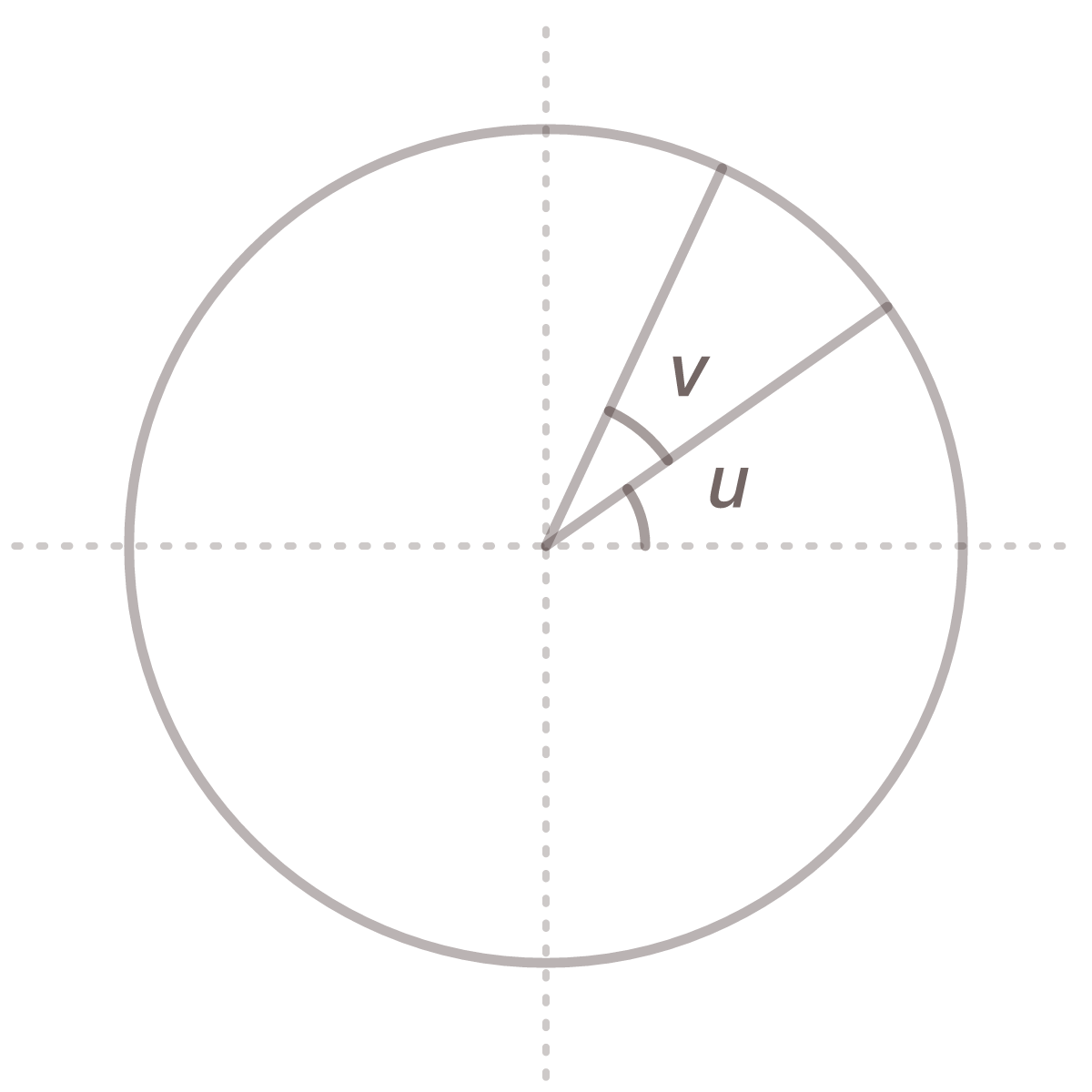
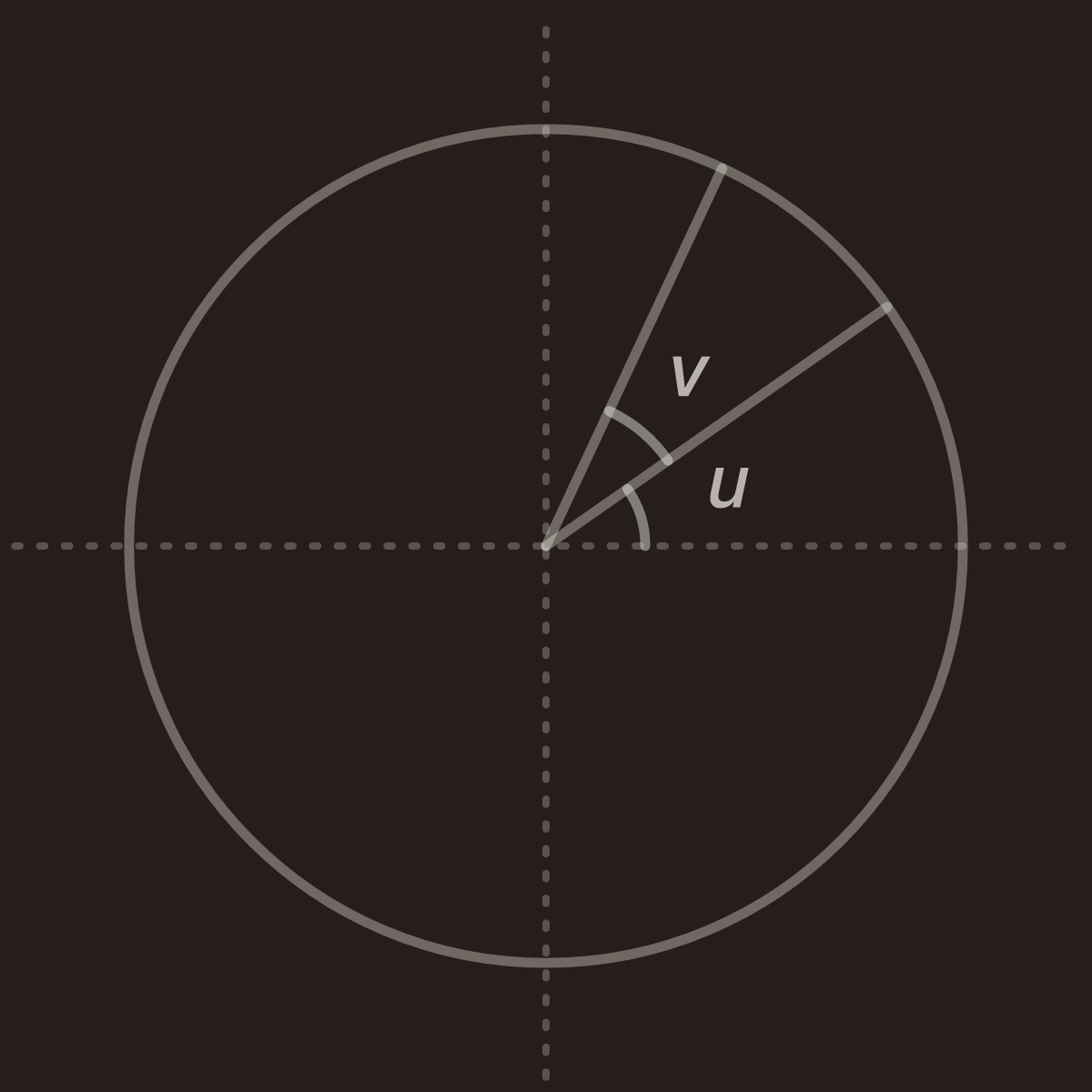
What the theorem says
- cos(u + v) = cos u · cos v − sin u · sin v
If you meant the sine, it is on the sine addition formula. The two formulas look alike and are easily confused.
There are two differences from the sine rule, and both are easy to lose:
| First term | Sign | Second term | |
|---|---|---|---|
| sin(u + v) | sin u cos v | + | cos u sin v |
| cos(u + v) | cos u cos v | − | sin u sin v |
The cosine rule keeps the functions apart — cosine with cosine, sine with sine — where the sine rule mixes them. And the cosine has a minus in the middle.
Why the sign is a minus
Put u = v = 45°. The left-hand side is cos 90° = 0. The right-hand side gives
- cos 45° cos 45° − sin 45° sin 45° = 0.5 − 0.5 = 0
With a plus it would have come to 1, which is wrong. The minus is what makes the rule true, and 45° is a quick check when you cannot remember which sign belongs where.
One more check: with u = v = 60°, u + v = 120° and cos 120° = −0.5. With a minus the right-hand side
is 0.25 − 0.75 = −0.5, as it should be; with a plus it would be 1.
Worked examples
An exact value for 75°. 75° = 30° + 45°:
- cos 75° = cos 30° cos 45° − sin 30° sin 45°
- = (√3/2)(√2/2) − (1/2)(√2/2)
- = √6/4 − √2/4 = (√6 − √2)/4 ≈ 0.259
An exact value for 15°. 15° = 45° − 30°, and with −v in place of v the middle sign turns into a plus:
- cos(u − v) = cos u cos v + sin u sin v
- cos 15° = (√2/2)(√3/2) + (√2/2)(1/2) = (√6 + √2)/4 ≈ 0.966
That cos 15° ≈ 0.966 and sin 75° ≈ 0.966 is no coincidence: the two angles are complements.
A check. u = 30°, v = 45°: 0.8660 · 0.7071 − 0.5 · 0.7071 = 0.6124 − 0.3536 = 0.2588, and cos 75° is 0.2588…
Common mistakes
- The wrong sign. The cosine takes a minus, the sine a plus. Test with 45° + 45° if you hesitate — the answer has to be 0.
- Mixing the functions. In the cosine rule like goes with like: cos·cos and sin·sin. Mixed products belong to the sine rule.
- Forgetting that the sign flips for a difference. cos(u − v) has a plus in the middle. The sign in the formula is always the opposite of the sign between the angles.
- Splitting the function. cos(u + v) is not cos u + cos v. At u = v = 90° the left is −1 and the right is 0.
Common questions
How do you remember which rule has which sign?
Think of cos 90° = 0. Putting 45° + 45° into the cosine rule means the two equal products have to cancel,
which takes a minus. The sine rule has no such requirement.
Is there a formula for the tangent as well?
Yes: tan(u + v) = (tan u + tan v) / (1 − tan u tan v). It follows from the two addition formulas by
dividing one by the other, in the same way as
the tangent quotient.
What does the rule give when u = v?
cos 2v = cos²v − sin²v, one of the three shapes of
the double angle formula.