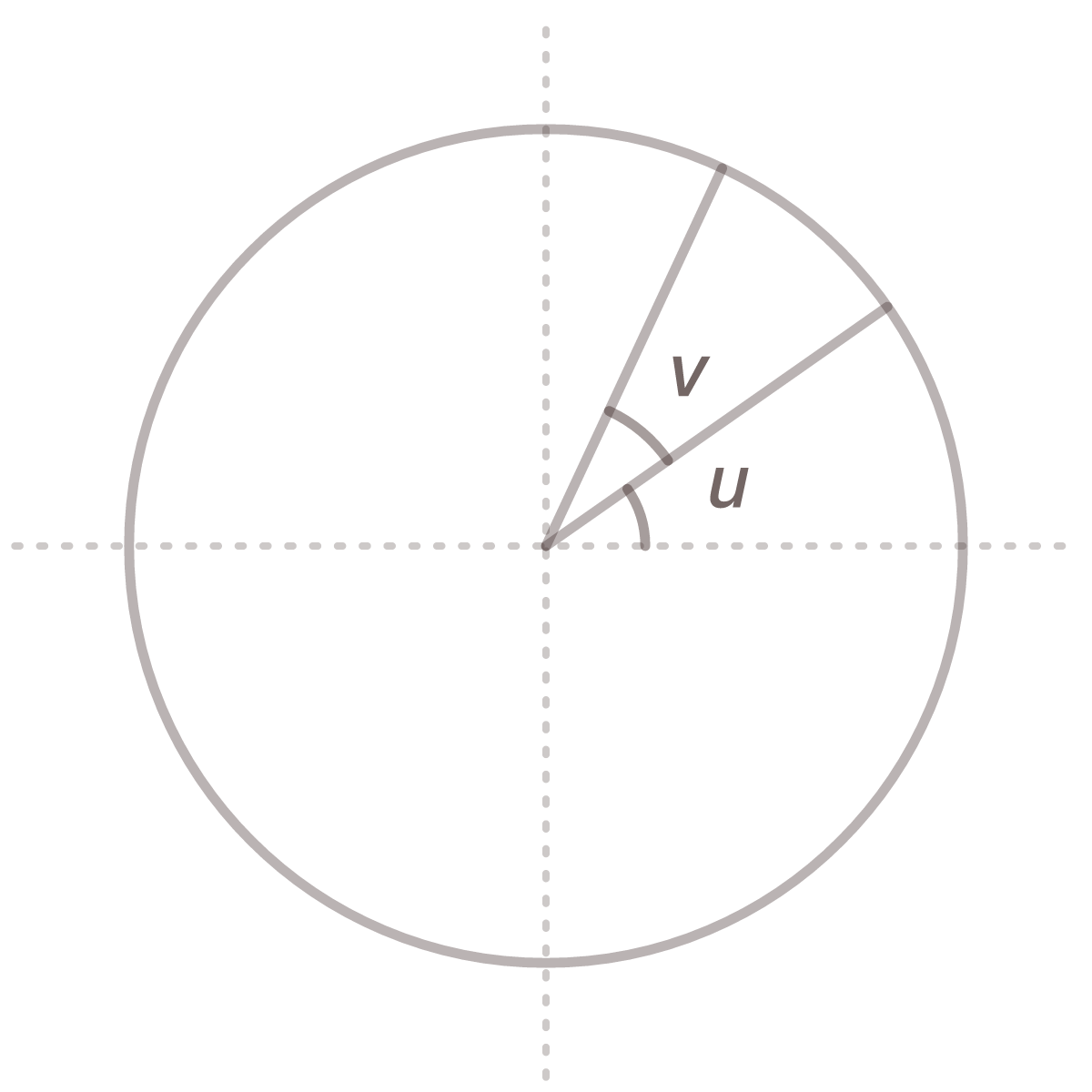
What the theorem says
- sin(u + v) = sin u · cos v + cos u · sin v
sin(u + v) is not sin u + sin v, though believing it is a common mistake. The formula says what it
is instead: a sum of two products, each mixing one angle’s sine with the other’s cosine.
The pattern is easy to hold on to if you notice that both terms have one sine and one cosine, and that the two angles swap places between the terms. The sign in the middle is a plus — it is the cosine addition formula that has the minus.
Why sin(u + v) cannot be sin u + sin v
One counterexample settles it. Take u = v = 90°:
- sin(90° + 90°) = sin 180° = 0
- sin 90° + sin 90° = 1 + 1 = 2
If splitting worked, 0 would equal 2. The reason is that the sine is not a linear function: it does not grow by the same amount for every degree you add, but flattens out towards 90° and then turns. Only functions that are straight lines through the origin may be split across a sum.
Worked examples
An exact value for 75°. 75° = 30° + 45°, and both are angles with known exact values:
- sin 75° = sin 30° cos 45° + cos 30° sin 45°
- = (1/2)(√2/2) + (√3/2)(√2/2)
- = √2/4 + √6/4 = (√2 + √6)/4 ≈ 0.966
The same trick gives exact values for 15° (= 45° − 30°) and 105° (= 60° + 45°).
Subtraction. The rule runs backwards by putting in −v: since sin(−v) = −sin v and cos(−v) = cos v,
- sin(u − v) = sin u cos v − cos u sin v
So there are not two formulas to remember, only a minus sign that comes along.
A check. u = 30°, v = 45°: 0.5 · 0.7071 + 0.8660 · 0.7071 = 0.3536 + 0.6124 = 0.9660, and sin 75° is 0.9659…
Common mistakes
- Splitting the function. sin(u + v) ≠ sin u + sin v, and the same goes for cosine, tangent, the square root and the logarithm. None of them distributes over a sum.
- Using the cosine formula’s sign. The sine has a plus in the middle, the cosine a minus. That swap is a common slip.
- Putting both angles in the same function. Each term needs one sine and one cosine.
sin u sin v + cos u cos vis cos(u − v). - Mixing degrees and radians. The rule holds in either unit, but your calculator has to be in the right mode. Keep both angles in the same one, and check the conversion if you are unsure.
Common questions
Does it have to be memorised?
Most exams put it on the formula sheet, but it is quick enough that knowing it pays off. Remember the
shape: sin-cos plus cos-sin, with the angles swapped.
What is it used for in practice?
Adding two oscillations of the same frequency but different phase — sound, alternating current, waves —
is done with this formula. The result is a single oscillation, and the rule says how big it is.
What happens when u and v are the same angle?
Both terms become equal and you get the
double angle formula: sin 2v = 2 sin v
cos v.