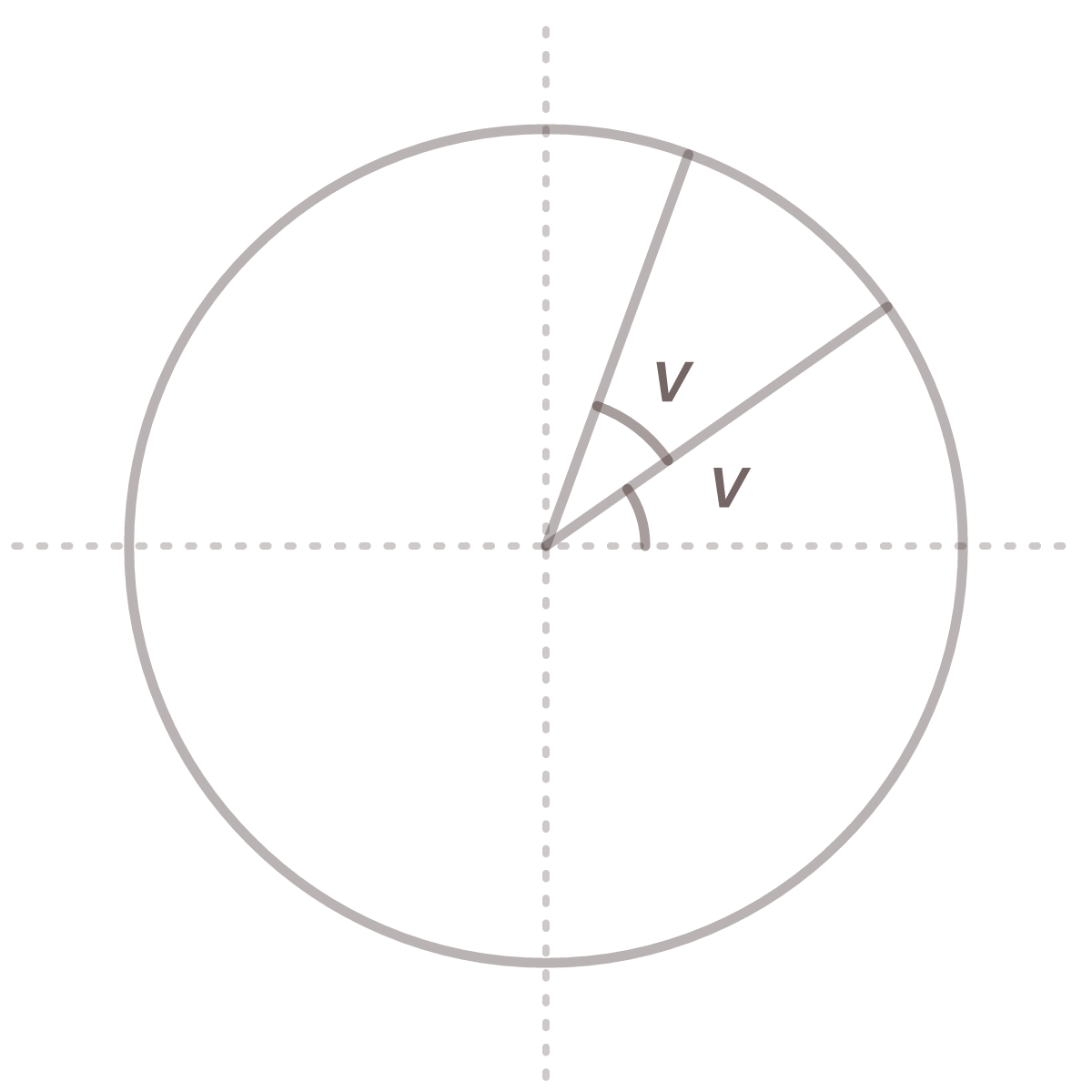
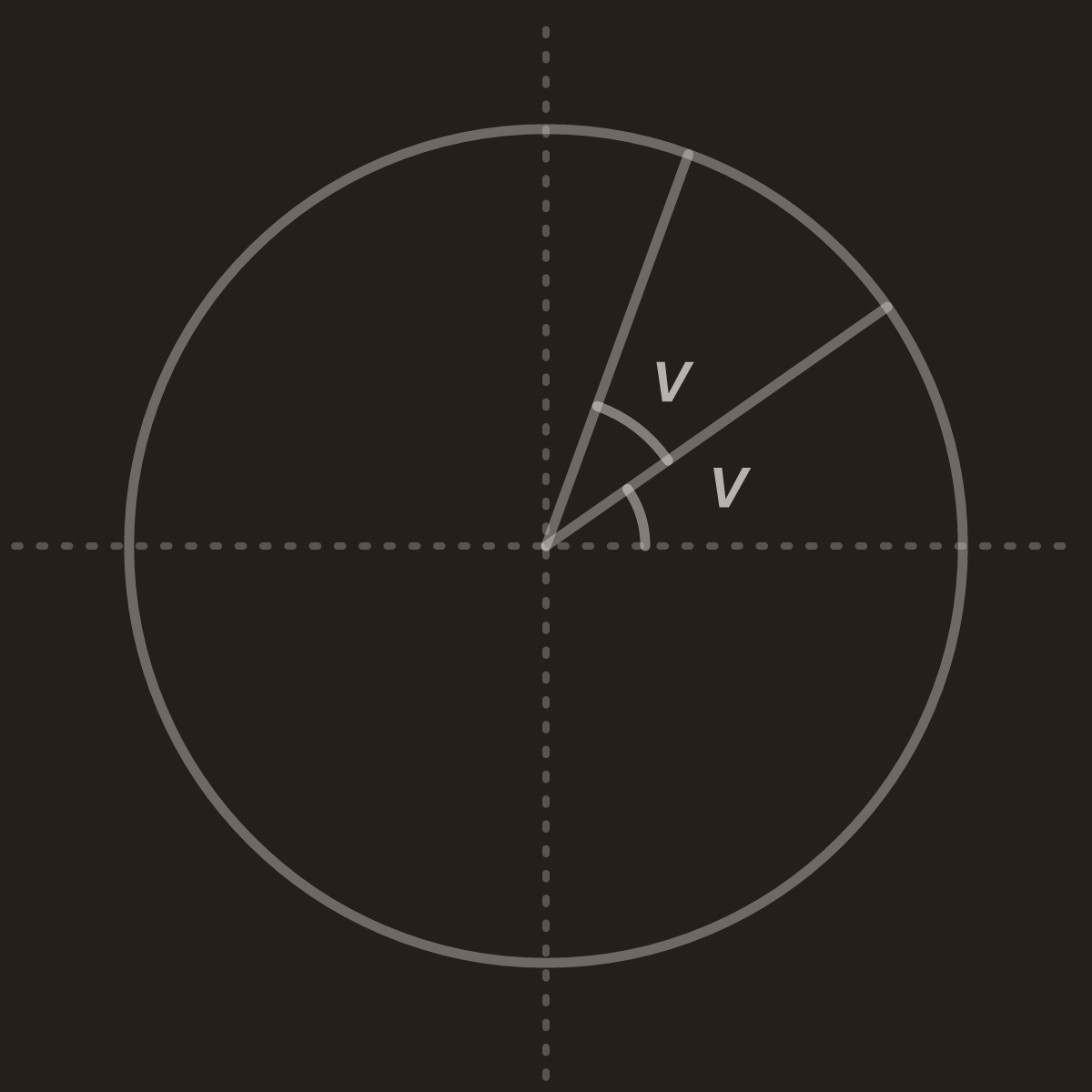
What the formula says
- sin 2v = 2 · sin v · cos v
The sine of the doubled angle is not the doubled sine. sin 60° is 0.866, while 2 · sin 30° is 1.0. It is the same trap as in the addition formula, and this rule is that rule: put u = v into sin(u + v) = sin u cos v + cos u sin v and the two terms become equal, so the sum is 2 sin v cos v.
The cosine has three faces
Putting u = v into the cosine addition formula gives cos 2v = cos²v − sin²v. Using the Pythagorean identity you can then trade one square for the other, which leaves three ways of writing the same number:
| Form | When it is the right choice |
|---|---|
| cos 2v = cos²v − sin²v | When both functions already appear in the problem |
| cos 2v = 2cos²v − 1 | When the rest of the equation has only cosines |
| cos 2v = 1 − 2sin²v | When the rest of the equation has only sines |
Mathematically they are worth the same. The point of knowing all three is to pick the one that leaves a single function standing — the equation then becomes a quadratic in that function, and quadratics you can solve.
The tangent has one form: tan 2v = 2 tan v / (1 − tan²v), when tan v exists and tan²v ≠ 1.
Worked examples
Straight ahead. v = 30°: sin 60° = 2 · sin 30° · cos 30° = 2 · 0.5 · 0.866 = 0.866. Correct — and note that 2 · sin 30° would have given 1.0, the wrong answer.
An equation that needs the rule. Solve sin 2v = sin v for 0° ≤ v ≤ 360°. Rewrite the left side:
- 2 sin v cos v = sin v
- 2 sin v cos v − sin v = 0
- sin v (2 cos v − 1) = 0
So either sin v = 0, giving v = 0°, 180°, 360°, or cos v = 0.5, giving v = 60° and 300°. Without the rewrite you are left with two different angles in one equation and nowhere to go.
Choosing the cosine form. Solve cos 2v + cos v = 0. The other term holds only a cosine, so pick 2cos²v − 1:
- 2cos²v + cos v − 1 = 0
a quadratic in cos v with roots cos v = 0.5 and cos v = −1.
Common mistakes
- Doubling the value instead of the angle. sin 2v ≠ 2 sin v, cos 2v ≠ 2 cos v. The 2 sits on the angle, not on the answer.
- Picking the wrong form of cos 2v. All three are true, but usually only one leaves a single function. Look at what the rest of the problem contains and choose accordingly.
- Losing roots by dividing. In the example above it is tempting to divide both sides by sin v. That throws away every solution where sin v = 0. Factor instead of dividing.
- Assuming it only holds for acute angles. It holds for every angle, including those where 2v runs past 360°.
Common questions
Is there a half angle formula too?
Yes, and it is the double angle rule read backwards: from cos 2v = 1 − 2sin²v you get sin(v/2) =
±√((1 − cos v)/2). The sign depends on which quadrant the half angle lands in.
What about the triple angle?
sin 3v = 3 sin v − 4sin³v, which comes from writing 3v as 2v + v and applying the addition formula once
more. It is rarely needed, but deriving it is good practice.
Where does sin 2v = 2 sin v cos v appear outside equations?
In integrals: an expression containing the product sin v cos v is far easier to integrate written as half
of sin 2v.