The three cases
Let v be the angle the calculator gives: v = arcsin a, arccos a or arctan a. n is any whole number.
| Equation | Solutions in degrees | Solutions in radians |
|---|---|---|
| sin x = a | x = v + n · 360° or x = 180° − v + n · 360° | x = v + 2πn or x = π − v + 2πn |
| cos x = a | x = ±v + n · 360° | x = ±v + 2πn |
| tan x = a | x = v + n · 180° | x = v + πn |
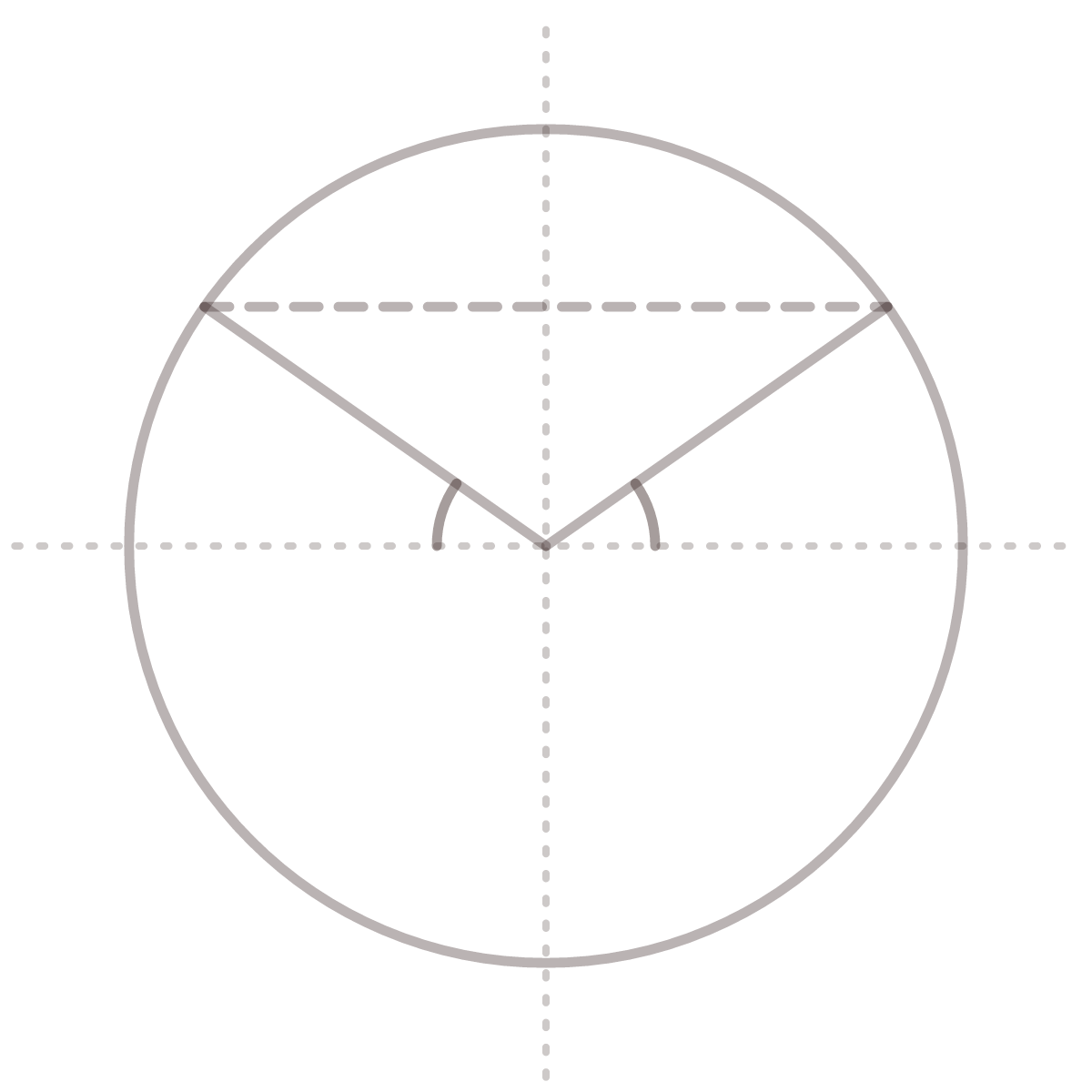
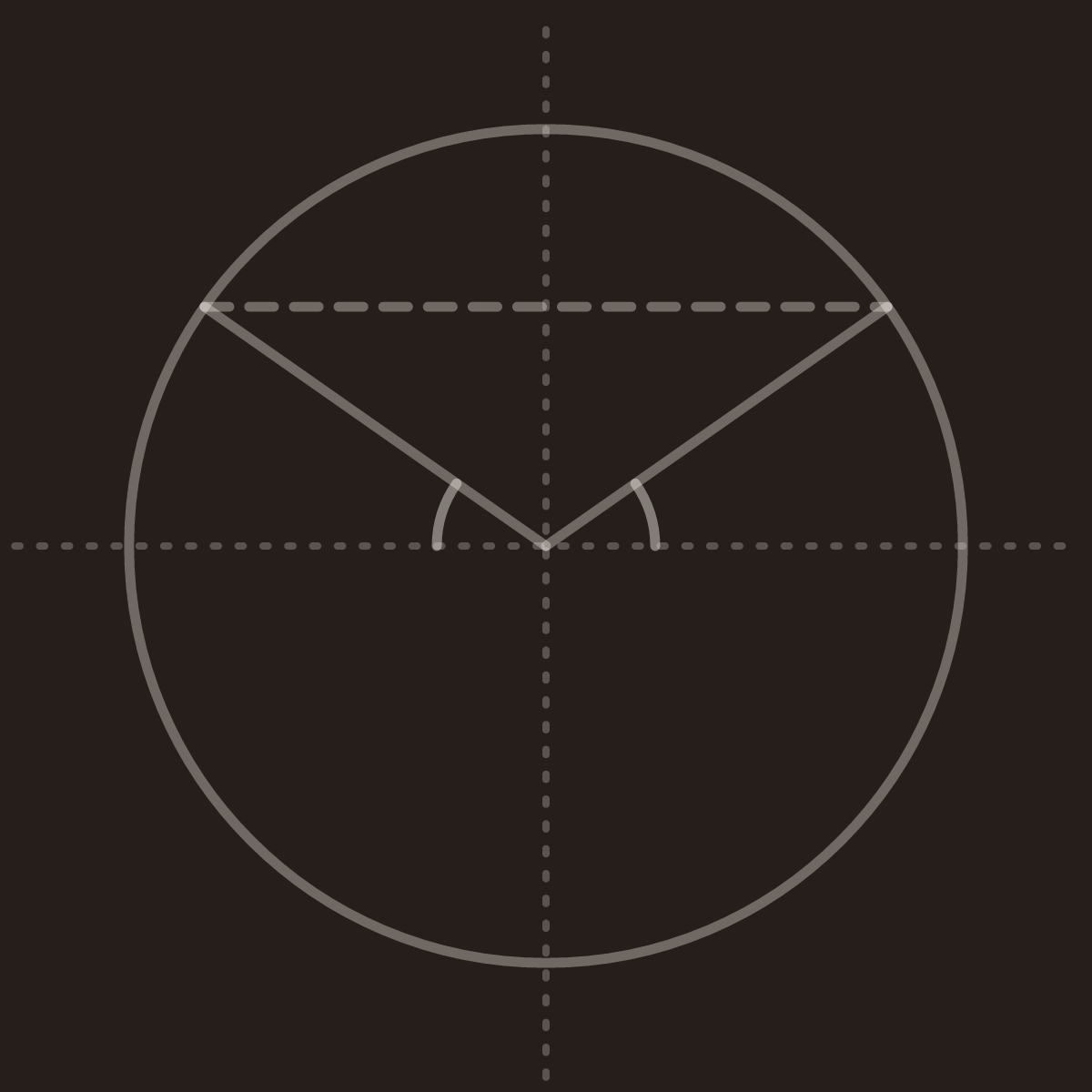
sin x = 0.5 gives v = 30°, and the solutions are x = 30° + n · 360° or x = 150° + n · 360°.
The second solution
The calculator shows only v. For the sine there is one more angle with the same value, 180° − v, and for the cosine −v. The two coincide only when the value is 1 or −1. Stop at the calculator’s answer and you have half the solutions, and nothing in the answer shows it.
| Equation | Calculator only | All solutions |
|---|---|---|
| sin x = 0.5 | x = 30° + n · 360° | x = 30° + n · 360° or x = 150° + n · 360° |
| cos x = 0.5 | x = 60° + n · 360° | x = **±**60° + n · 360° |
The tangent is the exception: its period is 180°, and the second angle is already in n · 180°.
With a number in front of x
sin 2x = 0.5 gives 2x = 30° + n · 360° or 2x = 150° + n · 360°. Divide everything by 2, the period too:
x = 15° + n · 180° or x = 75° + n · 180°.
Divide only the angle and keep n · 360°, and every other solution is lost. Between 0° and 360° the equation has four solutions — 15°, 75°, 195° and 255° — not two.
The same goes for a whole sinusoidal function: get the sine on its own, write both families, and divide last.
Common mistakes
- Forgetting the second family. sin x = a has two solutions per turn when −1 < a < 1.
- Not dividing the period. In sin kx = a, n · 360° is divided by k as well.
- Mixing degrees and radians. v = π/6 and n · 360° do not belong together. Pick one unit for the whole answer.
- Solving sin x = 2. Sine and cosine lie between −1 and 1. If a is outside that, there is no solution.
Common questions
Why n and not a number?
n stands for any whole number, positive, negative or zero. Each choice gives a solution one turn further
on or back.
How do I get the solutions in a given interval?
Put in n = 0, 1, 2 and so on, and negative n, and keep the x that land in the interval.